

The term forest scientist may be a new one for much of the general public, but it applies to the study of new materials for 3D printing in a very intriguing way. Composites lend to the infinite choices available, whether materials emerge from natural or synthetic sources. Now, a research team headed by Prof. Dr. Marie-Pierre Laborie from the Chair of Forest Biomaterials at the University of Freiburg has created a new wood-based biodegradable synthetic that can be developed into a viscous biopaste for 3D printing complex geometries. Proof of their study has recently been published in both Applied Bio Materials and Biomacromolecules regarding the details of their new composite.
Lignin is an organic polymer used in previous research studies too; for example, it has been mixed with nylon and carbon for enhanced printability, as well as with cellulose and starch to act as a binding agent. Laborie and her team recognized the potential of lignin as it strengthens the cell walls of plants, resulting in a stable woody structure that is ultimately “lignified.”
This evolutionary trait protects plants from the elements, and from bugs. Known as waste from paper production, it is usually burned as a bioenergy source. Laborie and her team began exploring better ways to use the raw material, studying previous research regarding the use of lignin for biopaste and the development of biosynthetics.
The Role of 3D Printing in Medicine
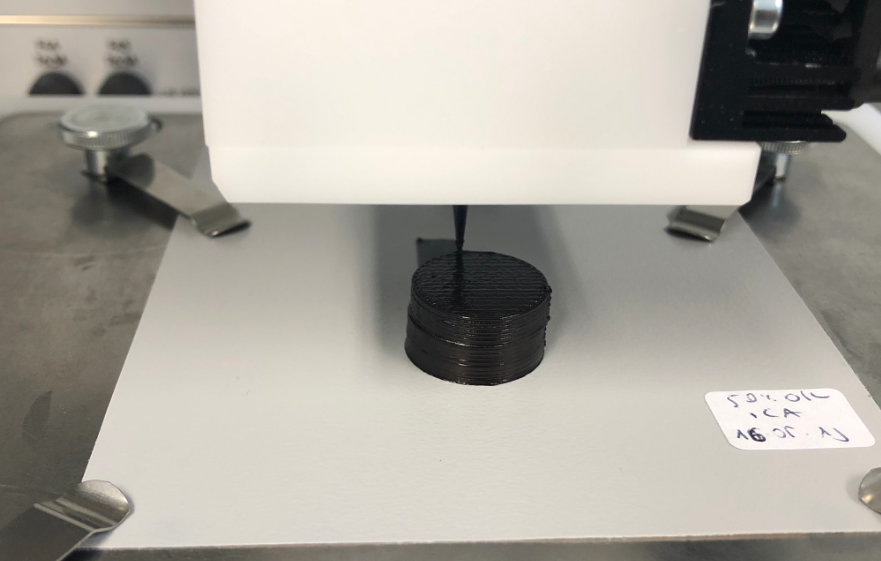
The biopaste used to print this cylinder in previous research consists of 50 percent lignin and 50 percent cellulose. See also: The Current State of Metal 3D Printing in 2020. (Image courtesy of Lisa Ebers)
While the authors do consider their new lignin composite as potentially suitable for “lightweight construction” applications, they report that additional research will be required first. Currently, they are experimenting with pure lignin made in a pilot biorefinery at the Fraunhofer Center for Chemical-Biotechnological Processes (CBP) in Leuna, a town in eastern Germany known for the production of chemicals.
“… whether the waste product from the paper industry can also be directly processed still has to be researched,” state the authors.
Biocompatible Materials and Processes
Other studies relied on chemical processing or experimenting with different materials. Some studies used lignin from beech trees, while others extracted it from different plants with varying material characteristics.
Research was initiated by the Sustainability Center Freiburg and the Fraunhofer Society, with research and 3D printing occurring with Prof. See also: Wire-Arc Additive Manufacturing with Nickel Alumin…. Dr. Christian Friedrich and Dr. Gopakumar Sivasankarapillai at the Freiburg Materials Research Center (FMF) of the University of Freiburg and with Dr. Gilberto Siqueira in the Swiss Federal Laboratories for Materials Testing and Research (EMPA) in Dübendorf, Switzerland.
[Source / Images: ScienceDaily; Phys Org; University of Freiburg]
The post Forest Scientists 3D Print Lignin for Sustainable Light Construction appeared first on 3DPrint.com | The Voice of 3D Printing / Additive Manufacturing.
Clinical Applications and Case Studies
from Your daily news from 3DPrint.com https://bit.ly/3blL21E
Related Articles
Frequently Asked Questions
How is 3D printing used in medicine?
3D printing is used in medicine for surgical planning models, custom implants, bioprinting tissue scaffolds, drug delivery systems, dental aligners, and prosthetics. It enables patient-specific solutions that improve outcomes and reduce surgery time.
What materials are biocompatible for 3D printing?
Common biocompatible materials include PEEK, titanium alloys (Ti6Al4V), bio-ceramics (hydroxyapatite), medical-grade resins, PLA for temporary implants, and hydrogels for bioprinting. Material choice depends on the application and required mechanical properties.
Is 3D printed medical equipment FDA approved?
Yes, several 3D printed medical devices have FDA clearance, including orthopedic implants, dental restorations, and surgical guides. Each device must go through the appropriate regulatory pathway based on its risk classification.
📌 Related Articles
- The Current State of Metal 3D Printing in 2020
- Wire-Arc Additive Manufacturing with Nickel Aluminum Bronze Cu-9Al-4Fe-4Ni-1Mn
- ABS 3D Printing Settings Guide: Temperature, Enclosure, and Cooling for Strong Parts
- Nylon Filament Review: Complete Guide to Polyamide 3D Printing (2026)
- 3DEXPERIENCE: A Virtual Journey, Part 1