
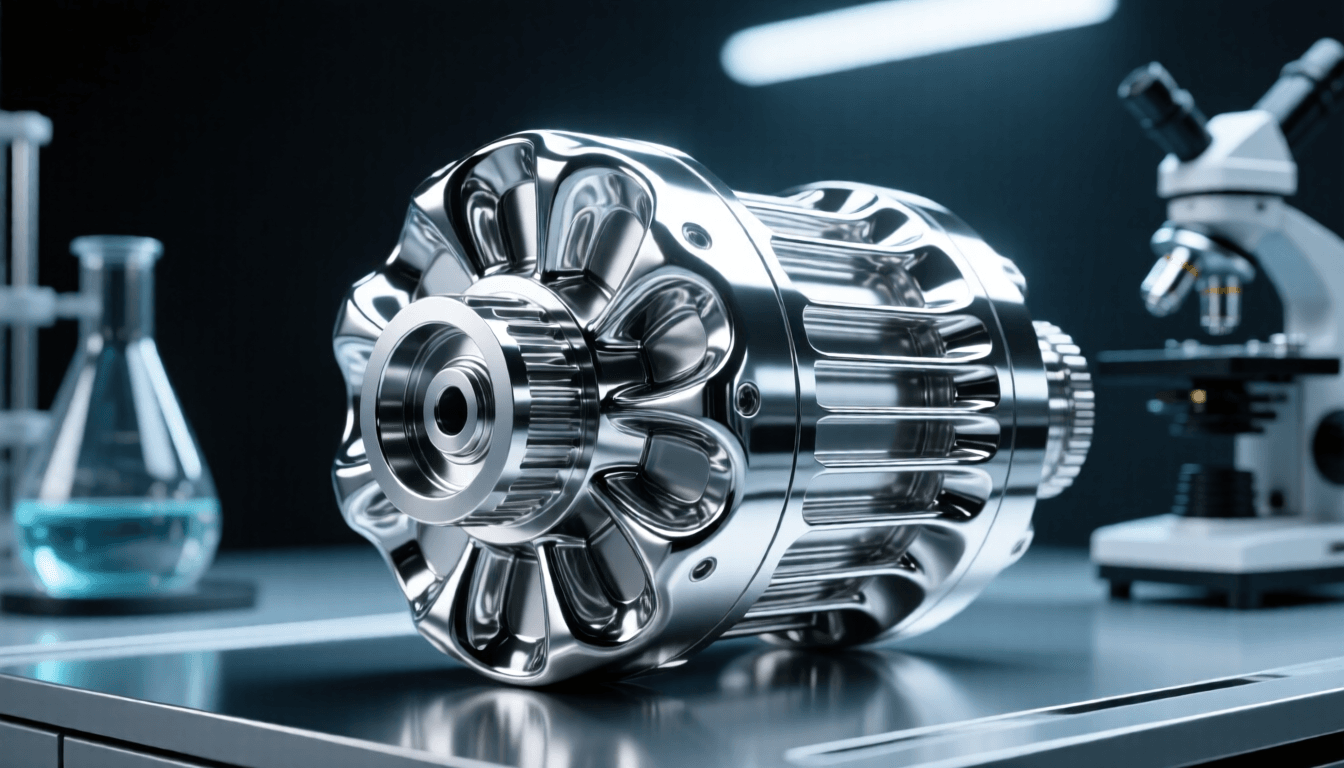
Researchers at Saarland University in Germany have developed novel metallic glass alloys that can be 3D printed into fully glass-like motor components, potentially making electric motors significantly more efficient. Led by Professor Ralf Busch and doctoral candidate Amirhossein Ghavimi, the work was carried out under the EU Pathfinder programme and could extend drone flight times, improve e-bike range, and reduce energy waste across countless electric devices.
What Is Metallic Glass?
Metallic glass — also known as amorphous metal or bulk metallic glass (BMG) — is a metal alloy with a disordered atomic structure, similar to window glass. Unlike crystalline metals where atoms are arranged in regular patterns, metallic glass atoms are frozen in a random configuration. This gives the material unique properties:
- High strength — often stronger than crystalline metals of the same composition
- Excellent soft magnetic properties — ideal for motor stators and transformers
- Low magnetic hysteresis loss — less energy wasted as heat when magnetized and demagnetized
- High elasticity — can spring back from deformation that would permanently bend crystalline metals
For electric motors, the key advantage is reduced energy loss. When conventional crystalline metals (like the silicon steel used in most motor cores) are repeatedly magnetized and demagnetized — which happens thousands of times per second in a running motor — some energy is lost as heat. Metallic glasses lose significantly less energy in this cycle, making them potentially far more efficient.
The Challenge: Getting Metallic Glass Into Motors
The problem has always been manufacturing. Metallic glasses need to be cooled extremely rapidly from their molten state to prevent crystallization — often at rates of millions of degrees per second. Traditional manufacturing methods can only produce thin ribbons (like the amorphous metal strips used in some transformer cores) or small, simple shapes.
Electric motor components, on the other hand, require complex 3D geometries with precise dimensions. The mismatch between what metallic glass manufacturing could produce and what motors need has kept the material out of practical use.
The 3D Printing Solution
The Saarland University team solved this by developing novel alloy compositions specifically designed for additive manufacturing. The key insight: instead of trying to cool existing metallic glass alloys fast enough, they created new alloys that resist crystallization during the 3D printing process.
“The breakthrough came just over a year ago,” Professor Busch told Popular Mechanics. The team identified three specific alloys that:
- Resist crystallization during the printing and cooling process
- Possess the magnetic and mechanical properties needed for motor components
- Can be deposited via 3D printing to create complex geometries
The resulting printed components maintain their fully amorphous (glass-like) structure, preserving the low-loss magnetic properties that make metallic glasses so attractive for motor applications.
Impact on Electric Motor Efficiency
Electric motors consume approximately 45% of global electricity. Even modest efficiency improvements translate to massive energy savings at scale. Metallic glass motor components could reduce core losses by up to 70-90% compared to conventional silicon steel laminations.
For specific applications:
| Application | Current Problem | Metallic Glass Benefit |
|---|---|---|
| Drones | Limited flight time (~30 min) | Longer flights from reduced motor losses |
| E-bikes | Range anxiety, battery weight | More range per charge, lighter motors |
| Industrial motors | Energy waste as heat | Significant electricity savings |
| Robotics | Battery life limits operation | Longer operating time |
| Electric vehicles | Range and efficiency | Improved powertrain efficiency |
How This Connects to Broader 3D Printing Trends
This research is part of a growing movement to use additive manufacturing to produce functional electromagnetic components. MIT’s recent demonstration of a fully 3D-printed electric motor showed that complete electromechanical devices can be printed. Saarland’s work shows that the materials themselves can be engineered specifically for the printing process, opening entirely new material categories for additive manufacturing.
Frequently Asked Questions
What is metallic glass?
Metallic glass (amorphous metal or bulk metallic glass) is a metal alloy with a disordered atomic structure like window glass, rather than the regular crystalline structure of conventional metals. This gives it high strength, excellent soft magnetic properties, and very low energy loss during magnetization cycles.
Why is metallic glass better for electric motors?
Metallic glass loses significantly less energy as heat when magnetized and demagnetized compared to conventional silicon steel used in motor cores. See also: 3D Printing Tungsten Carbide: How Hot-Wire Laser T…. This means motors run cooler and more efficiently, which extends battery life in portable devices and drones.
How did researchers 3D print metallic glass?
The Saarland University team developed novel alloy compositions that resist crystallization during the 3D printing process. Three specific alloys were identified that maintain their amorphous structure while possessing the magnetic and mechanical properties needed for motor components.
How much more efficient could these motors be?
Metallic glass motor components could reduce core energy losses by 70-90% compared to conventional silicon steel laminations, potentially extending drone flight times and improving e-bike range significantly.
When will metallic glass motors be available?
The research was completed under the EU Pathfinder programme between 2022 and early 2026. Commercial availability depends on scaling the 3D printing process and integrating the components into motor designs, likely several years away.
📌 Related Articles
Sources: Saarland University, Popular Mechanics, 3D Printing Industry, EurekAlert, Interesting Engineering, 3DPrinting.com