
Thingiverse is an indispensable tool for many desktop 3D printing users today. This hasn’t stopped owner Stratasys from creating a very similar tool for engineers and business users. GrabCAD is Stratasys’ community, platform, and tool that connects engineers with files and each other. If you’re unfamiliar, its kind of a combination between Stack Overflow and Thingiverse. The GrabCAD community is extensive and has over 4 million CAD files that can be exchanged between users as well as forums and challenges. Abe Gladstone is the Software Marketing Manager at Stratasys and the Product Manager of GrabCAD. I interviewed Gladstone to learn more about the quiet giant that is GrabCAD.
He explained, “GrabCAD is the Stratasys community for professional engineering and manufacturing people,” focused on people such as “engineers, product developers, and product designers.” “The centerpiece of GrabCAD is the library of over 7 million members with 4 million CAD files…engineers can take bits and pieces from others and bring in their own CAD.” The community is there so people can “learn, improve, exchange information, and work together.” GrabCAD “is CAD agnostic. It lets you see an exploded view of a CAD file”, “upload any CAD file and collaborate.”
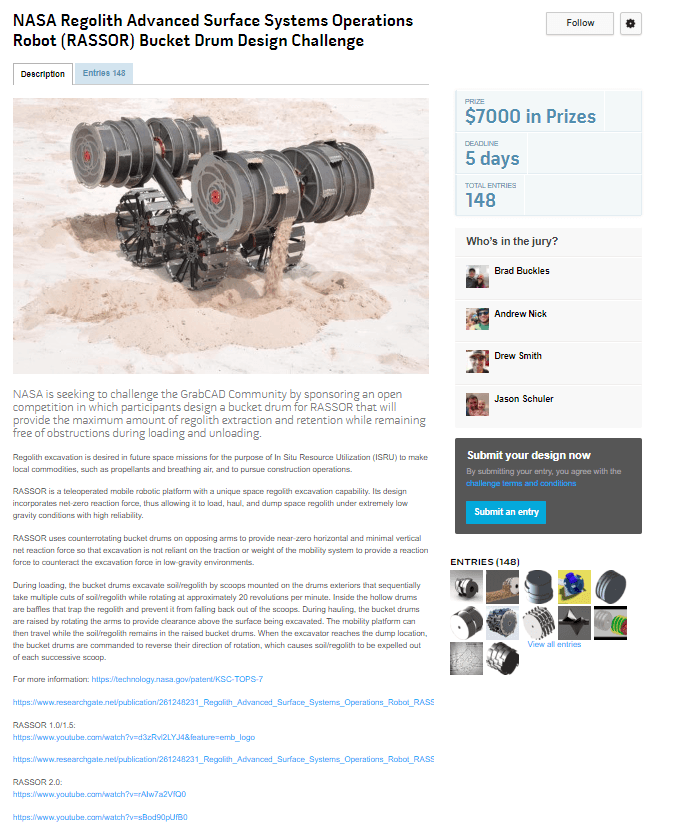
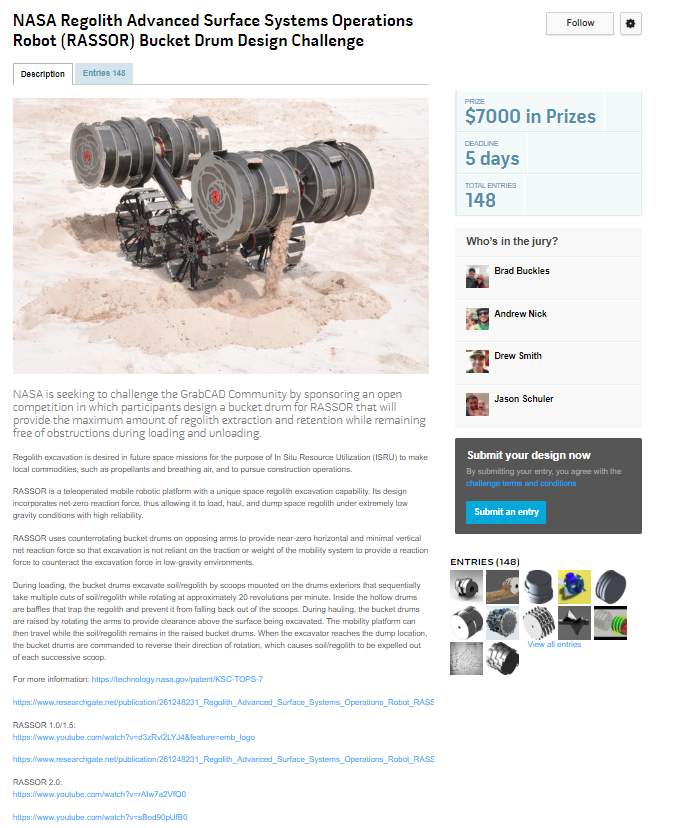
The site hosts regular challenges to motivate and engage the community and are paid for by sponsors. “A company can pose a challenge, help judge and award prize money.” Usually there are about 20 finalists and three to four winners. Subjects range from COVID-19 to NASA regolith and the Grundfos Challenge, in which entrants were invited to design and integrate a gear unit for a hydronic valve into an enclosure box. In other words, not a lot of Yodas and the like.
How 3D Printing Responded to COVID-19
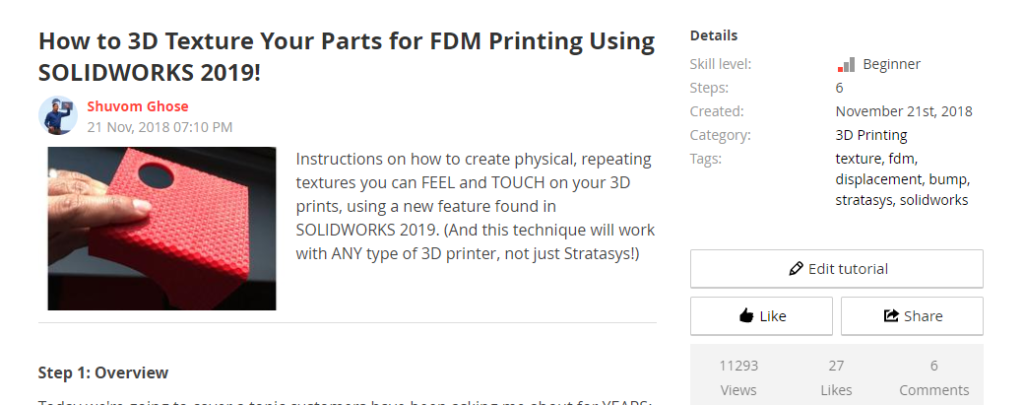
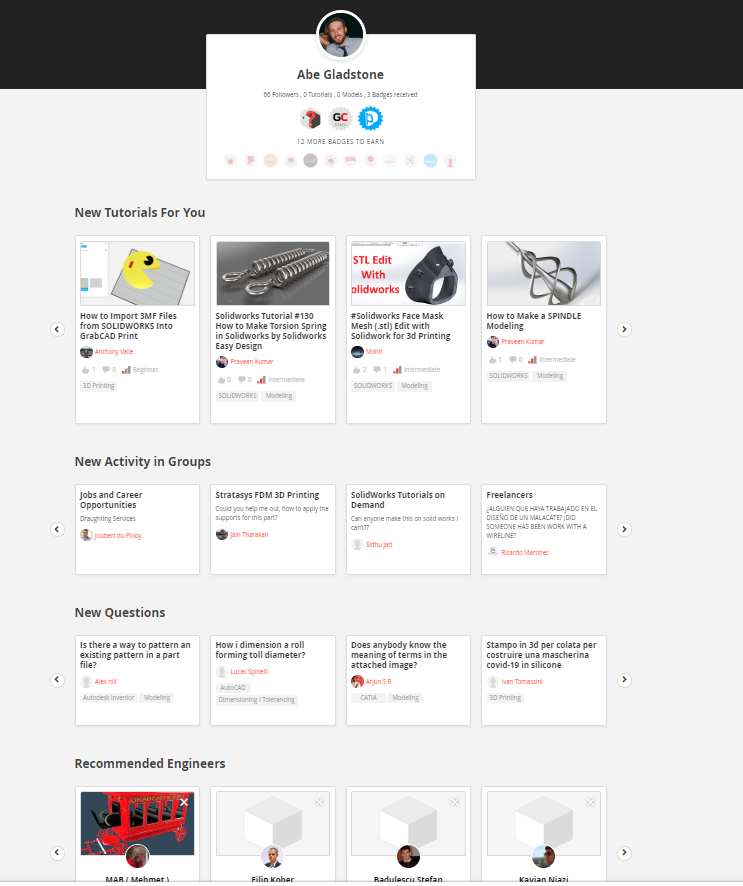
According to Gladstone, GrabCAD has around 13 to 15 million pageviews per month with 300,000 of those views going to the Q&A Questions section, where users can find many answers to broad and specific questions from engineers on all manner of topics. There is also a tutorial section with guides for different concepts, skills, and CAD packages at different levels. Additionally, the site hosts groups, where members can get together according to skill, location, or shared interest.
Workbench is the user’s primary interface in GrabCAD and a collaborative tool with versioning that lets you create and use a common CAD library, share files, share BOM lists, and work with others. You can also sync desktop files with Workbench, lock files so only you can edit them, and add markup to annotate files. In a distributed world, Workbench is a tool that can let remote teams work together. GrabCAD Print also allows you to slice and nest files for Stratasys printers, as well as queue files, control settings, and monitor prints.
HP and the Pandemic Manufacturing Shift
Gladstone sees his job as “talking to customers, listening to feedback..always making improvements” and “streamlining the CAD to 3D Print workflow.” Going forward, Gladstone hopes to support more file types, increase community engagement further, and generate a more tailored experience. More customized offerings “tailored toward STEM” and more specialized features like “tutorials with only CATIA files” for example, are in the pipeline.
In terms of a business model, GrabCAD should remain free, “as long as I’m here”, Gladstone said, but “private versions and private spaces may be paid.” Take GrabCAD Shop, for instance. See also: The Current State of Metal 3D Printing in 2020. This tool helps users queue, track, and print work orders for print farms. It is meant to be a solution for centralized or distributed 3D printing in offices or universities. Shop has a paid version and it is hoped that revenue from this will support the wider GrabCAD community.
The company isn’t looking to develop a fully-fledged CAD tool with Gladstone stating, “We’re not in the CAD business.” He hopes to partner with CAD companies to do drive the site forward.
Supply Chain Disruptions and Digital Solutions
The post Stratasys’ Abe Gladstone on GrabCAD’s 7 Million Members with 4 Million CAD Files appeared first on 3DPrint.com | The Voice of 3D Printing / Additive Manufacturing.
from Your daily news from 3DPrint.com https://bit.ly/3d7qusT
Related Articles
Frequently Asked Questions
How did 3D printing help during COVID-19?
During the COVID-19 pandemic, 3D printing enabled rapid production of critical medical supplies including face shields, ventilator components, nasal swabs, and PPE. Distributed manufacturing allowed makers worldwide to produce items locally without waiting for traditional supply chains.
What was the pandemic digital manufacturing shift?
The pandemic accelerated adoption of digital manufacturing including 3D printing, as companies sought more resilient supply chains. Organizations shifted from centralized to distributed production, using digital files to produce parts locally on demand.
Can 3D printing supply chains be resilient in emergencies?
Yes, 3D printing provides supply chain resilience through distributed manufacturing — designs can be shared digitally and produced anywhere with compatible equipment, eliminating the need for physical inventory and shipping of parts.
📌 Related Articles
- Best 3D Printer Upgrades That Actually Improve Print Quality: Complete 2026 Guide
- The Current State of Metal 3D Printing in 2020
- Best Budget 3D Printer Upgrades That Actually Improve Print Quality: Belts, Springs, Hotends & More
- ABS 3D Printing Settings Guide: Temperature, Enclosure, and Cooling for Strong Parts
- Bambu Lab P1S vs Bambu Lab P2S: Full Specs Comparison & Buyer’s Guide