

Call me sentimental, but I am a sucker for a good story where 3D printing is used to help an animal get back on its feet, especially when the animal in question is a dog. Case in point – the tale of Ping, the paralyzed puppy.

The Role of 3D Printing in Medicine
Prior to surgery, Ping had to be hand-fed while he was hospitalized with his neck brace. (Image: Vet Times)
The adorable five-month-old Chihuahua weighs just about one kilogram, or a little over two pounds – less than a bag of sugar. Ping’s owner, Zoe Cekalla, noticed that the puppy was having trouble walking on all of his legs, and when the problem progressively got worse over the course of a week and he became paralyzed, Cekalla took him to her local veterinarian. They were quickly referred to Hamilton Specialist Referrals in High Wycombe, northwest of London. There, veterinary neurologist John Parker took the case.
CT and MRI scans were quickly performed to get to the root of the tiny dog’s problem.
“When Ping was first brought in to us he was depressed and couldn’t walk. The weakness had progressed rapidly and was affecting all of his limbs,” Parker said. “He also had a head tilt and his eye reflexes were reduced. We knew from these signs the problem was localized to his brain or cervical spinal cord.”
Biocompatible Materials and Processes

A tiny paralyzed Chihuahua can now walk – after it was given a custom-designed 3D printed bionic implant in its neck. (Image: SWNS)
Ping was diagnosed with a severe malformation in his neck, where the bones had not formed correctly. See also: The Current State of Metal 3D Printing in 2020. This caused a region of instability, which resulted in direct pressure on his spinal cord that led to his weakness. Parker explained that the technical term for the pup’s condition is atlantoaxial subluxation.
“The first two bones in the neck were partially dislocated. The second neck bone – the axis – hadn’t formed completely and the area needed stabilising to provide Ping any chance of recovery,” Parker said.
Clinical Applications and Case Studies
“However, Ping was so small – he weighed barely a kilogram – and in such a tiny space, traditional orthopaedic implants would be too large to place safely.”
Ping was then hospitalized, and, in order to prevent any more damage to his spinal cord, had to wear a neck brace. Nursing care kept him comfortable while he waited for surgery. The Hamilton veterinary team used the puppy’s CT images to design bespoke 3D printed surgical guides, which would allow them to accurately place tiny 1 mm diameter screws in his neck to stabilize the area.
Regulatory Considerations and Safety
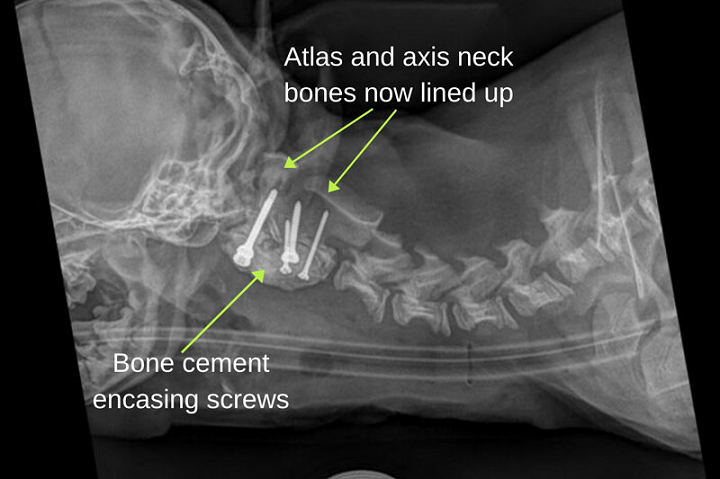
The x-ray after surgery shows the atlas and axis bones in line, stabilized with bone screws and cement. (Image: Vet Times)
Six days later, Parker and surgery specialist Michael Hamilton performed the surgery, using the 3D printed guides to precisely place the screws around the unstable part of Ping’s neck. For further stability, the screws were then encased in bone cement.

Research Breakthroughs and Innovations
Ping after surgery, happy and on the road to a full recovery. See also: Best 3D Printer Upgrades That Actually Improve Pri…. (Image: Vet Times)
Ping recovered quickly, and was able to walk out of the hospital on his own, pain-free, just one week later. His owner said that Ping is doing well and happy to be home, which you can clearly see in the video below.
“He’s such a tiny little puppy and I was devastated when he became so weak. When I heard he needed spinal surgery I couldn’t believe such a tiny dog would cope with such a major procedure,” Cekalla said.
The Future of Bioprinting and Medical AM
“The team at Hamilton’s were fantastic and I can’t thank John, Michael and the whole team enough for all their expertise and care. It truly is amazing that my bionic puppy is back to his normal self so quickly.”
Discuss this story and other 3D printing topics at 3DPrintBoard.com or share your thoughts in the Facebook comments below.
The Role of 3D Printing in Medicine
The post Ping the Paralyzed Puppy Walks Again, Thanks to 3D Printed Surgical Guides appeared first on 3DPrint.com | The Voice of 3D Printing / Additive Manufacturing.
Related Articles
Frequently Asked Questions
How is 3D printing used in medicine?
3D printing is used in medicine for surgical planning models, custom implants, bioprinting tissue scaffolds, drug delivery systems, dental aligners, and prosthetics. It enables patient-specific solutions that improve outcomes and reduce surgery time.
What materials are biocompatible for 3D printing?
Common biocompatible materials include PEEK, titanium alloys (Ti6Al4V), bio-ceramics (hydroxyapatite), medical-grade resins, PLA for temporary implants, and hydrogels for bioprinting. Material choice depends on the application and required mechanical properties.
Is 3D printed medical equipment FDA approved?
Yes, several 3D printed medical devices have FDA clearance, including orthopedic implants, dental restorations, and surgical guides. Each device must go through the appropriate regulatory pathway based on its risk classification.
📌 Related Articles
- The Current State of Metal 3D Printing in 2020
- Best 3D Printer Upgrades That Actually Improve Print Quality: Complete 2026 Guide
- The Ultimate Guide to 3D Printer Calibration: Complete Step-by-Step Manual
- Bambu Lab P1S vs Bambu Lab P2S: Full Specs Comparison & Buyer’s Guide
- Best Budget 3D Printer Upgrades That Actually Improve Print Quality: Belts, Springs, Hotends & More