
International researchers are moving to the next level in digital fabrication, publishing their findings in ‘Shape-Adaptive Metastructures with Variable Bandgap Regions by 4D Printing.’ Focusing on how 4D metastructures can filter acoustics and transform filtering ranges, the authors used FDM printing with a 4D printer head to experiment with deforming materials that are lower in density, and easy to program and control.
The benefits of 3D printing are enormous for many applications today, mainly related to affordability and speed in production for on-demand needs that can also be completely customized. In many cases, 3D printing allows for the creation of parts or systems that may not have been possible previously, allowing users to expand on one innovation after another. With 4D printing and materials like shape-memory polymers (SMPs), users can fabricate and engage with responsive, reconfigurable architectures.
SMPs are affected by conditions in the environment like heat or moisture, causing them to shift or expand, and then ultimately reverting to their original shape. Acoustic metamaterials, however, can control waves through material. Previous researchers have developed methods to find bandgaps, as well as demonstrating how to vary lattice geometry and structural stiffness. In this study, the authors investigated how to create metastructures capable of manipulating elastic wave propagation.
Such structure is essential in vibration mitigation and acoustic attenuation,” stated the authors. “Inspired by thermomechanics of SMPs and the potential of fused deposition modeling (FDM) in 4D printing self-bending elements, adaptive functionally graded (FG) beams are fabricated. It is shown, experimentally and numerically, how 4D printing speed can control shape recovery and self-bending features of active elements.”
Understanding Filament Properties
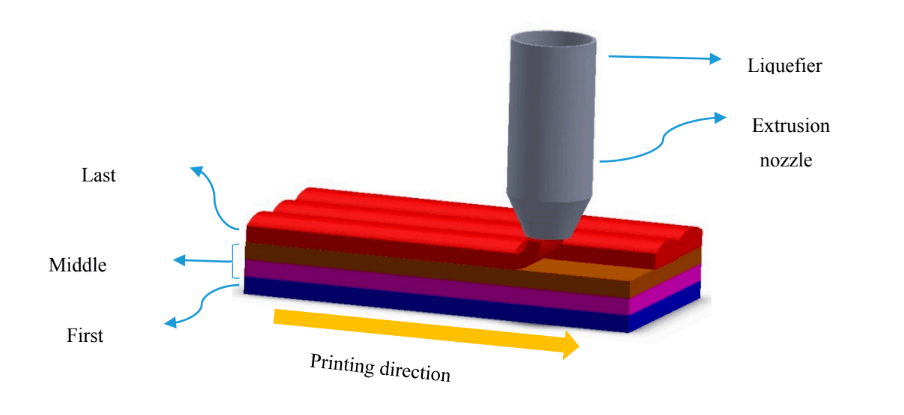
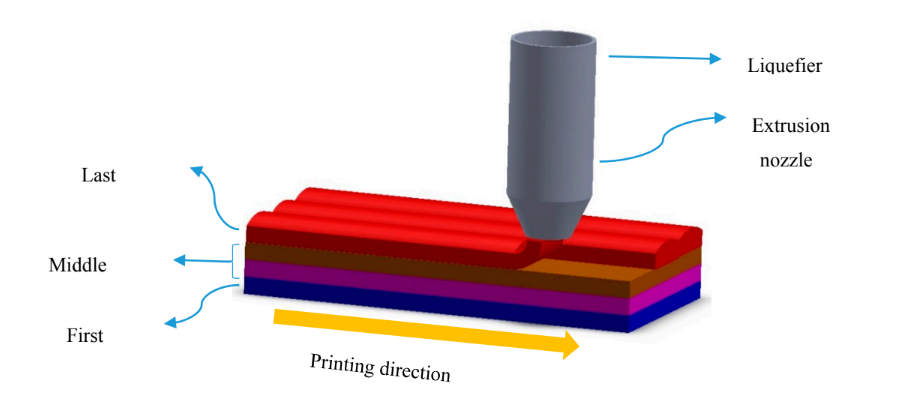
A schematic of the fused deposition modeling (FDM) method.
For fabrication of the beam-like samples (30 × 1.6 × 1), the research team used PLA with a 3DGence DOUBLE printer. Five samples were created, all at different speeds (Sp = 5, 10, 20, 40, 70 mm/s).
Material Comparison and Selection
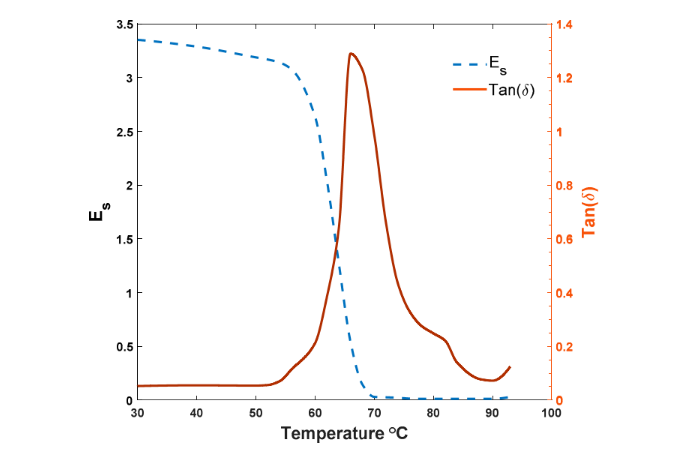
Dynamic-mechanical analyzer (DMA) test for the 3D-printed polylactic acid (PLA).
Each print was then dipped into hot water, cooled, and analyzed for potential transformation.
“As can be seen, samples with a straight temporary shape may transform into curved beams,” stated the researchers. “This means that the samples may already be programmed and prestained during the 4D printing process.”
Print Settings and Optimization
The research team also noted that when they increased 4D printing speed, both bending angle and curvature increased also:
“The faster the 4D printing, the greater the prestrain and consequently the deformation. Finally, experiments revealed that the FDM 4D printing technology has high potential in fabricating and programming adaptive objects with self-bending features.”
Strength and Durability Testing
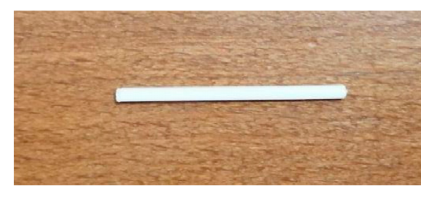
The beam configuration after 4D printing.

The configuration of the samples 4D-printed at different speeds of (a) 5, (b) 10, (c) 20, (d) 40, and (e) 70 mm/s after the heating–cooling process.
Cost and Availability Considerations
Heating could also serve as another environmental factor to manipulate curvature. Varying of speed and temperature also changed dispersion ‘significantly,’ and the bandgap switch decreased due to local resonance switching frequency depending on speed.
“The excellent accuracy of the proposed technique was checked via a comparative study with experiments and computational results from the developed in-house FE MATLAB-based solution. See also: The Current State of Metal 3D Printing in 2020. Two periodic architected temperature-sensitive metastructures with adaptive dynamical characteristics were conceptually proposed,” concluded the authors. “The COMSOL-based computational tool was then applied to dynamically analyze periodic metastructures with self-bending active elements 4D-printed at different printing speeds.
Advanced and Specialty Filaments
“It was found that the metastructures have the capability of controlling elastic wave propagation by forming bandgaps or frequency ranges where the wave cannot propagate. It was observed that the bandgap size and frequency range could be controlled and broadened through local resonances by changing 4D printing speed and thermal excitation. Due to the absence of a similar concept and results in the specialized literature, this article is likely to advance the state-of-the-art tunable metastructures for vibration mitigation and sound attenuation.”
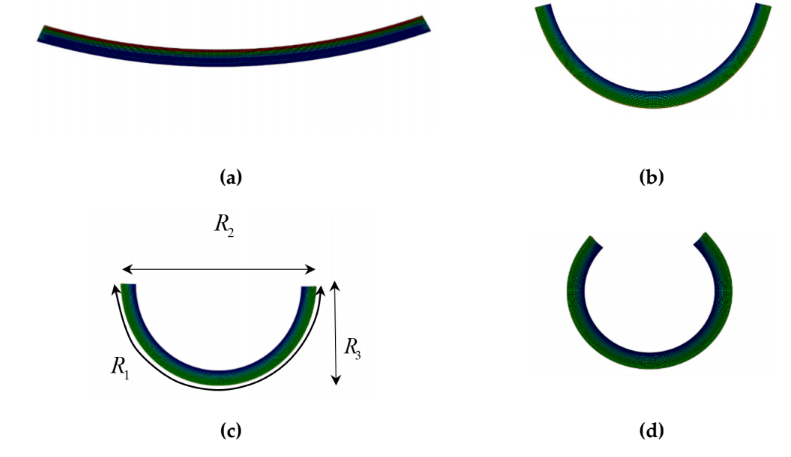
Finite element (FE) COMSOL Multiphysics simulation of the samples 4D-printed with different speeds of (a) 10, (b) 20, (c) 40, and (d) 70 mm/s after the heating–cooling process.
Understanding Filament Properties
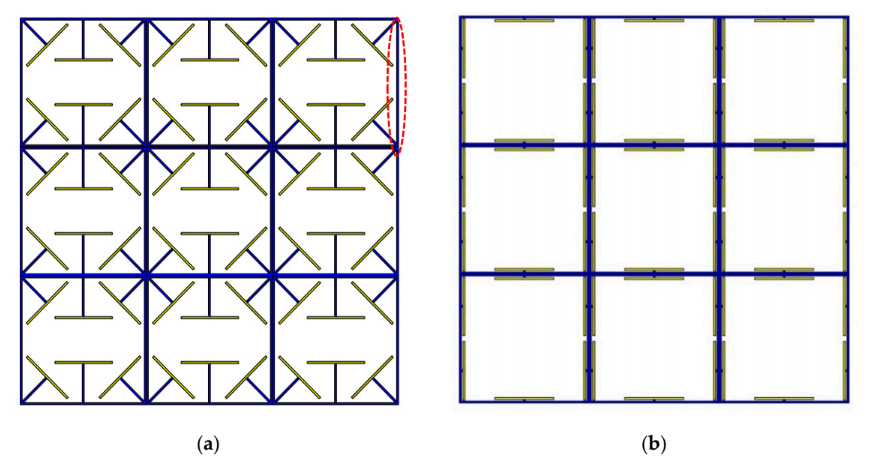
Periodic metastructures with active and passive components: (a) diagonal structure; (b) parallel structure (the red dashed oval shows the fixed-fixed beam used for the frequency normalization).
Today, researchers are involved in many different experiments regarding 4D printing, from creating autonomous structures to 4D printed soft robotics, new materials, and much more. What do you think of this news? Let us know your thoughts! Join the discussion of this and other 3D printing topics at 3DPrintBoard.com.
[Source / Images: ‘Shape-Adaptive Metastructures with Variable Bandgap Regions by 4D Printing’]
The post Customized FDM 4D Printing for Metastructures with Variable Bandgap Regions appeared first on 3DPrint.com | The Voice of 3D Printing / Additive Manufacturing.
Related Articles
Frequently Asked Questions
What is the best 3D printing filament for beginners?
PLA is the best starting filament — it prints easily at 190-220°C without an enclosure and produces good results. Once comfortable, PETG offers better strength and temperature resistance for functional parts.
How do I choose the right filament?
Consider the application: PLA for display models, PETG for functional parts, ABS/ASA for heat/sunlight exposure, TPU for flexible parts, and specialty filaments for engineering applications. Each has specific printer requirements.
What temperature should I print different filaments at?
PLA: 190-220°C nozzle / 50-60°C bed. PETG: 220-250°C / 70-80°C. ABS: 230-260°C / 100-110°C (enclosure needed). Nylon: 240-270°C / 70-90°C. Always check manufacturer recommendations for specific brands.
📌 Related Articles
- The Ultimate Guide to 3D Printer Calibration: Complete Step-by-Step Manual
- The Current State of Metal 3D Printing in 2020
- ABS 3D Printing Settings Guide: Temperature, Enclosure, and Cooling for Strong Parts
- Best 3D Printer Upgrades That Actually Improve Print Quality: Complete 2026 Guide
- Best Budget 3D Printer Upgrades That Actually Improve Print Quality: Belts, Springs, Hotends & More