
If you had access to the world’s #1 supercomputer, what would you do? Figure out whatever happened to the legendary PROMIS software developed for the U.S. Department of Justice? Predict the impact of an imminent financial collapse due to multiple simultaneous market failures due to the climate crisis? Me too.
Well, the team at GE Research had other plans in mind when the U.S. Department of Energy (DOE) selected a GE project among 47 winners in the 15th year of its Innovative and Novel Computational Impact on Theory and Experiment (INCITE) program. The project? Find new methods for optimizing jet engine and power generation efficiency with 3D printing.
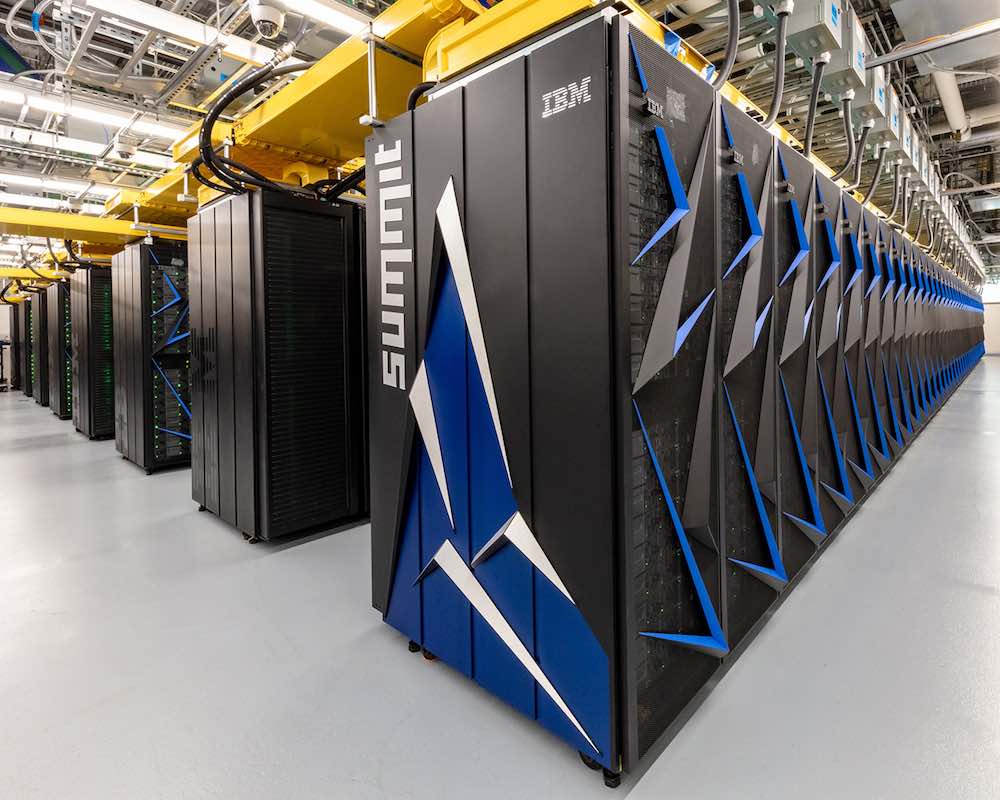
The INCITE program allows science and engineering projects to use some of the country’s powerful supercomputers from such labs as Oak Ridge, Argonne and Sandia National Laboratories to perform advanced calculations, simulations and other operations with the goal of making new scientific and technological discoveries. This, in turn, is meant to increase U.S. competitiveness in the global market. The processing power and time offered by supercomputers like Titan and Sierra at Oak Ridge National Laboratory are roughly the equivalent of running 10,000 computer processors simultaneously for over 9 months.
How 3D Printing Responded to COVID-19
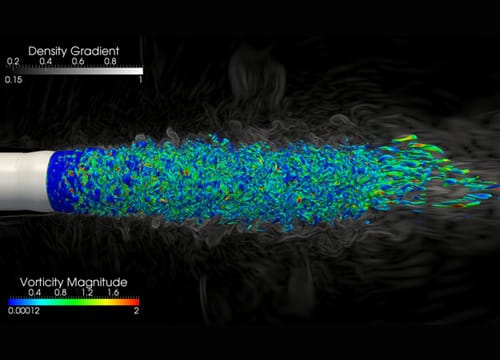
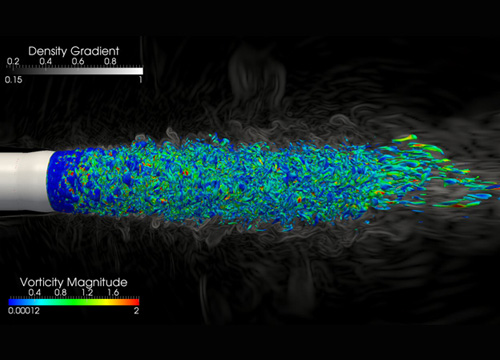
An image created on the Intrepid computer network at Argonne National Lab during research into jet engine exhaust flow. Image courtesy of GE Research.
In the case of GE Research, the project team, led by Michal Osusky, will positively impact GE’s design of gas turbines, which drive aircraft engines and the power generation equipment essential to GE’s Oil & Gas division. The team will leverage large eddy simulations to understand the flow physics that impact gas turbine performance. This includes: “flow mixing, boundary layer transitions, separated flows, multiscale flow structures, and coupling between high pressure turbine components.” The results of the studies will inform GE Research as it develops new, more efficient turbine designs that may ultimately lead to new, 3D-printed parts.
Osusky, from GE Research’s Thermosciences group, said of the ability to use the DOE’s supercomputers, “We’re able to conduct experiments at unprecedented levels of speed, depth and specificity that allow us to perceive previously unobservable phenomena in how complex industrial systems operate. See also: The Current State of Metal 3D Printing in 2020. Through these studies, we hope to innovate new designs that enable us to propel the state of the art in turbomachinery efficiency and performance.”
Due to the abstract nature of the work performed using supercomputers, it may be difficult to determine exactly what impact the research being conducted with them has on society and the planet at large. After all, massively parallel supercomputers featuring tens of thousands of off-the-shelf processors only became mainstream in the 1990s.
HP and the Pandemic Manufacturing Shift
The Summit supercomputer at ORNL. Image courtesy of ORNL.
Supercomputers play an important role in a great deal of advanced research, including quantum physics, weather forecasting and climate research, oil and gas exploration and molecular modeling, among other fields. Because they have likely influenced GE’s design work already, they will surely advance the conglomerate’s ongoing and future development.
Osusky also highlighted past partnerships with National Labs that could lead to improving the energy output of wind turbines by 5 percent, allowed GE to improve combined cycle power plant efficiency, and gave GE insight into the performance of jet engines. Previous work with the Sierra supercomputer at Lawrence Livermore National Laboratory allowed GE to test simulations of fuel injectors, which are difficult to test physically. Supercomputer simulations therefore make it possible to reduce the number of trials required to test them.

Supply Chain Disruptions and Digital Solutions
A fuel injector simulation created using the Sierra supercomputer at LLNL. Image courtesy of GE Research.
These incremental advancements in jet fuel nozzles or gas power facilities may not be enough, however, to achieve the efficiency necessary to cut global greenhouse gas emissions by 45 percent by 2030 and 100 percent by 2050, particularly when you think of the fuel efficiency achieved when flying and power generation are reduced overall. If you’re interested learning about other winners of the INCITE grants, including one related to studying climate, you can review the projects here.
The post Supercomputers to Aid GE Research in Gas Turbine Design appeared first on 3DPrint.com | The Voice of 3D Printing / Additive Manufacturing.
Medical PPE and Equipment Production
from Your daily news from 3DPrint.com http://bit.ly/3bUhBU3
Frequently Asked Questions
How did 3D printing help during COVID-19?
During the COVID-19 pandemic, 3D printing enabled rapid production of critical medical supplies including face shields, ventilator components, nasal swabs, and PPE. Distributed manufacturing allowed makers worldwide to produce items locally without waiting for traditional supply chains.
What was the pandemic digital manufacturing shift?
The pandemic accelerated adoption of digital manufacturing including 3D printing, as companies sought more resilient supply chains. Organizations shifted from centralized to distributed production, using digital files to produce parts locally on demand.
Can 3D printing supply chains be resilient in emergencies?
Yes, 3D printing provides supply chain resilience through distributed manufacturing — designs can be shared digitally and produced anywhere with compatible equipment, eliminating the need for physical inventory and shipping of parts.
📌 Related Articles
- The Current State of Metal 3D Printing in 2020
- Best Budget 3D Printer Upgrades That Actually Improve Print Quality: Belts, Springs, Hotends & More
- 3D Printing News: Multi-Material Breakthrough and Aerospace Market Boom
- Best 3D Printer Upgrades That Actually Improve Print Quality: Complete 2026 Guide
- ABS 3D Printing Settings Guide: Temperature, Enclosure, and Cooling for Strong Parts