
Markforged can happily claim to be a pioneer on a number of fronts in the additive manufacturing (AM) industry: 3D printing reinforcement fibers, low-cost metal 3D printing, unique quality control systems, software and more. While there are surely other new technologies on the horizon for the Boston-based startup, the most exciting offering from the company at the moment may be its metal 3D printing system, Metal X.
Demonstrating the capabilities of the Metal X, the U.S. military recently showed off its new Metal X system in a story for Stars and Stripes. In December, III Marine Expeditionary Force (III MEF) began running a Metal X system at its 3rd Maintenance Battalion shop at Camp Kinser one of the U.S.’s highly controversial military bases on the island of Okinawa.
The shop is staffed by 12 marines who repair parts for U.S. weapon systems and vehicles for all III MEF units, which occupy numerous bases across the small, Japanese island, as well as several bases on the larger island of Honshu and additional locations in South Korea and Hawaii. Typically, the crew has had to rely on CNC machines to make parts. As our readers know, this process can be costly, time consuming, and wasteful of material.

The State of Metal 3D Printing
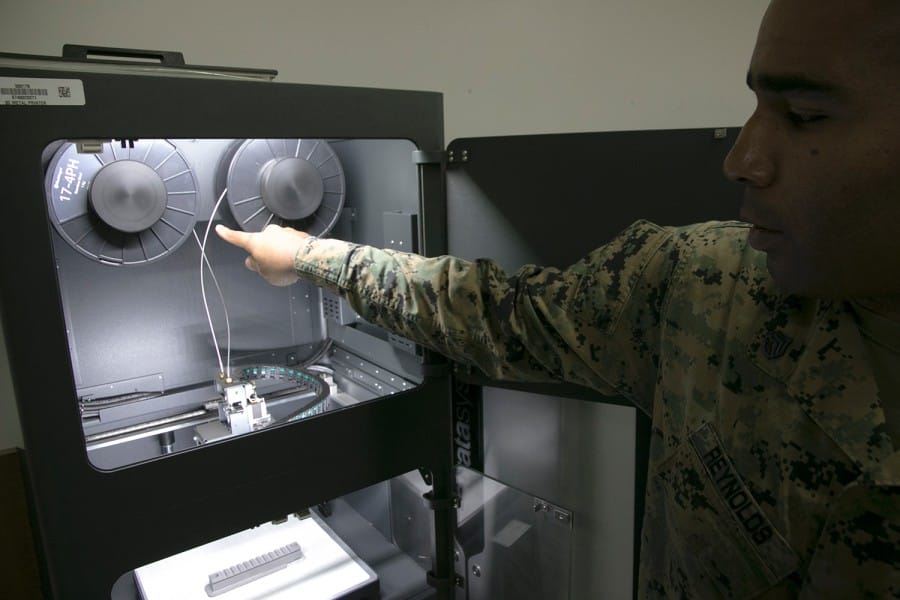
Quincy Reynolds with the Metal X 3D printer at Camp Kinser in Okinawa, Japan. Image courtesy of Matthew M. Burke/Stars and Stripes.
While the shop has had plastic 3D printers for the past four or five years, they have typically been reserved for prototyping. The Metal X system will make it possible for the military to 3D print metal end parts on demand. So far, these parts have included gauges for .50-caliber machine guns, sockets for wrenches and a piece to test weapon optics at the armory.
The Metal X extrudes metal powders bound together in a polymer matrix in a method similar to the traditional fused deposition modeling associated with desktop 3D printing. See also: Best 3D Printer Upgrades That Actually Improve Pri…. These “green” parts are then placed into a debinding station in which liquid argon washes away the plastic binder. The now “brown” parts are then placed into a furnace which sinters the metal parts for up to 27 hours and up to 1482°C, resulting in solid metal parts.
“Whereas with our new metal 3D printer, that opens up a whole new world for us,” shop foreman Staff Sgt. Quincy Reynolds said. “This piece of equipment is able to save time with the multiple prints and then you’re able to have a completed [piece] … that does not need any machining.”
Technical Challenges and Solutions
Whereas a marine might spend eight to 12 hours machining a single component, the metal 3D printer can produce multiple parts at once. Once the initial layers are printed successfully, the solider can move on to other activities. In turn, one user can work on four projects at a time. Because the furnace the staff is using only holds about half the capacity that the Metal X can print, the shop will be upgrading to a larger furnace.
“We’re asking units, ‘Hey, just give us a problem. Let us figure out the solution for you,’” Reynolds said. “Right now, the sky is the limit honestly with this printer. If you can think of it, we can literally do it.”
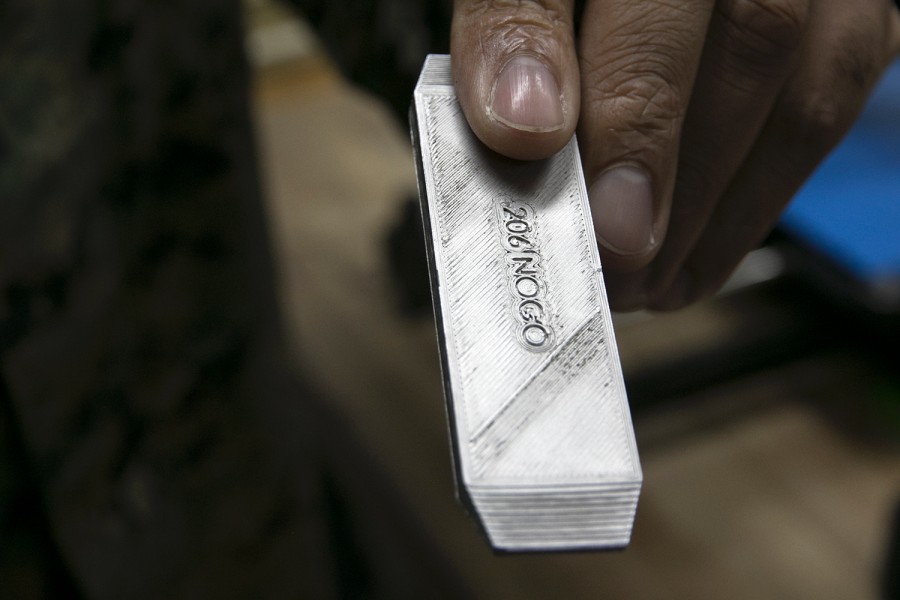
A .50 caliber machine gun gauge 3D printed by the U.S. military forces in Okinawa using the Metal X 3D printer. Image courtesy of Matthew M. Burke/Stars and Stripes.
Material Properties and Performance
From the description provided in Stars and Stirpes, the Metal X system is delivering on an endeavor that the U.S. See also: Bambu Lab A1 vs Elegoo Centauri Carbon: Full Specs…. military has long been pursuing: the ability to 3D print metal components on demand. The long-term goal for the military is to be able to make parts as close to a warzone as possible, potentially within portable fablabs.
Because the U.S. spends more on its military than the next seven countries combined, it has the expenses to research these cutting-edge initiatives and more. As the largest military force in the world (coincidentally also the largest polluter), the U.S. is under a seemingly constant need to remain a threat to other nations that might challenge its hegemony. For this reason, it has garrisoned the planet with over 1,000 military bases located in 80 countries, representing 95 percent of the globe’s total military installations (for comparison France, the U.K. and Russia have about 10-20 foreign outposts each and China has one).
As a result, the U.S. military is exploring a wide range of experimental 3D printing applications. Others include 3D printing meals for soldiers, 3D-printed grenade launchers, 3D-printed ship hulls, skin 3D printers for rapidly healing wounds.
Industrial Applications and Use Cases
The post Metal X 3D Printer Begins Operations at U.S. Military Base appeared first on 3DPrint.com | The Voice of 3D Printing / Additive Manufacturing.
from Your daily news from 3DPrint.com http://bit.ly/2OzViJB
Related Articles
Frequently Asked Questions
What is metal 3D printing?
Metal 3D printing (additive manufacturing) builds metal parts layer by layer using techniques like laser powder bed fusion, directed energy deposition, and binder jetting. It enables complex geometries impossible with traditional manufacturing while reducing material waste significantly.
How strong are 3D printed metal parts?
3D printed metal parts can achieve mechanical properties comparable to traditionally manufactured metals. Tensile strength and fatigue resistance depend on the process and post-processing, but many meet or exceed ASTM standards for wrought materials.
What are the main metal 3D printing technologies?
The primary technologies include Laser Powder Bed Fusion (LPBF), Electron Beam Melting (EBM), Directed Energy Deposition (DED), Binder Jetting, and Metal FDM (with bound filaments). Each has different strengths in terms of resolution, speed, and material options.
📌 Related Articles
- Best 3D Printer Upgrades That Actually Improve Print Quality: Complete 2026 Guide
- Bambu Lab A1 vs Elegoo Centauri Carbon: Full Specs Comparison & Buyer’s Guide
- Best Budget 3D Printer Upgrades That Actually Improve Print Quality: Belts, Springs, Hotends & More
- ABS 3D Printing Settings Guide: Temperature, Enclosure, and Cooling for Strong Parts
- 3D Printing Safety Equipment Guide: Respirators, Gloves, and Ventilation for 2026