
Lu Bing recently presented a thesis, ‘Mixture Design and Processing of Novel Spray-based Cementitious Materials for 3D Printing,’ to the School of Civil and Environmental Engineering at the Nanyang Technological University.
With a focus on 3D printing with concrete, Lu Bing notes the ‘remarkable progress’ being made with such materials—promoting more expanded automation in construction, decreasing the need for labor, and improving efficiency over traditional techniques. This is true in many different applications feeling the positive impacts of 3D printing too, from the medical industry to automotive and aerospace. Construction has seen its uses in bridges and a variety of different aspects of infrastructure—not to mention homes.
The Role of 3D Printing in Medicine
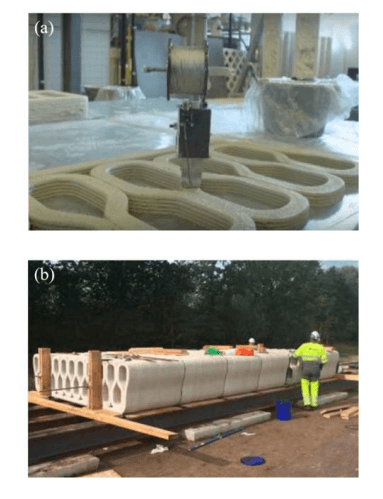
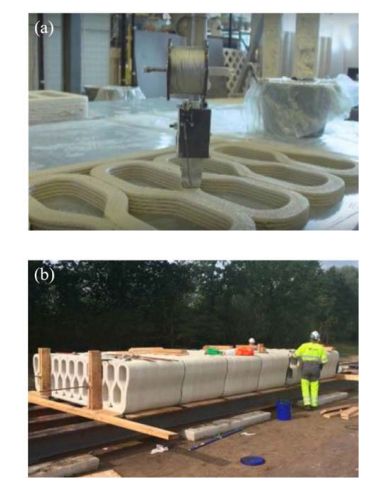
Printing and assembly of a 3D printed concrete bridge (Salet et al. 2018): (a) printing of the structure unit; (b) onsite assembly of the bridge. Reproduced under Creative Commons Attribution License (https://bit.ly/3d1YBnl, no changes were made to the figures)
Work with cement in 3D printing means the need for research and development regarding materials and inks, along with studies including investigation of sand/binder ratio, mixture optimization, and the use of a variety of materials.
“The 3D printing of cementitious materials could be divided into two phases, i.e. delivery and deposition phases (Lu et al. 2019b),” states Bing. “In the delivery phase, the printable cementitious material is delivered through the hose to the printing nozzle with the pressure provided by the pump. In the deposition phase, the printable cementitious material is deposited in a layer-by-layer manner to build the desired structure. The movement of the printing nozzle is usually controlled by gantry or robotic arm.”
Biocompatible Materials and Processes
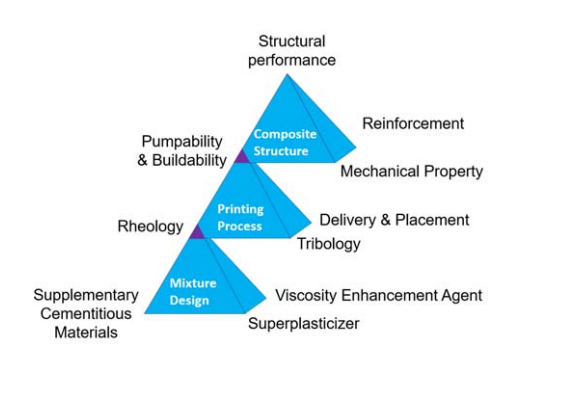
Multi-level material design of 3D printable cementitious materials (Lu et al.
2019b). Reproduced with permission © Elsevier

Robotic arm printing system for large-scale 3D cementitious material
printing (Zhang et al. 2018a). Reproduced with permission © Elsevier
Clinical Applications and Case Studies
3DPCM requires materials with both good pumpability and good buildability in terms of printing. Good pumpability can be delivered in a streamlined manner from the hose to the nozzle, with little chance of clogging. Good buildability leads to large height with very little deformation, meaning that prints are consistent and stable.
During delivery, concrete materials should exhibit low viscosity, and also low dynamic yield stress for pumpability. During printing, the material should offer high static yield stress.
Unstable or inconsistent flow can lead to serious problems like tearing, or varied dimensions in the layers. With inferior pumpability, however, comes a poor structural performance—and with poor buildability, structures may collapse.
Reinforcements must be added either separate from printing or placed simultaneously during fabrication.

Regulatory Considerations and Safety
Defects due to poor pumpability
Sprayable materials are pumped through a hose and then sprayed onto the substrate after being injected with air. See also: 3D Printing News: Multi-Material Breakthrough and …. For greater robustness, a wet-mix is usually used, pouring in water at the nozzle during dry-mix.
“… sufficient material adhesion to the substrate in the experiments was guaranteed in this study. However, lack of material adhesion to substrate can lead to the fall of sprayed materials with large thickness, which may affect material distribution. On the other hand, while there is no relevant study on loading mechanism of overhead spray-based printing, it is suspected that the competition between gravity, cohesion between each layer and adhesion to substrate plays an important role in the deposition,” concluded the researchers.
Research Breakthroughs and Innovations
“Substrates made of different materials may also affect the adhesion. In this thesis, timber plates were used as substrates. For more generic applications, other materials such as steel and hardened concrete can be applied in the future study. Tack test can be adopted to assess the adhesion, where thin plates made of substrate materials can be glued to the two parallel testing plates. Alternatively, overhead spray-based 3D printing can be carried out for different substrates with the same mixture. Through comparison of maximum sprayed layers and failure modes, the adhesion between mixture and different substrates can also be assessed.”
What do you think of this news? Let us know your thoughts! Join the discussion of this and other 3D printing topics at 3DPrintBoard.com.
[Source / Images: ‘Mixture Design and Processing of Novel Spray-based Cementitious Materials for 3D Printing’]
The Future of Bioprinting and Medical AM
The post 3D Printing with Cement: Novel Spray-Based Materials appeared first on 3DPrint.com | The Voice of 3D Printing / Additive Manufacturing.
Frequently Asked Questions
How is 3D printing used in medicine?
3D printing is used in medicine for surgical planning models, custom implants, bioprinting tissue scaffolds, drug delivery systems, dental aligners, and prosthetics. It enables patient-specific solutions that improve outcomes and reduce surgery time.
What materials are biocompatible for 3D printing?
Common biocompatible materials include PEEK, titanium alloys (Ti6Al4V), bio-ceramics (hydroxyapatite), medical-grade resins, PLA for temporary implants, and hydrogels for bioprinting. Material choice depends on the application and required mechanical properties.
Is 3D printed medical equipment FDA approved?
Yes, several 3D printed medical devices have FDA clearance, including orthopedic implants, dental restorations, and surgical guides. Each device must go through the appropriate regulatory pathway based on its risk classification.
📌 Related Articles
- The Current State of Metal 3D Printing in 2020
- 3D Printing News: Multi-Material Breakthrough and Aerospace Market Boom
- Best 3D Printers Under $500: 2026 Comparison Guide
- The Complete 3D Printing Filament Guide: Types, Properties & When to Use Each
- Best Budget 3D Printer Upgrades That Actually Improve Print Quality: Belts, Springs, Hotends & More