
Our 3D Printing News Briefs this week are indeed brief, but no less important. We’ll tell you how 3DEO has reached an important production milestone, and also about the newest member of the 3MF Consortium.
3DEO Reaches 150,000 Production Parts Shipped
The State of Metal 3D Printing
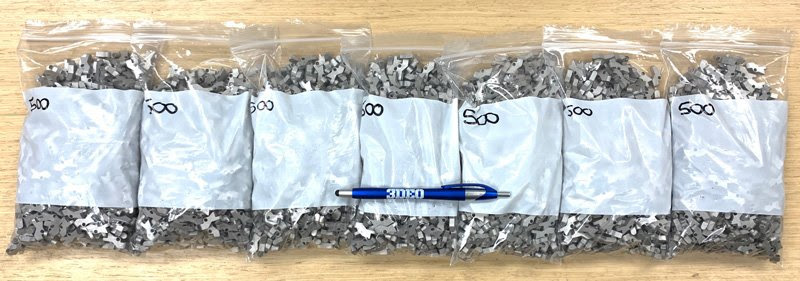
Monthly shipment of 3500 pieces to a 3DEO customer
Metal 3D printing company 3DEO, founded in 2016 for the purpose of competing against conventional manufacturing with high-volume metal additive manufacturing, recently announced that it has reached a major milestone: it’s shipped out 150,000 production parts for end-use applications. The California company’s mission is to make metal 3D printing available for mass production through its digital industrial platform, and this announcement is excellent evidence that it’s well on its way. 3DEO has an interesting business model – instead of selling its 3D printers, the company has focused on becoming an expert user of its own patented technology, and built an automated end-to-end industrial platform, to which its customers then have access.
“150 thousand parts is a terrific milestone for 3DEO. See also: The Current State of Metal 3D Printing in 2020. It validates our patented technology, our unique business model, and our mission to break metal additive manufacturing (AM) into high-volume production. Today, we routinely win bids against traditional manufacturing because of our competitive cost structure and material performance,” said 3DEO’s President Matt Sand.
Technical Challenges and Solutions
“150,000 parts shipped is only the beginning for us. We are scratching the surface of what’s possible with metal AM in the $130 billion U.S. metal parts market. With our additive and automation software and hardware, combined with our world-class R&D team and quality systems, we are primed to scale metal AM into millions of parts next year.”
3MF Consortium Announces New Specification and Member
 Five years ago, Microsoft launched the new .3MF file format for 3D printing, along with the collaborative 3MF Consortium. It works to define the 3D Manufacturing Format that facilitates easier operation, making it possible to send 3D models sent to other applications, services, and platforms. Members of the consortium include Ultimaker, GE Global Research, ASTM International, Autodesk, and now Viaccess-Orca (VO), a global provider of advanced data solutions and digital content protection. VO, which will be a Founding Member, helped the consortium define its new 3MF Secure Content Specification, which will address production control requirements and payload protection and is available through GitHub under a permissive BSD license.
“In a modern cloud-connected world, data security and end-to-end encryption are playing an increasingly important role to mitigate the risk of leakages and data corruption in globally distributed manufacturing environments. Protecting the integrity and confidentiality of product designs, patient-specific biometric data, and other sensitive manufacturing content is critical to enabling additive manufacturing to scale into final part production in distributed, contractual, and highly regulated manufacturing environments,” stated Scott White, Software Distinguished Technologist at HP Inc. “We are thrilled that Viaccess-Orca joined the consortium and contributed their decades-long expertise to the design of the 3MF Secure Content extension. The final specification defines the payload encryption based on industry standards, and allows third parties to build their own key management ecosystems upon it. We believe this will allow it to be used to address a broad range of critical use cases simply and seamlessly.”
Material Properties and Performance
As a consortium member, VO will help address digital asset security aspects in the digital manufacturing industry. See also: 3D Printing News: Multi-Material Breakthrough and …. The company also announced the general release of its Secure Manufacturing Platform (SMP), which makes sure that digital assets are traceable and secure, in compliance with the new 3MF specification, across digitally distributed supply chains.
Discuss these stories and other 3D printing topics at 3DPrintBoard.com or share your thoughts in the Facebook comments below.
The post 3D Printing News Briefs, June 20, 2020: 3DEO and 3MF Consortium appeared first on 3DPrint.com | The Voice of 3D Printing / Additive Manufacturing.
Industrial Applications and Use Cases
from Your daily news from 3DPrint.com https://bit.ly/2YQjrje
Frequently Asked Questions
What is metal 3D printing?
Metal 3D printing (additive manufacturing) builds metal parts layer by layer using techniques like laser powder bed fusion, directed energy deposition, and binder jetting. It enables complex geometries impossible with traditional manufacturing while reducing material waste significantly.
How strong are 3D printed metal parts?
3D printed metal parts can achieve mechanical properties comparable to traditionally manufactured metals. Tensile strength and fatigue resistance depend on the process and post-processing, but many meet or exceed ASTM standards for wrought materials.
What are the main metal 3D printing technologies?
The primary technologies include Laser Powder Bed Fusion (LPBF), Electron Beam Melting (EBM), Directed Energy Deposition (DED), Binder Jetting, and Metal FDM (with bound filaments). Each has different strengths in terms of resolution, speed, and material options.
📌 Related Articles
- The Current State of Metal 3D Printing in 2020
- 3D Printing News: Multi-Material Breakthrough and Aerospace Market Boom
- Best 3D Printer Upgrades That Actually Improve Print Quality: Complete 2026 Guide
- 3D Printing Tungsten Carbide: How Hot-Wire Laser Technology Creates Metal Harder Than Steel
- ABS 3D Printing Settings Guide: Temperature, Enclosure, and Cooling for Strong Parts