
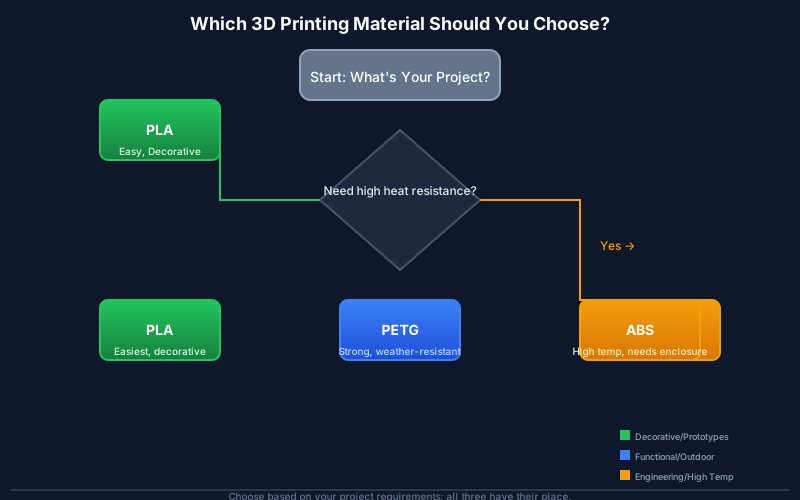
PLA is the beginner-friendly choice for decorative prints; PETG offers the best balance of strength and ease; ABS excels in durability and heat resistance but requires an enclosure. Match the material to your project’s needs, not just what you have on hand.
What You’ll Learn
- The fundamental properties that set PLA, PETG, and ABS apart
- Which material is optimal for indoor vs outdoor applications
- How print temperature and adhesion requirements differ
- Real-world use cases for each filament type
- Safety considerations (fumes, warping, bed preparation)
Introduction
Choosing the right filament is as important as tuning your printer settings. Most beginners start with PLA because it “just works,” but as your projects evolve, you’ll encounter requirements that PLA can’t meet. PETG and ABS fill those gaps—but they come with their own trade-offs. This comparison cuts through the marketing to give you practical guidance.
Material Properties at a Glance
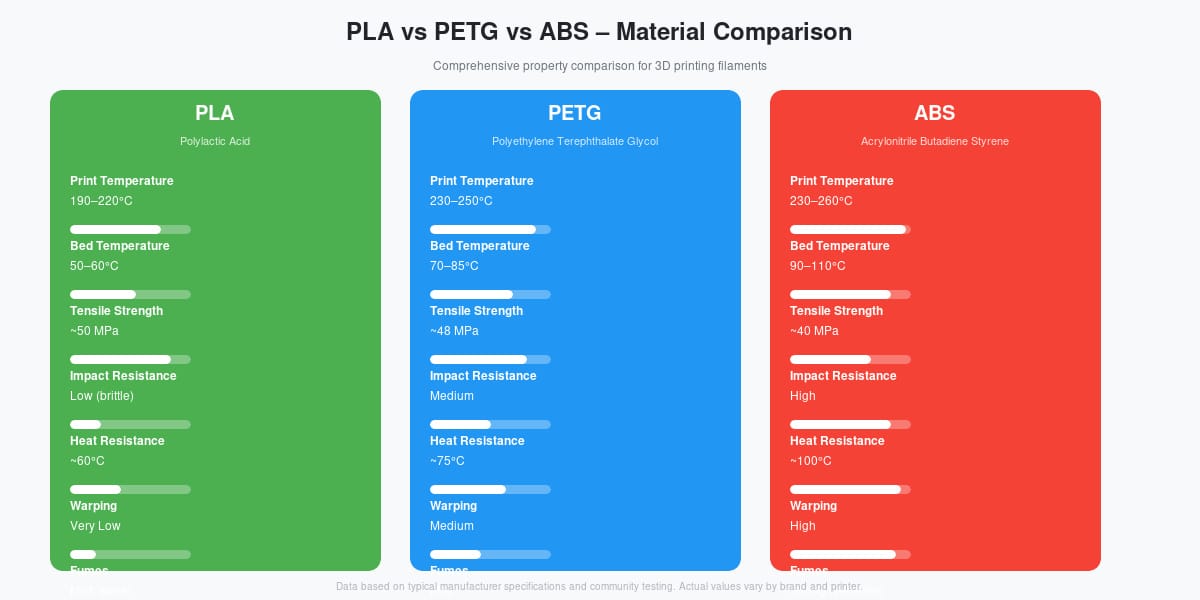
| Property | PLA (Polylactic Acid) | PETG (Polyethylene Terephthalate Glycol) | ABS (Acrylonitrile Butadiene Styrene) |
|---|---|---|---|
| Print Temperature | 190–220°C | 230–250°C | 230–260°C |
| Bed Temperature | 50–60°C (optional) | 70–85°C | 90–110°C |
| Tensile Strength | ~50 MPa | ~48 MPa | ~40 MPa |
| Impact Resistance | Low (brittle) | Medium | High |
| Heat Resistance | ~60°C (softens) | ~75°C | ~100°C |
| Warping Tendency | Low | Medium | High (needs enclosure) |
| Fumes | Mild, sweet smell | Mild | Strong, requires ventilation |
| Ease of Use | Very Easy | Easy | Moderate |
Data sourced from manufacturer spec sheets and community testing. Your results may vary based on brand and printer calibration.
Deep Dive: When to Use Each Material
PLA: The Decorative Workhorse
PLA excels when you need sharp details and minimal hassle. It’s the go-to for figurines, prototypes that won’t see stress, and educational projects. However, PLA degrades under prolonged sunlight and can deform in a hot car. Avoid functional parts that bear load or experience high temperatures.
Best for:
- Cosplay props and display models
- Household decor (non-structural)
- Prototypes for fit-checking
- Beginner learning projects
PETG: The Balanced All-Rounder
PETG combines strength, chemical resistance, and reasonable ease of use. It’s tougher than PLA and doesn’t require an enclosure like ABS. PETG prints slower due to its tendency to string, and first-layer adhesion is critical, but the results are durable enough for mechanical parts and outdoor use (with UV-resistant variants).
Best for:
- Functional prototypes with moving parts
- Outdoor fixtures (garden mounts, enclosures)
- Food-safe containers (if using food-grade PETG)
- Tool holders and workshop organisers
ABS: The Industrial Choice
ABS is the strongest of the three and withstands higher temperatures, making it suitable for engineering applications. However, it warps significantly without a heated enclosure and emits unpleasant fumes. Modern solutions like ABS-Like blends and enclosure kits have lowered the barrier, but ABS remains the most challenging to print reliably.
Best for:
- Automotive interior brackets
- High-stress mechanical parts
- Items exposed to temperatures above 60°C
- Projects where post-processing (acetone smoothing) is desired
Pro Tips
- Dry your filaments: PETG and ABS absorb moisture quickly, causing bubbles and weak layer adhesion. Use a filament dryer or store with desiccant.
- Calibrate retraction: Stringing is most noticeable with PETG. Fine-tune retraction distance and speed for clean surfaces.
- Use adhesives sparingly: A glue stick or PEI sheet often works better than hairspray for PLA and PETG. ABS benefits from a brim or raft to combat warping.
- Print slower for strength: Increased layer adhesion from slower print speeds often yields stronger parts than faster prints with thicker layers.
- Ventilate for ABS: Even with enclosures, ABS fumes contain styrene. Use an exhaust fan or filter system.
Common Mistakes
- Using PLA for functional parts that bear weight – PLA’s low impact resistance leads to sudden brittle failure.
- Ignoring bed leveling with PETG – Its stickiness can cause over-adhesion and damage the build surface if the nozzle is too close.
- Printing ABS without an enclosure – Drafts cause uneven cooling and guaranteed warping.
- Choosing price over quality – Cheap filaments have inconsistent diameters and additive mixes that ruin repeatability.
- Skipping test prints – Temperature towers and adhesion squares save hours of failed large prints.
FAQ
Can I print PETG on a glass bed?
Yes, and it often works very well with a light application of glue stick or hairspray. PETG tends to bond strongly to glass, so ensure your first layer height is correct to avoid damaging the glass when removing prints.
Is ABS worth the hassle for everyday prints?
For most hobbyist projects, PETG is the smarter choice. Reserve ABS for parts that specifically need its thermal or mechanical properties, or when you already have an enclosed printer.
Does PLA need a heated bed?
Not strictly. See also: ABS 3D Printing Settings Guide: Temperature, Enclo…. PLA adheres well to blue painter’s tape, PEI, or even a clean glass surface at room temperature. A 50–60°C bed improves consistency but isn’t mandatory.
How do I store filaments long-term?
Keep filaments in airtight containers with desiccant packs. For humid environments, consider a sealed dry box with a filament dryer running continuously. PLA is more forgiving than PETG and ABS.
Can I paint or glue these materials?
PLA paints well with acrylics and bonds with cyanoacrylate. PETG is trickier to glue; use epoxy or specialised PETG adhesives. ABS welds beautifully with acetone vapour and accepts most model paints.
Conclusion
There’s no single “best” filament—only the best material for your specific project. Stock PLA for quick prototypes and display pieces, keep PETG on hand for functional parts that need durability, and reach for ABS only when temperature resistance and strength are paramount. As you gain experience, you’ll develop an intuition for which material to reach for first. Start with PLA to master your machine, then gradually incorporate PETG and ABS as your project demands expand.
Related Resources
Explore these additional resources to deepen your understanding of 3D printing materials:
- Filament Settings Database – Find optimal printer profiles for various filaments.
- Ultimate Calibration Guide – Fine-tune your printer for each material.
- Printer Comparison Tool – Compare printers by material compatibility.
External references:
- NIST 3D Printing Additive Manufacturing – Standards and research.
- PLA vs PETG vs ABS: A Comprehensive Comparison – Industry overview.
- MatterHackers Materials Guide – Detailed material properties.
Where to Buy Filament
Disclosure: Some of the links below are affiliate links. If you make a purchase, we may earn a commission at no extra cost to you. This helps support this site.
These links go to Amazon with our affiliate tag. If you prefer to support local retailers or buy directly from manufacturers, we encourage that as well!
Frequently Asked Questions
What is the best 3D printing filament for beginners?
PLA is the best starting filament — it prints easily at 190-220°C without an enclosure and produces good results. Once comfortable, PETG offers better strength and temperature resistance for functional parts.
How do I choose the right filament?
Consider the application: PLA for display models, PETG for functional parts, ABS/ASA for heat/sunlight exposure, TPU for flexible parts, and specialty filaments for engineering applications. Each has specific printer requirements.
What temperature should I print different filaments at?
PLA: 190-220°C nozzle / 50-60°C bed. PETG: 220-250°C / 70-80°C. ABS: 230-260°C / 100-110°C (enclosure needed). Nylon: 240-270°C / 70-90°C. Always check manufacturer recommendations for specific brands.
📌 Related Articles
- Creality Creality Ender 3 V3 Plus vs Creality Ender 3 Pro: Full Specs Comparison & Buyer’s Guide
- ABS 3D Printing Settings Guide: Temperature, Enclosure, and Cooling for Strong Parts
- Best 3D Printer Upgrades That Actually Improve Print Quality: Complete 2026 Guide
- Best Budget 3D Printer Upgrades That Actually Improve Print Quality: Belts, Springs, Hotends & More
- Bambu Lab A1 vs Elegoo Centauri Carbon: Full Specs Comparison & Buyer’s Guide