
/
Results and Key Findings
/
/
Applications and Use Cases
/
Results and Key Findings
/
/
/
Results and Key Findings
/
/
Technology and Innovation
/
Results and Key Findings
/
/
Applications and Use Cases
/
Results and Key Findings
/
/
/
Results and Key Findings
/
/
/
Results and Key Findings
/
/
Applications and Use Cases
/
Results and Key Findings
/
/
/
Results and Key Findings
/
/
Research and Development
/
Results and Key Findings
/
/
Applications and Use Cases
/
Results and Key Findings
/
/
/
Results and Key Findings
/
/
Technology and Innovation
/
Results and Key Findings
/
/
Applications and Use Cases
/
Results and Key Findings
/
/
/
Results and Key Findings
/
/
/
Results and Key Findings
/
/
Applications and Use Cases
/
Results and Key Findings
/
/
/
Results and Key Findings
/
/
/
Results and Key Findings
/
/
Applications and Use Cases
/
Results and Key Findings
/
/
/
Results and Key Findings
/
/
Technology and Innovation
/
Results and Key Findings
/
/
Applications and Use Cases
/
Results and Key Findings
/
/
/
Results and Key Findings
/
/
/
Results and Key Findings
/
/
Applications and Use Cases
/
Results and Key Findings
/
/
/
Results and Key Findings
/
No one wants to be operated on by a surgeon who has little hands-on training, but throughout history, finding suitable models or cadavers has been challenging for medical students who want nothing more than the luxury of many quiet hours perfecting their procedures as they continue on their way to being experienced doctors.
/
Applications and Use Cases
/
/
Technology and Innovation
/
Applications and Use Cases
/
/
/
Applications and Use Cases
/
/
Research and Development
/
Applications and Use Cases
/
/
Technology and Innovation
/
Applications and Use Cases
/
/
/
Applications and Use Cases
/
/
/
Applications and Use Cases
/
/
Technology and Innovation
/
Applications and Use Cases
/
/
/
Applications and Use Cases
/
/
Applications and Use Cases
/
/
Technology and Innovation
/
Applications and Use Cases
/
/
/
Applications and Use Cases
/
/
Research and Development
/
Applications and Use Cases
/
/
Technology and Innovation
/
Applications and Use Cases
/
/
/
Applications and Use Cases
/
/
/
Applications and Use Cases
/
/
Technology and Innovation
/
Applications and Use Cases
/
/
/
Applications and Use Cases
/
Key Highlights and Main Points
/
Applications and Use Cases
/
/
Technology and Innovation
/
Applications and Use Cases
/
/
/
Applications and Use Cases
/
/
Research and Development
/
Applications and Use Cases
/
/
Technology and Innovation
/
Applications and Use Cases
/
/
/
Applications and Use Cases
/
/
/
Applications and Use Cases
/
/
Technology and Innovation
/
Applications and Use Cases
/
/
/
Applications and Use Cases
/
Simulation devices, while more complex, are also extremely helpful to students and doctors. Now, Swiss medical researchers from the University of Bern have developed a new training method, detailed in the recently published “Neurosurgical simulator for training aneurysm microsurgery—a user suitability study involving neurosurgeons and residents.”
/
Applications and Use Cases
/
/
Technology and Innovation
/
Applications and Use Cases
/
/
/
Applications and Use Cases
/
Currently, training for intracranial aneurysms is limited because of the difficulty level involved in such microsurgery. Medical students and surgeons typically gain experience through watching and assisting during procedures, performing surgery under the watchful eye of skilled doctors, as well as studying videos. While there are some types of virtual reality simulation available, the researchers were motivated to improve on the technology with patient-specific models that even include features like blood circulation and pulsatility–something that is very important for training purposes but historically has been lacking.
/
Applications and Use Cases
/
Considering the delicate nature of intracranial aneurysm microsurgery, it is critical for students to understand the vascular nature of the aneurysm as well as exactly what happens in the case of a rupture. Students and doctors training should understand the surgical process overall, along with learning how to spot occlusions (blockage). It is concerning that because models and other experiential education are so hard to come by, there may just continue to be a lack of trained cerebrovascular neurosurgeons.
/
Applications and Use Cases
/
The goal of this study was to create a progressive simulator based on a 3D printed model that would be able to train both residents and neurosurgeons in clipping intracranial aneurysms. The materials used are meant to mimic human tissue, including:
/
Applications and Use Cases
/
-
/
- Arterial wall patency
- Thickness
- Elasticity
- Pulsatile blood flow
Applications and Use Cases
/
/
Applications and Use Cases
/
/
Applications and Use Cases
/
/
Applications and Use Cases
/
/
Applications and Use Cases
/
/
Applications and Use Cases
/
/
Applications and Use Cases
/
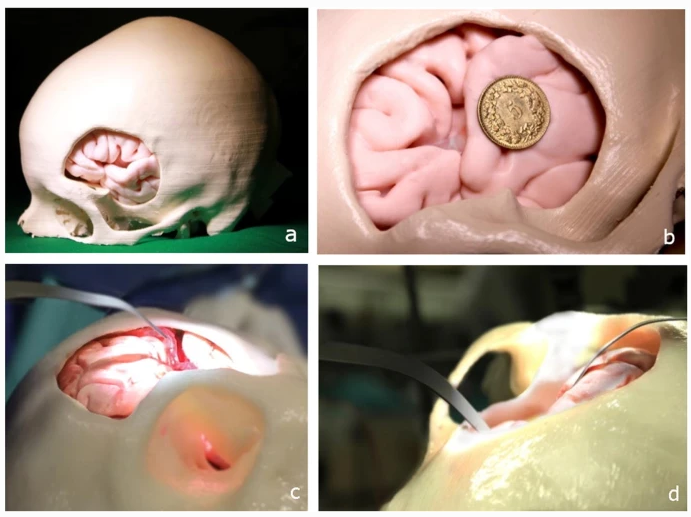
Representation of the model during the training study: a Patient-specific 3D-printed trephined skull with brain model. b MCA aneurysm model located in the left Sylvian fissure. c Pulsating blood vessel and access to the pathology of the model. d Brain retractor during manipulation by resident.
/
Applications and Use Cases
/
/
Applications and Use Cases
/
Twenty-five neurosurgeons and residents participated in the research study. Sixteen were in their early residencies with less than four years of training in the field of neurosurgery; nine were in late residencies and already board-certified, with anywhere from four to fifteen years of neurosurgical training. The residents and surgeons evaluated the efficacy of the new simulator, using a five-point scale to grade the following:
/
Applications and Use Cases
/
-
/
- Surgical simulation anatomy
- Realism
- Haptics
- Tactility
- General usage
Applications and Use Cases
/
/
Applications and Use Cases
/
/
Applications and Use Cases
/
/
Applications and Use Cases
/
/
Applications and Use Cases
/
/
Applications and Use Cases
/
/
Applications and Use Cases
/
/
Applications and Use Cases
/
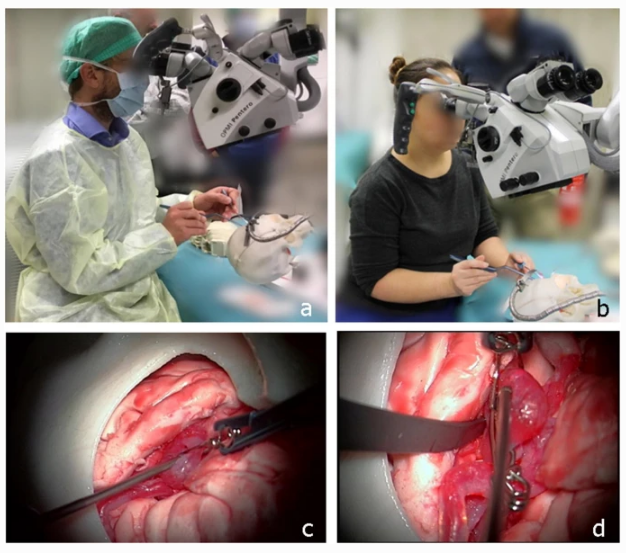
Pictorial representation from the simulator and study participation: a Expert neurovascular surgeon manipulating the aneurysm model in the simulator and trying to clip. b Young resident neurosurgeon clipping. c Attempt to clipping. d Exploration after clipping
/
Applications and Use Cases
/
/
Applications and Use Cases
/
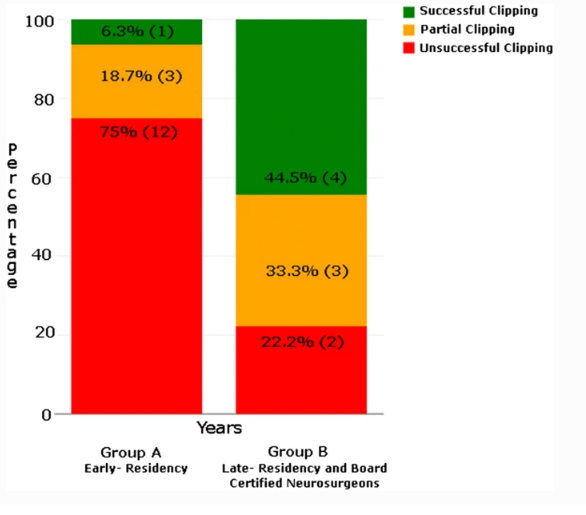
In order to evaluate the feasibility of a future validation study on the role of the simulator in neurosurgical postgraduate training, an expert neurosurgeon assessed participants’ clipping performance, and a comparison between groups was done.
/
Applications and Use Cases
/
See the chart below for results from group A and group B.
/
Applications and Use Cases
/
/
Applications and Use Cases
/
Nature of clipping (successful, unsuccessful, and partially done) vs. years of experience between group A and group B participants.
/
Applications and Use Cases
/
/
Applications and Use Cases
/
3D printing, while offering substantial advantages to other industries like aerospace, construction, and energy, has been particularly impressive in changing the face of medicine due to the ability to offer more patient-specific treatment; this study offers good evidence of that in comparison to traditional types of training. Over 80 percent of the participants thought the study “was a good alternative to theoretical and conventional learning.”
/
Applications and Use Cases
/
/
Applications and Use Cases
/
“To date, neurosurgeons have been using only one indicator of performance: patient outcomes. Our simulator could incorporate alternative measures to improve and maintain skills,” concluded the researchers.
/
Applications and Use Cases
/
“Further studies are needed in order to confirm that the present simulator is a valuable clinical tool for measuring, evaluating, and maintaining quality assurance in the training and education of future generations of neurosurgeons.”
/
Applications and Use Cases
/
/
Applications and Use Cases
/
[Source / Images: “Neurosurgical simulator for training aneurysm microsurgery—a user suitability study involving neurosurgeons and residents”]
/
Applications and Use Cases
/
The post 3D Printing Aids Intracranial Aneurysm Microsurgery Simulation appeared first on 3DPrint.com | The Voice of 3D Printing / Additive Manufacturing.
/
Applications and Use Cases
/
from 3DPrint.com | The Voice of 3D Printing / Additive Manufacturing https://bit.ly/3lGXT2h
/
Applications and Use Cases
/
Related Articles: Ansys and EOS Partner for Metal 3D Printing Simulation · Teton Offers Smart Slice 3D Printing Simulation for Ultimaker Essentials · 3D Printing for Preoperative Simulation of Complex Cardiovascular Surgery
Frequently Asked Questions
What is 3D printing and how does it work?
3D printing (additive manufacturing) builds objects layer by layer from a digital model. The most common type, FDM, extrudes melted plastic filament. Other methods include resin (SLA) and powder-based (SLS). Each layer solidifies before the next is added.
What can you make with a 3D printer?
3D printers can create functional parts, prototypes, tools, art, replacement components, toys, household items, and much more. Applications range from hobby projects to industrial aerospace components and medical implants.
📌 Related Articles
- The Current State of Metal 3D Printing in 2020
- 3D Printing Tungsten Carbide: How Hot-Wire Laser Technology Creates Metal Harder Than Steel
- Best Budget 3D Printer Upgrades That Actually Improve Print Quality: Belts, Springs, Hotends & More
- 3D Printing News: Multi-Material Breakthrough and Aerospace Market Boom
- Best 3D Printers Under $500: 2026 Comparison Guide