

Petri Damsten, an award-winning fine art photographer and ex-software engineer, wanted a device to project light patterns onto a wall or a model – but since it was for occasional use, he looked to build one, instead of purchasing expensive, commercial strobe-based projector kits which can cost upwards of $100.
To project light patterns on a wall using a strobe, stencilled circular discs, called GOBO or short for ‘Goes Before Optics’, are used to create custom patterns, shapes, logos, signage, and other visuals that are projected onto a surface. Typically, GOBOs are made of steel or glass, but with the advent of LED sources (which generate less heat), plastic GOBOs have become increasingly popular and provide a more flexible, cheaper alternative to printed physical signage or banners. This is where Damsten looked to 3D printing to see if he could design and build the GOBOs and adapters himself.

The State of Metal 3D Printing
Image Courtesy of Petri Damsten
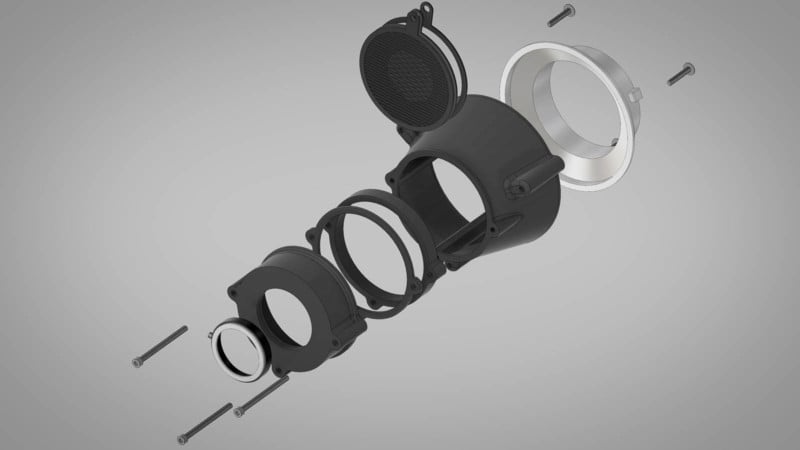
Image Courtesy of Petri Damsten
To successfully build his own DIY custom GOBO holder and GOBOS, Damsten turned to 3D printing, using a desktop Prusa FDM printer and PETG plastic. PETG was preferred to PLA since it can withstand higher temperatures, and if black filament is used for the adapter, it also provides the necessary opaqueness required. The adapter, mounts, GOBO holder and rings, were all designed in Fusion 360, and were designed to fit with a Bowens mounting ring, and macro extension tubes for a Nikon F mount. Using his own custom 3D printer, Damsten claims the cost of developing these parts DIY could be as low as $30.
Technical Challenges and Solutions
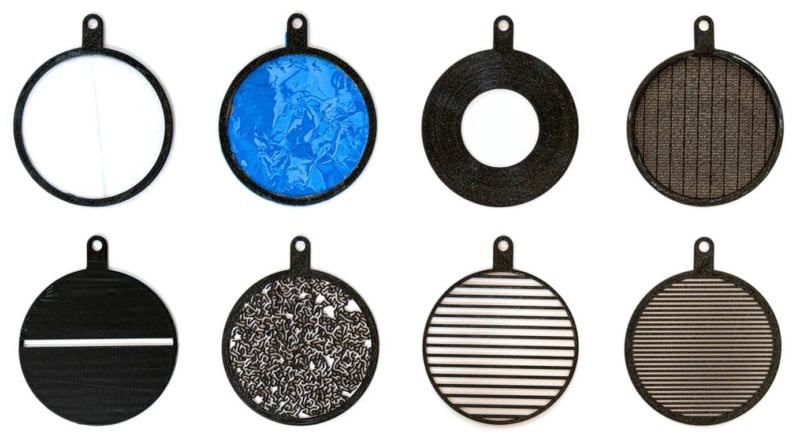
The adapter has multiple slots for GOBOS to be inserted between the strobe and the lenses. In this design, three GOBO slots were made, one for diffusion and the other two for patterns or gels. The GOBOs, able rotate 180 degrees in their slots, had 3D printed rings onto which diffusion fabric, gels or laser printed images were glued. With Fusion 360, SVG files can be used to import graphics and 3D print a complete GOBO.
Material Properties and Performance
Image Courtesy of Petri Damsten
M5 threads were printed directly into the plastic, with threaded rods adding rigidity to the whole length of the adapter, proving robust enough for occasional assembly/disassembly. Though the macro extension tube was cheap, Damsten recommends that, if the device is to be used frequently, more robust parts would be required and it may be better in that case to purchase strobe, lens or macro ring mounts as opposed to printing them in plastic.
Industrial Applications and Use Cases
Image Courtesy of Petri Damsten

Raw Photo. Image Courtesy of Petri Damsten

Comparing Metal AM to Traditional Manufacturing
Final photograph. Image Courtesy of Petri Damsten
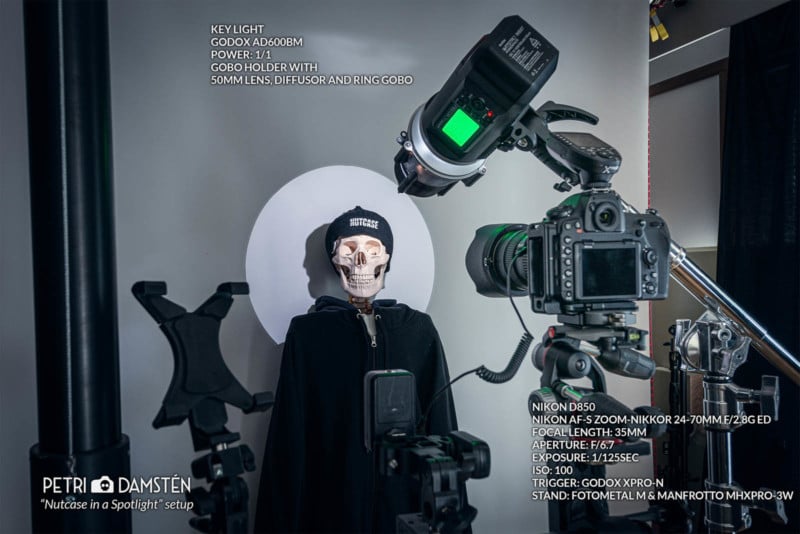
With Damsten’s approach, custom patterns, graphics and GOBO adapters can be 3D printed by individuals to suit each occasion or event, and customized to fit with static or dynamic light fixtures or photography devices. In this case, he used the GOBOs to take portrait photographs of himself and his skeleton model ‘Frank’ with really interesting and fun results.
DIY 3D printing projects such as this, shared with the public, truly make cutting-edge solutions accessible and affordable to individuals globally, like never before. At this end of the spectrum, it empowers photographers by enabling them to design or customize cameras, lighting fixtures, accessories, or innovations entirely on their own, while at the other end, advances in 3D printing technology, as applied to photography, now mean that an entire camera can be 3D printed, including the lens.
The post 3D Printed GOBO Projector Holder and Adapter Made by Award-Winning Finnish Photographer appeared first on 3DPrint.com | The Voice of 3D Printing / Additive Manufacturing.
Future Developments in Metal Additive Manufacturing
from Your daily news from 3DPrint.com https://bit.ly/3l2DCoy
Related Articles
Frequently Asked Questions
What is metal 3D printing?
Metal 3D printing (additive manufacturing) builds metal parts layer by layer using techniques like laser powder bed fusion, directed energy deposition, and binder jetting. It enables complex geometries impossible with traditional manufacturing while reducing material waste significantly.
How strong are 3D printed metal parts?
3D printed metal parts can achieve mechanical properties comparable to traditionally manufactured metals. Tensile strength and fatigue resistance depend on the process and post-processing, but many meet or exceed ASTM standards for wrought materials.
What are the main metal 3D printing technologies?
The primary technologies include Laser Powder Bed Fusion (LPBF), Electron Beam Melting (EBM), Directed Energy Deposition (DED), Binder Jetting, and Metal FDM (with bound filaments). Each has different strengths in terms of resolution, speed, and material options.
📌 Related Articles
- Best 3D Printer Upgrades That Actually Improve Print Quality: Complete 2026 Guide
- 3D Printing Tungsten Carbide: How Hot-Wire Laser Technology Creates Metal Harder Than Steel
- Best Budget 3D Printer Upgrades That Actually Improve Print Quality: Belts, Springs, Hotends & More
- Prusa Research Mini+ vs Prusa MK4: Full Specs Comparison & Buyer’s Guide
- ABS 3D Printing Settings Guide: Temperature, Enclosure, and Cooling for Strong Parts