
This week, during the 8th Additive World Conference in Eindhoven, the winners of the Additive World Design for Additive Manufacturing Challenge 2020 were announced virtually by Ultimaker’s Steven van de Staak, the Chairman of the Jury for the contest. Additive World is an initiative of Additive Industries, which holds the annual design challenge for the purpose of increasing industrial 3D printing examples, in hopes of inspiring other industries to create dedicated AM applications. There are two categories – one for students and one for professionals – and the participants are challenged to redesign a conventional machine or product part for 3D printing.
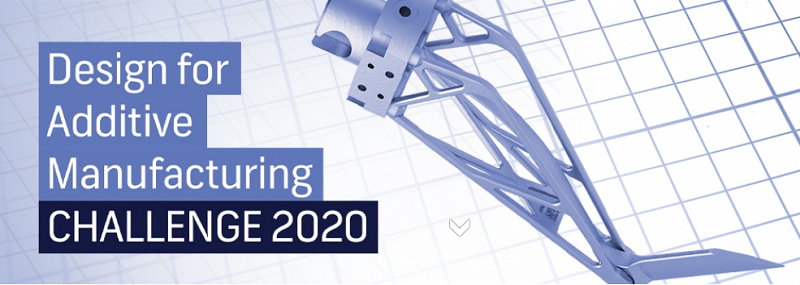
The professional six-member jury watched the pitch videos for the designs of six finalists, three in each category; you can see these designs in the image below. From left to right, top row to bottom, the finalist designs are:
- “Laser Welding Head,” Jaap Bulsink, K3D Bihca (Netherlands, professional category)
- “Media Block,” Nina Uppenkamp, SMS Group (Germany, professional category)
- “Expandable Intervertebral Cage,” Donatien Campion, 3DMedLab (France, professional category)
- “Hip Implant Stem Design,” Younes Chahid, BiomimeticAM (UK, student category)
- “Stabilizer Mount,” Dong Zhang, SCUT Robotlab, (China, student category)
- “Brake Caliper,” Samir Mulgaonkar, Sunriser (US, student category)
How 3D Printing Responded to COVID-19
Finalists
After evaluating the finalists’ designs to see if they have what Additive Industries calls “the distinctive features and freedom additive manufacturing has to offer,” made a unanimous decision in each category.
“The winning designs are inspiring use cases of industrial 3D metal printing,” the company writes.
HP and the Pandemic Manufacturing Shift
The winner of the professional category, for the second year running, is Dutch company K3D and its Laser Welding Head design, efficiently printed without supports and created for precision components supplier Hittech Bihca. While there were other excellent designs, this particular application has several features that set it above the rest: namely conformal cooling channels, functional integration, improved performance, lightweight, and optimized local porosities. The judges believe that the application, which could not be produced through any other method than 3D printing, “made a strong business case and design in a real, industrial application.”
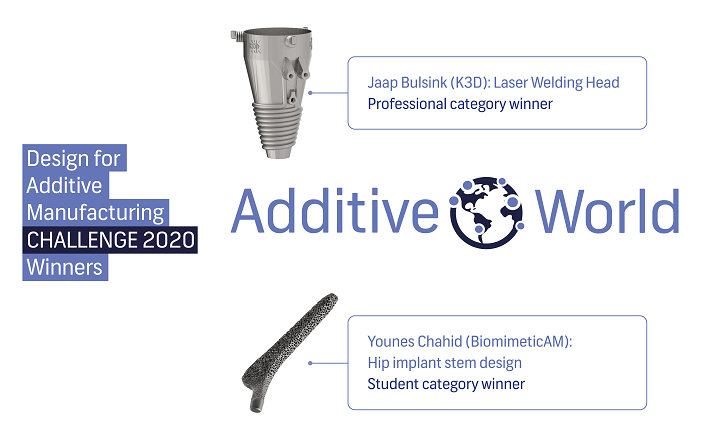
Chahid from UK-based BiomimeticAM won first prize in the student category for his Hip Implant Stem design. This “highly functional” piece, which is optimized for metal AM with different lattice densities and thicknesses for better bone ingrowth, can help shorten operation and recovery times, which in turn helps to improve patients’ lives. The design can be printed without supports, and since it can be nested, is able to maximize the amount of parts per build; this also helps lower the total cost per part, so it can “allow for democratising this for patients around the world.”
Nina Uppenkamp with Germany’s SMS Group received an honorable mention for her redesigned Media Block, which the judges call a “great design with a compelling business case.” Both the original part, and the redesign, were “functionally tested and compared,” and Uppenkamp’s design is optimized for metal AM.
“Her presentation was also amongst the best we have seen, very concise and professional,” Additive Industries wrote.
Supply Chain Disruptions and Digital Solutions
All six finalists received a free software license for Altair Inspire and Autodesk Netfabb. See also: ABS 3D Printing Settings Guide: Temperature, Enclo…. The two winners received the 3D printed Award and a 3D printing starter-pack from MakerPoint, while student winner Chahid took home an Ultimaker 2+ printer and the professional K3D team received an Ultimaker S3.
 Registration is currently open for the Additive World Design for Additive Manufacturing Challenge 2021. Once you register, you’ll receive a copy of the challenge manual, which includes important contest deadlines, rules, and requirements. Participants can send in their Submission Forms, motivations, and (re)designs through February 1, 2021. Please email designchallenge@additiveindustries.com if you have any questions.
Discuss this story and other 3D printing topics at 3DPrintBoard.com or share your thoughts in the Facebook comments below.
(Source/Images: Additive Industries)
Medical PPE and Equipment Production
The post 2020 Additive World Design for Additive Manufacturing Challenge Winners Announced Virtually appeared first on 3DPrint.com | The Voice of 3D Printing / Additive Manufacturing.
Frequently Asked Questions
How did 3D printing help during COVID-19?
During the COVID-19 pandemic, 3D printing enabled rapid production of critical medical supplies including face shields, ventilator components, nasal swabs, and PPE. Distributed manufacturing allowed makers worldwide to produce items locally without waiting for traditional supply chains.
What was the pandemic digital manufacturing shift?
The pandemic accelerated adoption of digital manufacturing including 3D printing, as companies sought more resilient supply chains. Organizations shifted from centralized to distributed production, using digital files to produce parts locally on demand.
Can 3D printing supply chains be resilient in emergencies?
Yes, 3D printing provides supply chain resilience through distributed manufacturing — designs can be shared digitally and produced anywhere with compatible equipment, eliminating the need for physical inventory and shipping of parts.
📌 Related Articles
- The Current State of Metal 3D Printing in 2020
- ABS 3D Printing Settings Guide: Temperature, Enclosure, and Cooling for Strong Parts
- Best 3D Printer Upgrades That Actually Improve Print Quality: Complete 2026 Guide
- 3D Printing Tungsten Carbide: How Hot-Wire Laser Technology Creates Metal Harder Than Steel
- Best Budget 3D Printer Upgrades That Actually Improve Print Quality: Belts, Springs, Hotends & More