

Switzerland-based JellyPipe, an online B2B marketplace connecting customers with 3D printing solution providers, resellers, and service providers, is now expanding its presence beyond continental Europe to UK and Ireland. The platform has successfully served over 5,500 clients since being founded in 2018, primarily in Germany, Austria, Switzerland and Italy until now. Currently, the company is focusing on recruiting 3D printing solutions and service providers in the UK & Ireland to onboard onto their platform.
Understanding Filament Properties
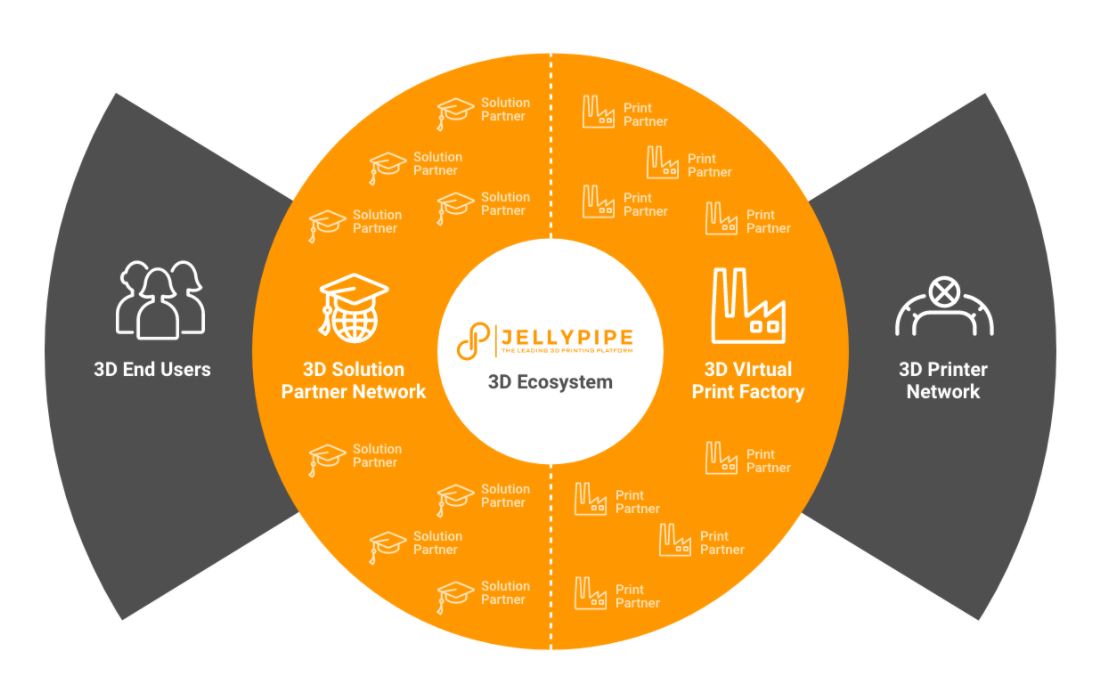
3D Printing Ecosystem – JellyPipe. Image courtesy of JellyPipe.
At present, the platform offers 63 material options, 14 technologies, and 132 experts or 3D solution partners on its platform. Customers first choose a 3D solution partner based on the country, consulting requirement (research, production, engineering etc) and industry.

Material Comparison and Selection
JellyPipe order platform. Image courtesy of JellyPipe.
What this also enables is for experts in 3D printing to setup virtual shops on JellyPipe’s platform where users, once matched, can upload their files to receive guidance on any repair or improvement for a part, as well as a range of quotes from the service providers to choose from.
While there have been similar connecting networks or marketplaces, such as 3DHubs, JellyPipe’s B2B platform is unique in that it has a strong focus on providing consultative services to end-customers through a 3D solution partner who is a certified engineer and an expert in 3D printing. Their consultative network enables customers to understand and select the best suited 3D printing process, material or design considerations for their application— advice and knowledge that is critical to optimizing projects and to meeting customer expectations efficiently.
Print Settings and Optimization
The customer primarily connections and communicates with the 3D solution partner as their point of contact with JellyPipe, who provide unbiased support in design optimization, process, post-process or material selection specific to the customer requirement. Then the order is sent out to a manufacturing network of 3D printing service providers and, once quotes are received, the customer can choose based on pricing or lead times. The platform uses a complex, secure, software engine, with fully automated tools to make the consulting, DfAM guidance, vendor selection and order process as simple as possible. George Benz, president and co-founder of JellyPipe, views this ease-of-use as critical:
“Simplicity is the absolute key behind Jellypipe’s success. The number of 3D printing service suppliers in our ecosystem means that customers have access to 13 different additive manufacturing processes, and 50 different printable plastic or metal materials. Time and costs are optimised as they will always receive a fastest delivery or best price offer, and ordering really couldn’t be more simple — upload the file, it is checked and if necessary repaired and then the order placed, all free of charge. We ensure that customers communicate with 3D printing solutions providers instead of direct with service providers in order to receive impartial professional advice on specific applications, limits, and optimisation of 3D printing for their specific requirements.”
Strength and Durability Testing
Remarking ahead of the expansion into the UK and Ireland, Benz said:
“We are delighted to bring the Jellypipe 3D printing platform to the United Kingdom and Ireland. Since 2018, Jellypipe has been working in continental Europe, and this is an important step for us as we work towards our platform being used globally. The principal behind Jellypipe is very simple, but is made possible by some extremely complex and intricate software which is the engine that makes using our platform so intuitive and rewarding commercially for all parts of the 3D printing ecosystem we host. Users of Jellypipe can easily access a huge resource of knowledge, advice, and consultation to ensure that the correct materials, 3D printing technology, and finishing is selected, and then receive quotes from the most extensive network of 3D printing service providers based on speed of delivery or lowest cost. It really couldn’t be more powerful or more simple to engage.”
Cost and Availability Considerations
Since 2018, when JellyPipe was launched, the company has been doubling its revenue and number of orders every quarter and looked to break-even early in the first quarter of 2020. As it looks to expand into further regions, it’d be interesting to see how the advantages of a 3D solution partner/consultant service plays out for end users, as compared to other marketplace platforms, especially with DfAM guidance increasingly critical as customers now look towards production using 3D printing.
The post Swiss-based JellyPipe Expands B2B 3D Printing Marketplace to UK appeared first on 3DPrint.com | The Voice of 3D Printing / Additive Manufacturing.
from 3DPrint.com | The Voice of 3D Printing / Additive Manufacturing https://bit.ly/3caNF6G
Related Articles: Protolabs Expands European Presence with Larger German 3D Printing Operations · Due Pi Greco expands from prototyping to production with Stratasys Carbon Fiber 3D printing · nScrypt Expands 3D Printing Presence in Asia Thanks to Distribution Agreement
Frequently Asked Questions
What is the best 3D printing filament for beginners?
PLA is the best starting filament — it prints easily at 190-220°C without an enclosure and produces good results. Once comfortable, PETG offers better strength and temperature resistance for functional parts.
How do I choose the right filament?
Consider the application: PLA for display models, PETG for functional parts, ABS/ASA for heat/sunlight exposure, TPU for flexible parts, and specialty filaments for engineering applications. Each has specific printer requirements.
What temperature should I print different filaments at?
PLA: 190-220°C nozzle / 50-60°C bed. PETG: 220-250°C / 70-80°C. ABS: 230-260°C / 100-110°C (enclosure needed). Nylon: 240-270°C / 70-90°C. Always check manufacturer recommendations for specific brands.
📌 Related Articles
- The Current State of Metal 3D Printing in 2020
- ABS 3D Printing Settings Guide: Temperature, Enclosure, and Cooling for Strong Parts
- Best 3D Printer Upgrades That Actually Improve Print Quality: Complete 2026 Guide
- 3D Printing Tungsten Carbide: How Hot-Wire Laser Technology Creates Metal Harder Than Steel
- Best Budget 3D Printer Upgrades That Actually Improve Print Quality: Belts, Springs, Hotends & More