
/
Results and Key Findings
/
/
Applications and Use Cases
/
Results and Key Findings
/
/
/
Results and Key Findings
/
/
Technology and Innovation
/
Results and Key Findings
/
/
Applications and Use Cases
/
Results and Key Findings
/
/
/
Results and Key Findings
/
/
/
Results and Key Findings
/
/
Applications and Use Cases
/
Results and Key Findings
/
/
/
Results and Key Findings
/
/
Research and Development
/
Results and Key Findings
/
/
Applications and Use Cases
/
Results and Key Findings
/
/
/
Results and Key Findings
/
/
Technology and Innovation
/
Results and Key Findings
/
/
Applications and Use Cases
/
Results and Key Findings
/
/
/
Results and Key Findings
/
/
/
Results and Key Findings
/
/
Applications and Use Cases
/
Results and Key Findings
/
/
/
Results and Key Findings
/
/
/
Results and Key Findings
/
/
Applications and Use Cases
/
Results and Key Findings
/
/
/
Results and Key Findings
/
/
Technology and Innovation
/
Results and Key Findings
/
/
Applications and Use Cases
/
Results and Key Findings
/
/
/
Results and Key Findings
/
/
/
Results and Key Findings
/
/
Applications and Use Cases
/
Results and Key Findings
/
/
/
Results and Key Findings
/
Italian researchers from the Department of Mechanical and Aerospace Engineering, Politecnico di Torino, explore the use of sensors in 3D printing for medical applications. Authors G. De Pasquale, A. Buffon, and L. Bongiorni have recently published the results of their study in a short white paper, Sensors integration in additive DMLS metal parts.
/
Technology and Innovation
/
/
Technology and Innovation
/
Key Highlights and Main Points
/
Technology and Innovation
/
In this study, one sensor was considered for both “high temperature exposure and even high cost,” while the other was meant for basic, more affordable use. The researchers experimented with encapsulating the sensors into specimens fabricated during the study, with the goal of:
/
Technology and Innovation
/
-
/
- Calibrating the 3D printing process with accurate parameters and operations
- Optimizing integration of the sensor during 3D printing
- Supporting validation of sensing performances afterward
Technology and Innovation
/
/
Technology and Innovation
/
/
Technology and Innovation
/
/
Technology and Innovation
/
/
Technology and Innovation
/
/
Technology and Innovation
/
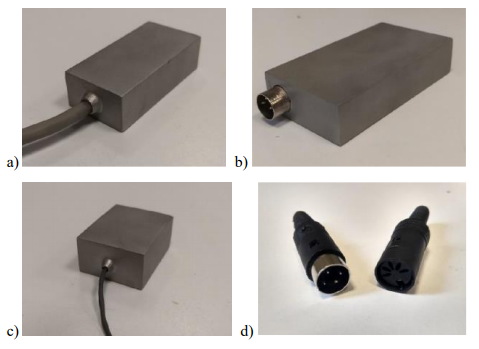
“The first sensor type is piezo-resistive thermal sensor PT100 with cylindrical probe with 5.90 mm diameter and 30.3 mm length,” explained the authors. “The probe is connected by wire with special thermal insulation protection based on silicon. The second sensor type is general purpose piezo-resistive accelerometer with standard electric cable.”
/
Technology and Innovation
/
/
Technology and Innovation
/
/
Technology and Innovation
/
Samples of 17-4PH parts with integration of thermal sensor (a, b) and inertial sensor (c) and 3-poles connector (d).
/
Technology and Innovation
/
/
Technology and Innovation
/
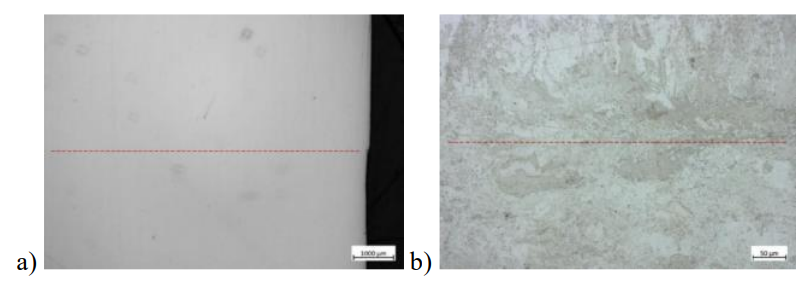
During the study, the researchers found that with SLM optimization, they were able to prevent material alterations sometimes caused to the structure of the part when foreign bodies were introduced into the metal. The 17-4PH samples were polished and finished, and then evaluated by using a 12.5x magnification factor to examine the density of the materials, as well as a 200x magnification factor to analyze surface microstructure.
/
Technology and Innovation
/
Density was found to be at 100%, with no sign of pores or “discontinuities.” The researchers reported a minor shift between surface layers during printing, but the problem was easily fixed through additional mechanical surface tooling; otherwise, the metal part was found to be “homogenous, and without defects.”
/
Technology and Innovation
/
/
Technology and Innovation
/
Surface micrographs at 12.5x (a) and 200x (b) magnification factors.
/
Technology and Innovation
/
/
Technology and Innovation
/
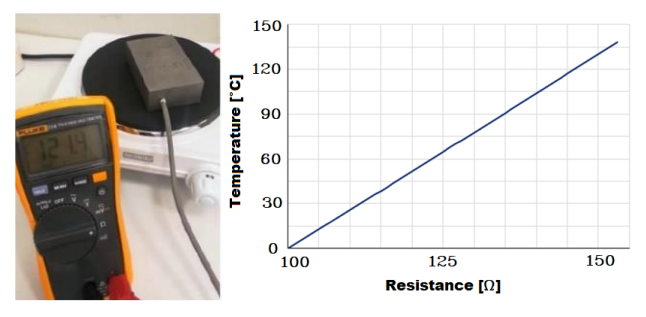
The thermal sensors were tested for functionality, focusing on performance in terms of precision, sensibility, and repeatability. The authors used an analog-to-digital converter, along with a heating plate to perform tests. Ultimately, they concluded that while users could feasibly integrate any type of electronics, applications could be improved with more advanced configurations.
/
Technology and Innovation
/
/
Technology and Innovation
/
“In particular, the sensing of wearable systems customized on the characteristics of the individual subject is an attractive application for the near future.”
/
Technology and Innovation
/
/
Technology and Innovation
/
/
Technology and Innovation
/
Functional validation of thermal sensors.
/
Technology and Innovation
/
/
Technology and Innovation
/
Find out more about 3D printing with sensors, from different types of materials being used to unique techniques being developed by researchers, and more.
/
Technology and Innovation
/
[Source / Images: Sensors integration in additive DMLS metal parts]
/
Technology and Innovation
/
The post Italian Researchers Integrate Sensors into 3D Printed Metal Structures appeared first on 3DPrint.com | The Voice of 3D Printing / Additive Manufacturing.
/
Technology and Innovation
/
from 3DPrint.com | The Voice of 3D Printing / Additive Manufacturing https://bit.ly/3iZnNg8
/
Technology and Innovation
/
Related Articles: University of Washington Researchers Analyze Effects of Powder Reuse on 3D printed Metal Parts · 3D Printed Surfboard: Researchers Test Different Bio-Inspired Core Structures · Hybrid 3D Printing Technique Creates Plastic-Metal Structures All at Once
Frequently Asked Questions
How is 3D printing used in robotics?
3D printing creates custom robot housings, grippers, gears, brackets, and structural components. It enables rapid prototyping of robot designs and production of lightweight, complex geometries that would be expensive with traditional manufacturing.
📌 Related Articles
- The Current State of Metal 3D Printing in 2020
- 3D Printing Tungsten Carbide: How Hot-Wire Laser Technology Creates Metal Harder Than Steel
- Best Budget 3D Printer Upgrades That Actually Improve Print Quality: Belts, Springs, Hotends & More
- 3D Printing News: Multi-Material Breakthrough and Aerospace Market Boom
- Best 3D Printer Upgrades That Actually Improve Print Quality: Complete 2026 Guide