
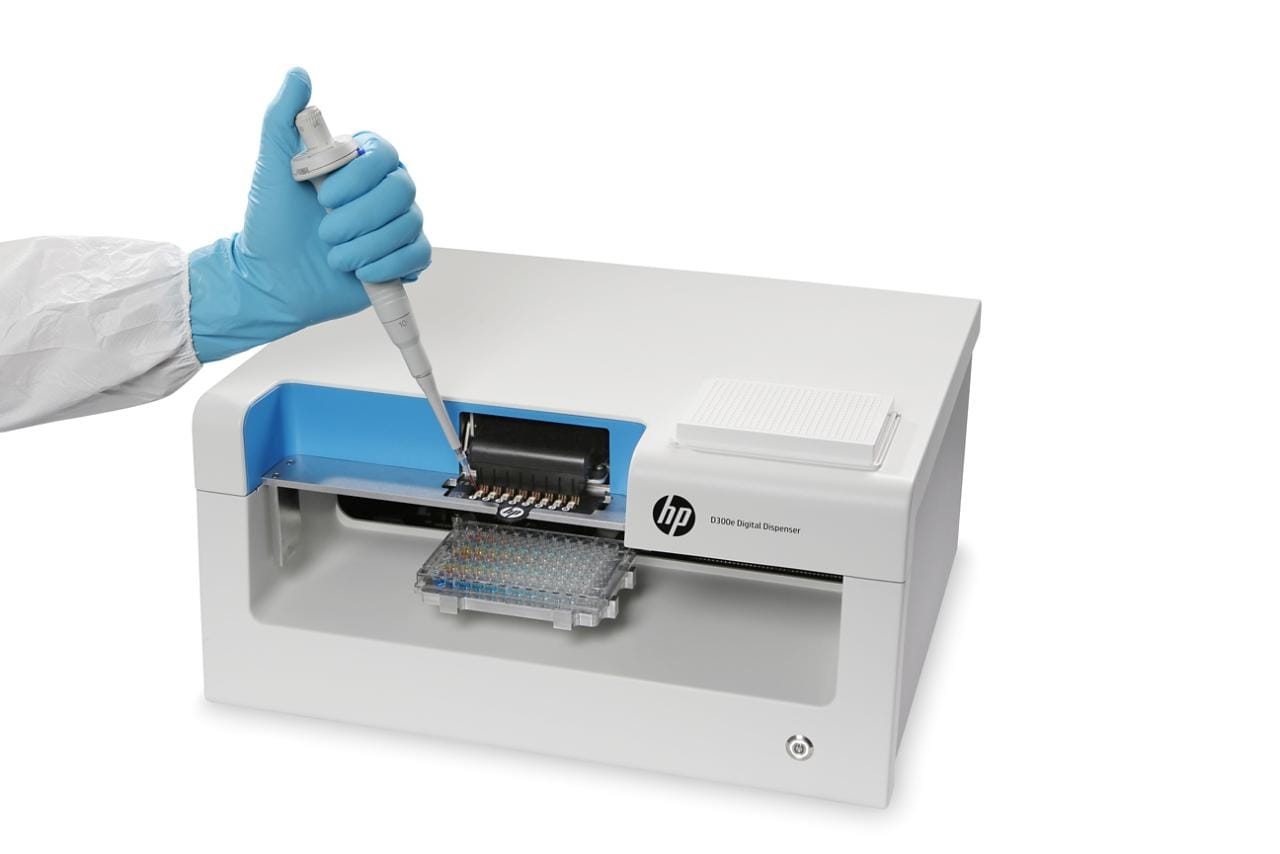
The result of years of research and development, the BioPrinter was created through a collaboration between HP’s Specialty Printing Systems (SPS), spearheaded by Annette Friskopp; the Microfluidics Technology and Operations (MTO) teams, and made in partnership with Tecan, a global provider of automated laboratory instruments and solutions. The D300e is a digital dispenser that uses inkjet printing technology and is the company’s first life science application in this domain, enabling automated laboratory dispensing to print pharmaceutical samples instead of ink.
It requires almost no set-up time and uses disposable dispense heads to minimize dead volumes and virtually eliminate the risk of cross-contamination, offering high quality, low volume dispensing for a wide range of applications. According to Tecan, the device eliminates up to six steps from the workflow for better speed, simplicity, efficiency, and productivity. Best of all, it operates with intuitive software that guides users through every operation, minimizing training times and increasing accessibility. It has built-in wizards that simplify the creation and execution of complex plate layouts and highlighted loading guides to identify the correct pipetting location for faster, simpler and more accurate operation.
The Role of 3D Printing in Medicine
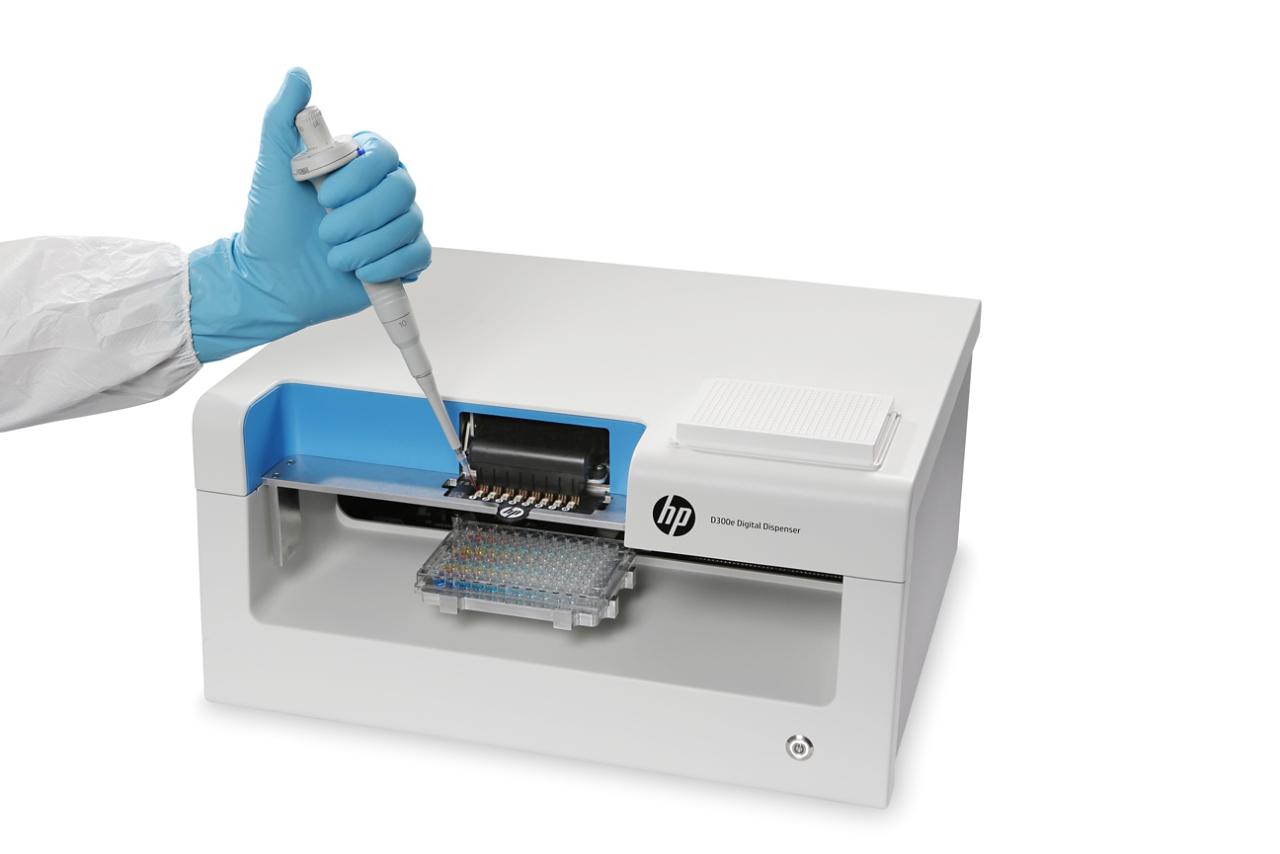
D300e BioPrinter (Image: HP)
The Director of Surgical Oncology Research Lab at UCSF, David Donner, leads a team that focuses on liver malignancies, particularly metastatic colorectal cancer that has metastasized into the liver and intrahepatic cholangiocarcinoma, and recently used the D300e’s automated lab dispensing to print pharmaceutical samples instead of ink to advance their work more efficiently.
“One of the challenges we face when studying these cancers is that, being in a clinical department, we are not interested in animal models and styding the characteristic of these particular cancer for decades, we’ve got patients who are in a hosptial now who need attention. So what we need to do is find drugs and drug combinations for each individual patient,” said Donner.

David Donner (Image: HP)
Biocompatible Materials and Processes
Donner went on to say that “personalized medicine is what we do: taking each patient’s specimen and isolating small spheroid groups called organoids, to then robotically load ultra low adherent tissue culture plates with individual orgaoinds. We want to screen libraries of drugs against each individual patient’s tumor specimen and that’s where the D300e comes in, allowing us to rapidly test libraries of drugs against each patient’s organoid and once we find an individual drug that seems to work well, we use that drug as a pole and rescreen our library to find something that will work well in conjunction with it. We are interested in synergies or at least additivities, because we want to kill the tumor and keep ahead of it. We want quality of life. We want cures. And the D300e is facilitating that.”
“All of the problems that we face with robotics, are overcome by using the D300e in conjunction with other robots that allows us to relatively rapidly loading organoids into tissue culture plates so that the D300e can also dispense drugs across those loaded organoids,” suggested the expert.
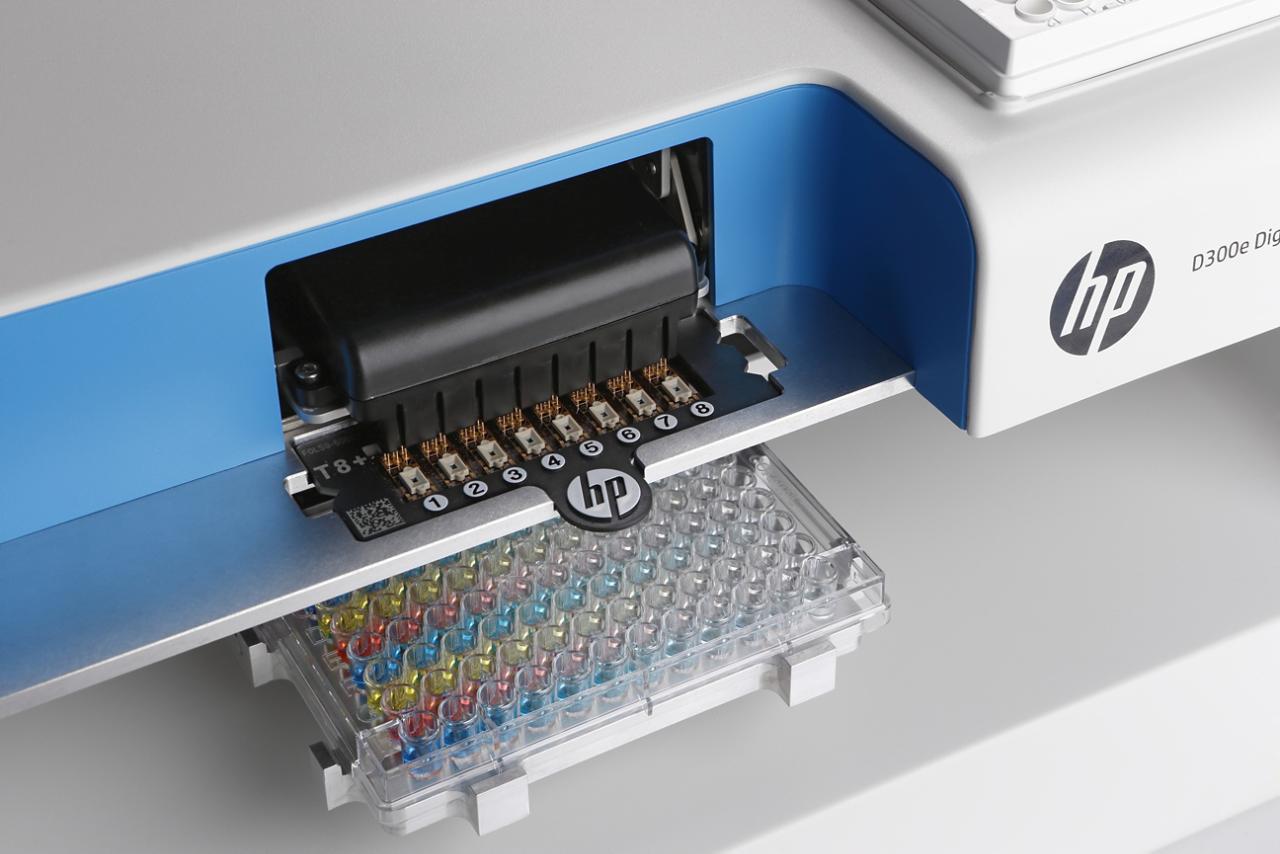
D300e BioPrinter dispensing system (Image: HP)
But it is not just UCSF using HP’s new bioprinter, labs and pharmaceutical companies all over the world already have it, including the Centers for Disease Control and Prevention (CDC) in the Antibiotic Resistance (AR) Lab Network, to perform antimicrobial susceptibility testing for health departments and hospitals nationwide.
According to the CDC, antibiotic resistance is one of the biggest public health challenges of our time. In the US alone, at least 2.8 million people get an antibiotic-resistant infection every year, and more than 35,000 people die. The CDC considers that fighting this threat is a public health priority that requires a collaborative global approach across sectors.
“It’s very exciting to see our inkjet printing technology support the CDC’s latest initiatives to help save lives,” asserted Todd Gustafson, President of HP Federal and Head of US Public Sector. “For over 75 years, HP has been enabling Federal organizations with technology that bring their missions to life. We’re honored to support the CDC in coming one step closer to more accelerated testing.”
Clinical Applications and Case Studies
For Jean Patel, microbiologist and science lead for CDC’s AR Laboratory Network, “bacteria continuously develop new ways to resist antibiotics.” The expert indicated that “once a drug is approved for use, the countdown begins until resistance emerges. In fact, resistance has even been detected before FDA approval.” He claims that to save lives and protect people, it is vital to make technology accessible to hospital labs nationwide. “We hope this pilot will help ensure our newest drugs last longer and put gold-standard lab results in healthcare providers’ hands faster.”
Both CDC and HP are making the D300e technology accessible to hospital labs nationwide. See also: The Current State of Metal 3D Printing in 2020. This is why Tuan Tran, President of HP Imaging, Printing and Solutions, considers that “applying technology in new and impactful ways is core to what we do at HP. The CDC’s use of HP Bioprinters epitomizes the power of print – pushing the boundaries of innovation while making the world safer, cleaner and healthier for all.”
The post HP’s New BioPrinter Helps Researchers Make Pharmaceutical Samples appeared first on 3DPrint.com | The Voice of 3D Printing / Additive Manufacturing.
Related Articles
Frequently Asked Questions
How is 3D printing used in medicine?
3D printing is used in medicine for surgical planning models, custom implants, bioprinting tissue scaffolds, drug delivery systems, dental aligners, and prosthetics. It enables patient-specific solutions that improve outcomes and reduce surgery time.
What materials are biocompatible for 3D printing?
Common biocompatible materials include PEEK, titanium alloys (Ti6Al4V), bio-ceramics (hydroxyapatite), medical-grade resins, PLA for temporary implants, and hydrogels for bioprinting. Material choice depends on the application and required mechanical properties.
Is 3D printed medical equipment FDA approved?
Yes, several 3D printed medical devices have FDA clearance, including orthopedic implants, dental restorations, and surgical guides. Each device must go through the appropriate regulatory pathway based on its risk classification.
📌 Related Articles
- Best 3D Printer Upgrades That Actually Improve Print Quality: Complete 2026 Guide
- The Current State of Metal 3D Printing in 2020
- Best Budget 3D Printer Upgrades That Actually Improve Print Quality: Belts, Springs, Hotends & More
- 3D Printing News: Multi-Material Breakthrough and Aerospace Market Boom
- 3D Printing Tungsten Carbide: How Hot-Wire Laser Technology Creates Metal Harder Than Steel