
International researchers are taking advantage of the next level beyond 3D printing to produce novel materials and structures, as outlined in the recently published ‘Reversible energy absorbing meta-sandwiches by FDM 4D printing.’
With a focus on reversible energy absorption applications, the authors fabricate ‘meta-sandwiches,’ developed from hyper-elastic polymers and elasto-plastic shape memory polymers.
Harkening to natural energy absorbers such as bones, teeth, hooves, and more, the scientists strive to create stable structures for use in cars and planes, make protective packaging, sports equipment, and more.
“The principle of energy absorption in meta-materials and lattice-based structures provides the capability to convert kinetic energy into other types of energies through elastic and/or plastic deformations, mechanical instability and structural collapse,” explain the authors.
Understanding Filament Properties
In recent work, plastic deformation in metal and plastics has been the route for energy absorption, using alloys like nickel-titanium (NiTi), or combining amorphous polymers and flexible elastomers. With 3D printing, however, scientists have been able to experiment with metamaterials and lattice-based structures with success in energy absorption.
Auxetic meta-sandwiches are evidence of a conceptual design made up of soft hyper-elastic polymers and elasto-plastic hard SMPs, accentuated with cold programming—and ultimately, the authors expect to see these concepts offer new benefits in the design process of reversible energy dissipation devices.
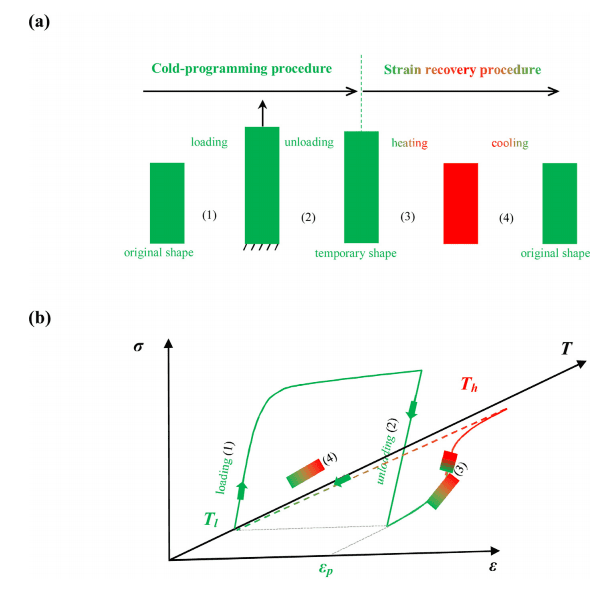
As smart materials that can deform and then return to their initial shape, SMPs were used here at room temperature ‘lower than their glass transition temperature.’ The researchers then heated it above transition temperature range until it reverted to its normal state.

Material Comparison and Selection
SMP cold programming: (a) thermomechanical procedure, (b) stress-strain temperature diagram.
“The dissipated energy through the plastic deformation of SMPs, revealed as a hysteresis loop, is considered as the energy absorption mechanism in this work,” explain the researchers. “The SME is also considered to introduce recoverable energy absorbers.”
The researchers used a 3DGence Double P255 (with dual interchangeable hotends for dual-material printing) for 4D printing their sample lattice-based energy absorbers.
Print Settings and Optimization
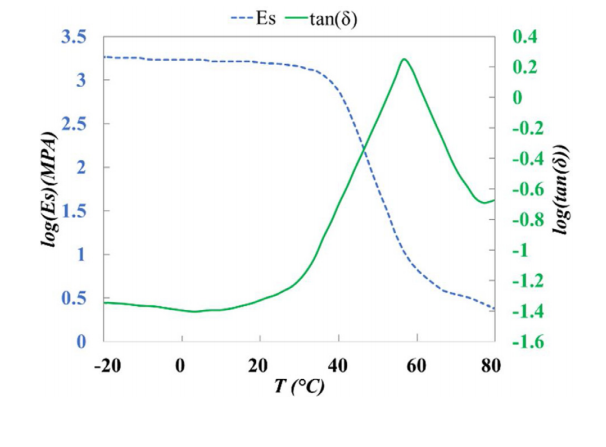
DMA measurement result on the 3D printed SMP in terms of storage
modulus (Es) and tan (𝛿).
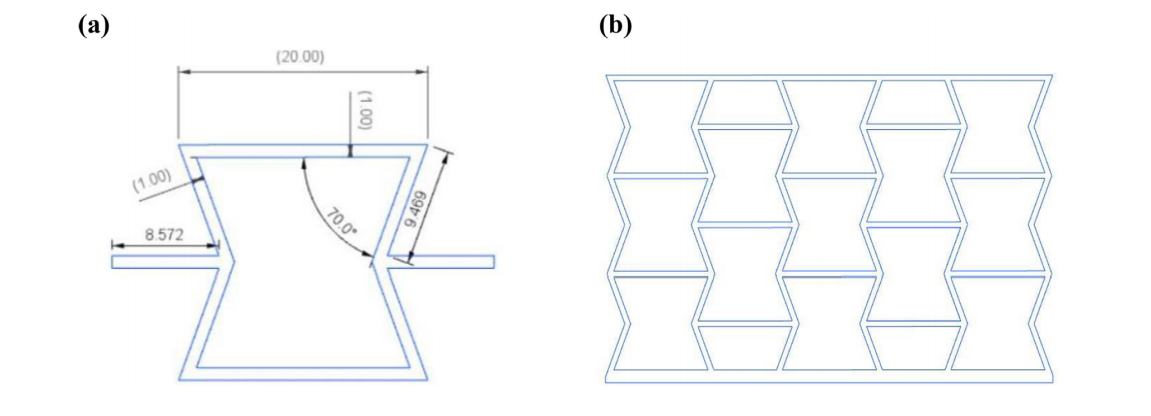
(a) Single unit cell and auxetic geometry, (b) lattice schematic
Evaluating the metastructures (both experimentally and numerically) showed that the designs offered the required non-linear stiffness and dissipating energy. Their experiments showed:
- Existence of the hysteresis loop
- Physics of snap-through instability
- Elasto-plasticity
“Comparison studies revealed that the main aspects of meta-sandwiches were well simulated in capturing yield stress, plateau during plastic deformation growth, unloading path and hysteresis area. It was also experimentally shown that the deformation and the dissipation processes are reversible opening an avenue for the design and implementation of recoverable energy dissipation devices for impact protection and shock mitigation applications,” concluded the researchers.
Strength and Durability Testing
“Due to the absence of similar concept and results in the specialized literature, this paper is likely to advance the state-of-the-art 4D printing tunable metasandwiches with reversible energy absorption features.”
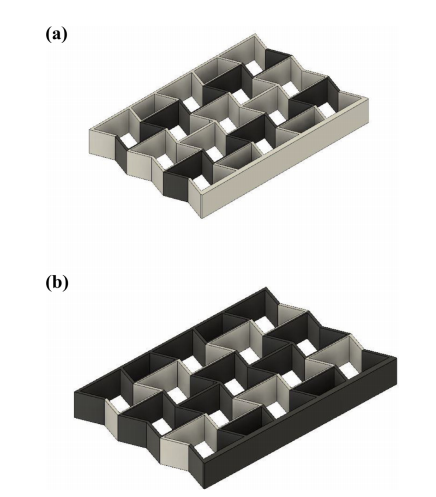
SMP meta-structure: (a)-(g) experimental and computational configuration, (h) force-displacement path for loading-unloading and thermal shape recovery (free strain recovery by thermal loading is represented by the red dash-dotted line), (i) dissipated and absorbed energies.
4D printing is one of the most exciting new areas to be inspired by 3D printing; and while it espouses much of the same technological processes, this is an area that seems even closer to magic, allowing for the use of exceptional metamaterials, magnetic actuators, composite materials, and more.
Cost and Availability Considerations
What do you think of this news? Let us know your thoughts! Join the discussion of this and other 3D printing topics at 3DPrintBoard.com.
[Source / Images: ‘Reversible energy absorbing meta-sandwiches by FDM 4D printing’]
The post FDM 4D Printing: Energy Absorbing Tunable Meta-Sandwiches Created appeared first on 3DPrint.com | The Voice of 3D Printing / Additive Manufacturing.
from Your daily news from 3DPrint.com http://bit.ly/2VspQkP
Frequently Asked Questions
What is the best 3D printing filament for beginners?
PLA is the best starting filament — it prints easily at 190-220°C without an enclosure and produces good results. Once comfortable, PETG offers better strength and temperature resistance for functional parts.
How do I choose the right filament?
Consider the application: PLA for display models, PETG for functional parts, ABS/ASA for heat/sunlight exposure, TPU for flexible parts, and specialty filaments for engineering applications. Each has specific printer requirements.
What temperature should I print different filaments at?
PLA: 190-220°C nozzle / 50-60°C bed. PETG: 220-250°C / 70-80°C. ABS: 230-260°C / 100-110°C (enclosure needed). Nylon: 240-270°C / 70-90°C. Always check manufacturer recommendations for specific brands.
📌 Related Articles
- The Current State of Metal 3D Printing in 2020
- Best Budget 3D Printer Upgrades That Actually Improve Print Quality: Belts, Springs, Hotends & More
- 3D Printing Tungsten Carbide: How Hot-Wire Laser Technology Creates Metal Harder Than Steel
- 3D Printing Safety Equipment Guide: Respirators, Gloves, and Ventilation for 2026
- Creality K2 Plus Combo Review: Multi-Color Mastery with Room to Spare