
Boston-based startup Markforged is growing rapidly, pulling in a whopping $82 million investment in March 2019. Now, the 3D printer manufacturer is getting some additional funds, though this time the amount won’t be disclosed because it comes from the highly secretive In-Q-Tel, Inc., the venture capital arm of the CIA.
Markforged announced that is has signed a strategic investment agreement with In-Q-Tel. The investment company, launched by the CIA in 1999, is involved with (sometimes controversial) projects across the government intelligence and security community. As we discussed in our series on In-Q-Tel, the company does not usually make public how much it invests in startups nor the specific role that it plays with those firms in which it invests.
However, our research suggested that average funds range between $500,000 to $3 million in exchange for equity in the company and an advisory role on the startup’s board. This allows In-Q-Tel to potentially guide product development and learn of any news before the public does.

Understanding Filament Properties
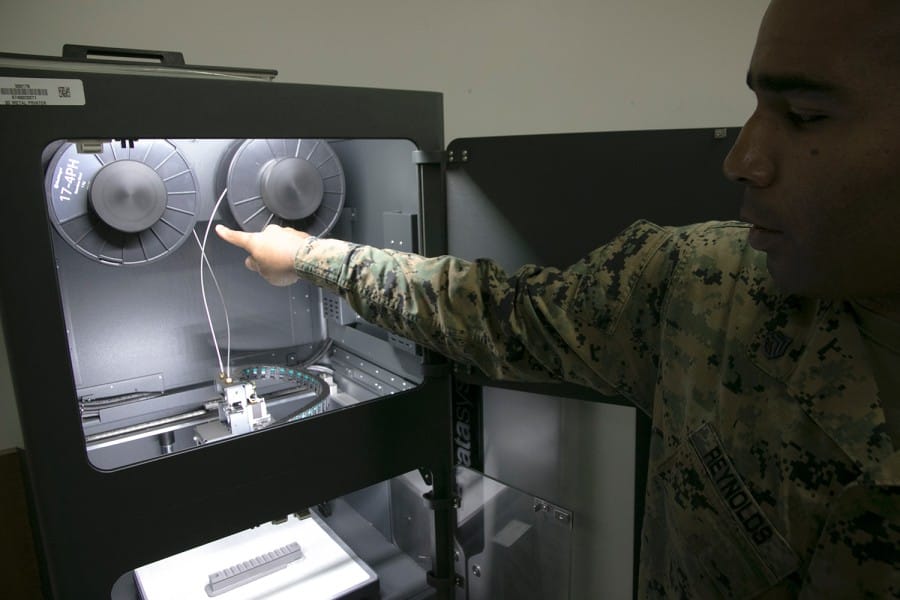
Quincy Reynolds with the Metal X 3D printer at Camp Kinser in Okinawa, Japan. Image courtesy of Matthew M. Burke/Stars and Stripes.
While Markforged has seen its technology deployed across a variety of industrial sectors, its low-cost metal 3D printing and fiber reinforcement systems have had strong success in the military and weapons sectors. According to the company, the U.S. military has hundreds of Markforged machines in operation, including the “first forward-deployed metal system to support combat operations and now has expanded its support operations to three continents.”
Given the sheer size of the U.S. military, it has funds to explore a wide range of 3D printing applications. Specifically, the III Marine Expeditionary Force is using the Metal X 3D printer as part of its repair services for U.S. occupation in the Asia-Pacific region. Having already worked with the U.S. military, then, it seems natural that Markforged would accept an investment from In-Q-Tel.
In-Q-Tel’s interest in Markforged also seems natural, as the investment vehicle has already provided funds for other startups in the space, including Voxel8, Fuel3D and Arevo. In particular, Arevo develops continuous carbon fiber 3D printing technology, though of a different variety than Markforged’s. Whereas Markforged has so far only released desktop-sized systems capable of continuous fiber reinforcement 3D printing, Arevo is focused on machines capable of printing entire bicycle frames. Moreover, Arevo uses a laser-mounted robotic arm to deposit pre-impregnated fiber reinforcement, while the Markforged process is more akin to traditional desktop FDM/FFF 3D printing.

Material Comparison and Selection
Guhring UK’s 3D-printed metal tools have been sent to customers for testing new concepts. See also: How Divergent Technologies Is 3D Printing Cruise M…. Image courtesy of Markforged.
The news comes on the heels of other exciting stories from Markforged, that include the recent release of pure copper for Metal X and the use of Metal X for 3D printing custom cutting tools for Guhring UK. At the beginning of February, Markforged became the first and, so far, only AM company to receive the ISO/IEC 27001 security certification, international standards signifying the ability of the company to ensure privacy, confidentiality, integrity, and availability across its product line. This includes its Eiger cloud printing platform, hardware, fleet management software, and information governance policies. Surely the startup was pursuing the certification ahead of its investment by In-Q-Tel, but it likely doesn’t hurt any interest the U.S. intelligence community might have had in Markforged.
The post CIA’s In-Q-Tel Invests in Markforged appeared first on 3DPrint.com | The Voice of 3D Printing / Additive Manufacturing.
Print Settings and Optimization
from Your daily news from 3DPrint.com http://bit.ly/2SCUuWI
Frequently Asked Questions
What is the best 3D printing filament for beginners?
PLA is the best starting filament — it prints easily at 190-220°C without an enclosure and produces good results. Once comfortable, PETG offers better strength and temperature resistance for functional parts.
How do I choose the right filament?
Consider the application: PLA for display models, PETG for functional parts, ABS/ASA for heat/sunlight exposure, TPU for flexible parts, and specialty filaments for engineering applications. Each has specific printer requirements.
What temperature should I print different filaments at?
PLA: 190-220°C nozzle / 50-60°C bed. PETG: 220-250°C / 70-80°C. ABS: 230-260°C / 100-110°C (enclosure needed). Nylon: 240-270°C / 70-90°C. Always check manufacturer recommendations for specific brands.
📌 Related Articles
- 3D Printing Tungsten Carbide: How Hot-Wire Laser Technology Creates Metal Harder Than Steel
- How Divergent Technologies Is 3D Printing Cruise Missiles for the U.S. Military
- The Current State of Metal 3D Printing in 2020
- Best 3D Printer Upgrades That Actually Improve Print Quality: Complete 2026 Guide
- Best Budget 3D Printer Upgrades That Actually Improve Print Quality: Belts, Springs, Hotends & More