
In February of 2020, the Australian Army announced a $1.5 million investment in Darwin- and Melbourne-based additive manufacturing company SPEE3D. The company worked with previous partners Charles Darwin University (CDU) and the Advanced Manufacturing Alliance (AMA) on developing a 12-month trial program, which was designed to test how feasible it was for Australian soldiers to deploy large-format metal 3D printers—specifically the WarpSPEE3D—in the field and on base.

The State of Metal 3D Printing
Australian Army Lance Corporal Sean Barton (R) and Craftsman Naythan Ryan (L) from the 1st Combat Service Support Battalion, prepare the Tactical WarpSPEE3D printer for operation during Exercise Buffalo Run at Mount Bundey Training Area, NT.
Since that time, soldiers from the Australian Army’s 1st Brigade have been learning how to use the technology, first at CDU, and then in a successful rapid deployment of the massive metal WarpSPEE3D printer earlier this summer during a brief field exercise 120 km southeast of Darwin. Now, SPEE3D just announced that the Australian Army has completed a second successful field deployment of its metal AM technology.
“This two-week exercise builds on the success of the first three-day trial in June and was the program’s first big test and further demonstrates the potential for this cutting-edge metal 3D printing technology to be deployed to the field by Defence Forces,” Aerin Langworthy, SPEE3D’s Marketing Manager, told 3DPrint.com in an email.
Technical Challenges and Solutions
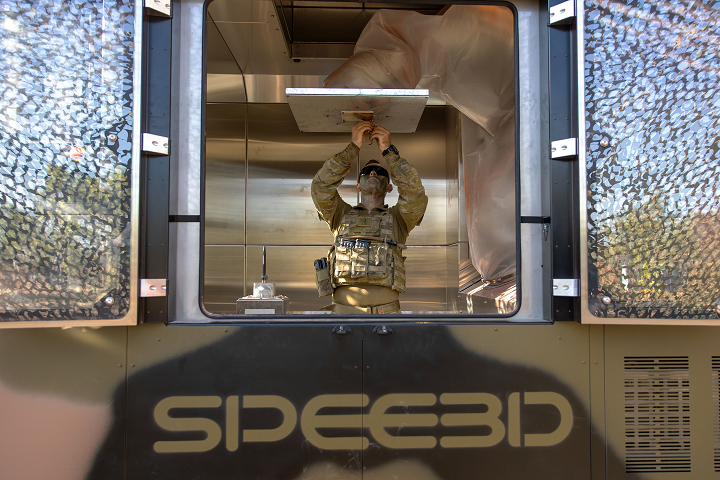
Australian Army Lance Corporal Sean Barton prepares the WarpSPEE3D printer for part assembly during Exercise Buffalo Run.
The goal of the Australian Army’s investment in SPEE3D’s patented supersonic 3D deposition (SP3D) process, based on cold spray technology, was to, as Langworthy wrote, “significantly increase the availability of unique metal parts to the Army compared to what the regular supply chain can provide.” With two successful field deployment exercises completed in a matter of months, I’d say things are going pretty well.
Material Properties and Performance
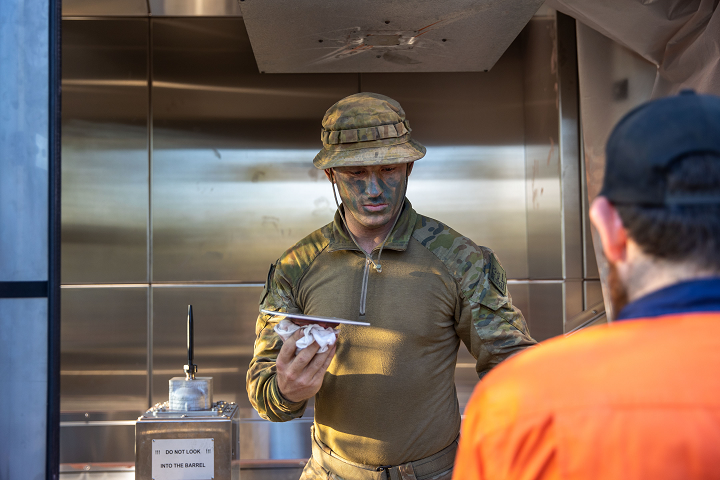
Australian Army Lance Corporal Sean Barton removes a newly 3D metal printed part from the WarpSPEE3D printer.
Soldiers with the Australian Army’s 1st Combat Service Support Battalion (CSSB)’s larger Brigade Support Group brought the WarpSPEE3D system, which can 3D print parts up to 1 x 0.7 m with its 265 mm high nozzle, to the Mount Bundey Training Area in the Northern Territory (NT) for Exercise Buffalo Run. There, in the humidity and high temperatures, the soldiers worked with the WarpSPEE3D in a two-week-long field exercise to make sure the system has what it takes to 3D print parts in extreme situations.

Industrial Applications and Use Cases
Australian Army Craftsman Naythan Ryan inspects a newly 3D printed part from the WarpSPEE3D printer.
Since its first deployment to Darwin in June, the large-format metal WarpSPEE3D 3D printer has received multiple modifications and upgrades, and this time around, the soldiers moved the system to multiple field locations, sometimes during 37°C days with 80% humidity. Once it was set up each time, they 3D printed and machined metal spare parts for military use.
“This second field deployment proves our technology is a genuine solution for expeditionary metal 3D printing,” SPEE3D’s CEO Byron Kennedy said in a press release. “This two-week trial demonstrates the WarpSPEE3D is a robust workhorse that is capable of printing real parts and solving real problems in the field. It also proves that soldiers can take control of the whole workflow of creating the spare parts they need, from design to printing and post-processing, right here where they need them.”
Comparing Metal AM to Traditional Manufacturing
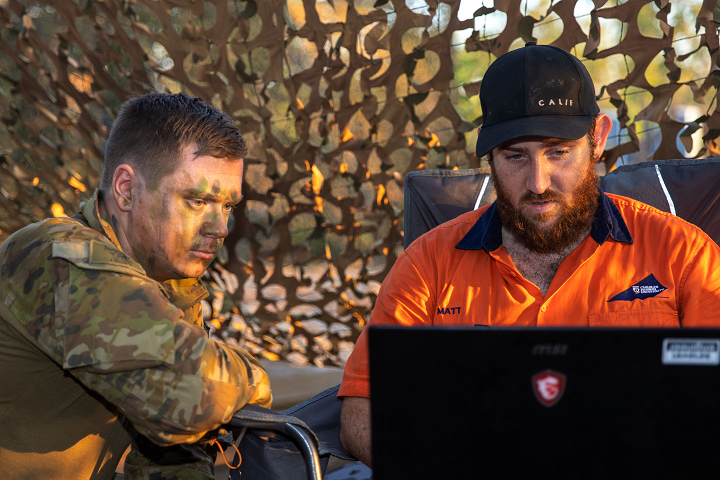
Australian Army Craftsman Naythan Ryan learns software design techniques from Matthew Harbidge, a 3D printing engineer from SPEE3D.
The WarpSPEE3D printer can fabricate large parts—up to 40 kg in weight—at a rapid rate of 100 grams a minute. See also: Best 3D Printer Upgrades That Actually Improve Pri…. Rather than using costly gasses and high-powered lasers, SPEE3D’s metal AM process makes use of kinetic energy and metal cold spray technology to ensure more affordable metal 3D printing, which we now know can be achieved out in the field. This unique method allows users to quickly 3D print industrial-quality parts out of metals, such as aluminum and copper, in only minutes, as opposed to days and even weeks.
Future Developments in Metal Additive Manufacturing
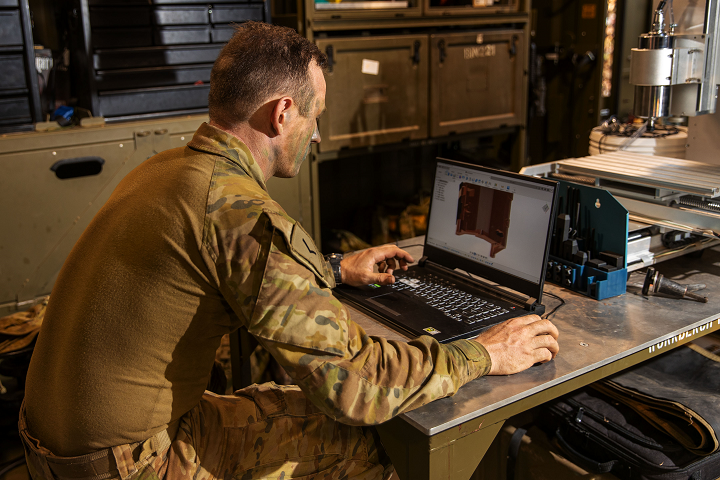
Australian Army Lance Corporal Sean Barton uses engineering software to design spare parts to be 3D printed inside a mobile workshop.
The Australian Army’s trial program with SPEE3D, CDU, and the AMA and is working to make sure that more unique parts are available to its soldiers than they could readily access using the normal supply chain. Using the company’s additive manufacturing technology enables them to do so in a more cost-effective, scalable way.
The State of Metal 3D Printing
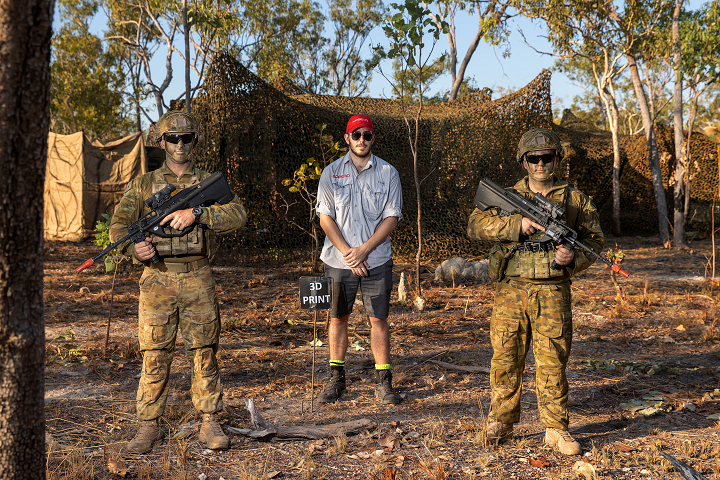
Australian Army Lance Corporal Sean Barton (L) and Craftsman Naythan Ryan stand with Louis Cianciullo from SPEE3D in front of a mobile 3D printing field workshop.
(Source: SPEE3D / Images: CPL Rodrigo Villablanca)
The post Australian Army Deploys WarpSPEE3D Metal 3D Printer in Second Field Test appeared first on 3DPrint.com | The Voice of 3D Printing / Additive Manufacturing.
from Your daily news from 3DPrint.com https://bit.ly/2D33a3A
Frequently Asked Questions
What is metal 3D printing?
Metal 3D printing (additive manufacturing) builds metal parts layer by layer using techniques like laser powder bed fusion, directed energy deposition, and binder jetting. It enables complex geometries impossible with traditional manufacturing while reducing material waste significantly.
How strong are 3D printed metal parts?
3D printed metal parts can achieve mechanical properties comparable to traditionally manufactured metals. Tensile strength and fatigue resistance depend on the process and post-processing, but many meet or exceed ASTM standards for wrought materials.
What are the main metal 3D printing technologies?
The primary technologies include Laser Powder Bed Fusion (LPBF), Electron Beam Melting (EBM), Directed Energy Deposition (DED), Binder Jetting, and Metal FDM (with bound filaments). Each has different strengths in terms of resolution, speed, and material options.
📌 Related Articles
- The Current State of Metal 3D Printing in 2020
- Best 3D Printer Upgrades That Actually Improve Print Quality: Complete 2026 Guide
- 3D Printing Tungsten Carbide: How Hot-Wire Laser Technology Creates Metal Harder Than Steel
- Best Budget 3D Printer Upgrades That Actually Improve Print Quality: Belts, Springs, Hotends & More
- 3D Printing News: Multi-Material Breakthrough and Aerospace Market Boom