
Electron beam melting (EBM) has a unique place in the additive manufacturing (AM) industry in that there is only one EBM hardware manufacturer (GE Additive subsidiary Arcam) and the technology is targeted primarily toward two industry segments: aerospace and orthopedics.
By targeting the orthopedics space, Arcam has won over a number of companies that use its technology specifically for 3D printing orthopedic implants. One of the latest to showcase its use of EBM for 3D printing implants in Maine-based Amplify Additive, which is applying over 20 years-worth of AM experience toward the orthopedics industry.
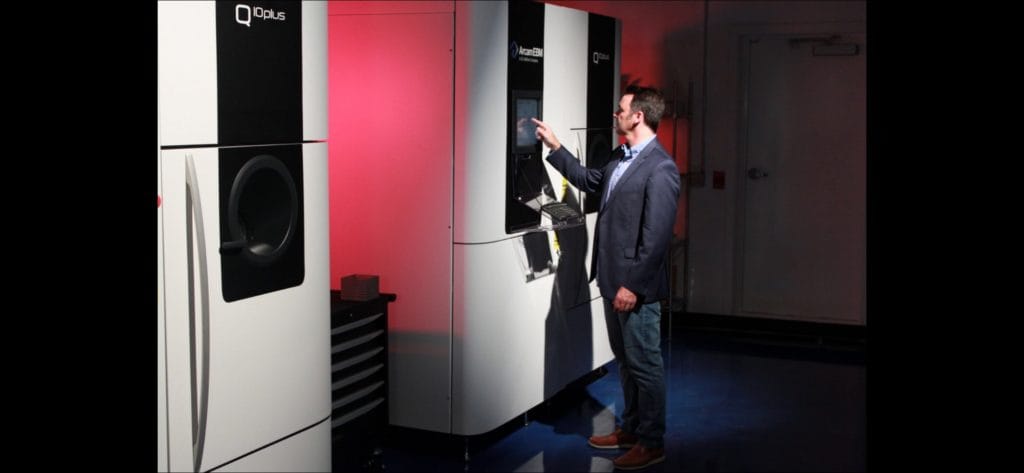
The company was founded in 2018 as a means of delivering additive solutions to the medical customers, advising them on design, supply chain strategies and how to improve time to market. Amplify opened its first production facility in 2019, which now runs three Q10plus machines and will be obtaining an ISO 13485:2016 certification.
The Role of 3D Printing in Medicine
According to founder Brian McLaughlin, Amplify Additive often acts as a go-between for doctors and designers because the organizations they work with don’t have the infrastructure necessary to run additive systems and produce end-use parts.

Biocompatible Materials and Processes
Amplify Additive’s Q10plus systems. Image courtesy of GE Additive.
“We often to act as the bridge between two very different disciplines – orthopedic surgeons and design engineers,” McLaughlin said. “Teams often have a shared vision, but uncertainty about how best to implement additive can sometimes present hurdles to overcome. We’re able to use that combination to add value and offer organizations solutions to overcome those hurdles – because we implicitly understand both sides of the conversation.”
According to SmarTech Analysis, the orthopedic segment of the additive manufacturing market generated nearly $200 million in 2016 and is expected to grow by about 30 percent CAGR until at least 2025. While AM will lead to an increasing amount of patient-specific medical treatments more broadly, EBM in particular has specific benefits for 3D-printed orthotics.

Clinical Applications and Case Studies
Series production of 3D-printed implants. Image courtesy of GE Additive.
The technology results in a rougher final texture directly from the print bed than metal parts printed with laser powder bed fusion, which in turn generates greater bone growth and adhesion (“osseointegration”). See also: 3D Printing Tungsten Carbide: How Hot-Wire Laser T…. Additionally, Arcam machines feature a scanning system that quickly switches the electron beam between surface locations and maintains a melt pool at the same time, allows for rapid fabrication. This, especially when combined with the stacking of parts within the build chamber, benefits serial production.
Amplify is aiming to position itself as an orthopedic center of excellence for AM in the U.S. and, later, around the globe. It doesn’t plan to limit itself to just one of Arcam’s two major verticals, however. After it establishes success in the orthopedic sector Amplify will target the aerospace market as well.
Regulatory Considerations and Safety
The post Amplify Additive Adopts Arcam’s EBM for Orthopedic Production appeared first on 3DPrint.com | The Voice of 3D Printing / Additive Manufacturing.
from Your daily news from 3DPrint.com http://bit.ly/2TahdbO
Related Articles
Frequently Asked Questions
How is 3D printing used in medicine?
3D printing is used in medicine for surgical planning models, custom implants, bioprinting tissue scaffolds, drug delivery systems, dental aligners, and prosthetics. It enables patient-specific solutions that improve outcomes and reduce surgery time.
What materials are biocompatible for 3D printing?
Common biocompatible materials include PEEK, titanium alloys (Ti6Al4V), bio-ceramics (hydroxyapatite), medical-grade resins, PLA for temporary implants, and hydrogels for bioprinting. Material choice depends on the application and required mechanical properties.
Is 3D printed medical equipment FDA approved?
Yes, several 3D printed medical devices have FDA clearance, including orthopedic implants, dental restorations, and surgical guides. Each device must go through the appropriate regulatory pathway based on its risk classification.
📌 Related Articles
- Best 3D Printer Upgrades That Actually Improve Print Quality: Complete 2026 Guide
- 3D Printing Tungsten Carbide: How Hot-Wire Laser Technology Creates Metal Harder Than Steel
- Best Budget 3D Printer Upgrades That Actually Improve Print Quality: Belts, Springs, Hotends & More
- 3D Printing News: Multi-Material Breakthrough and Aerospace Market Boom
- The Current State of Metal 3D Printing in 2020