
Quick Answer: What Are Specialty Engineering Filaments?
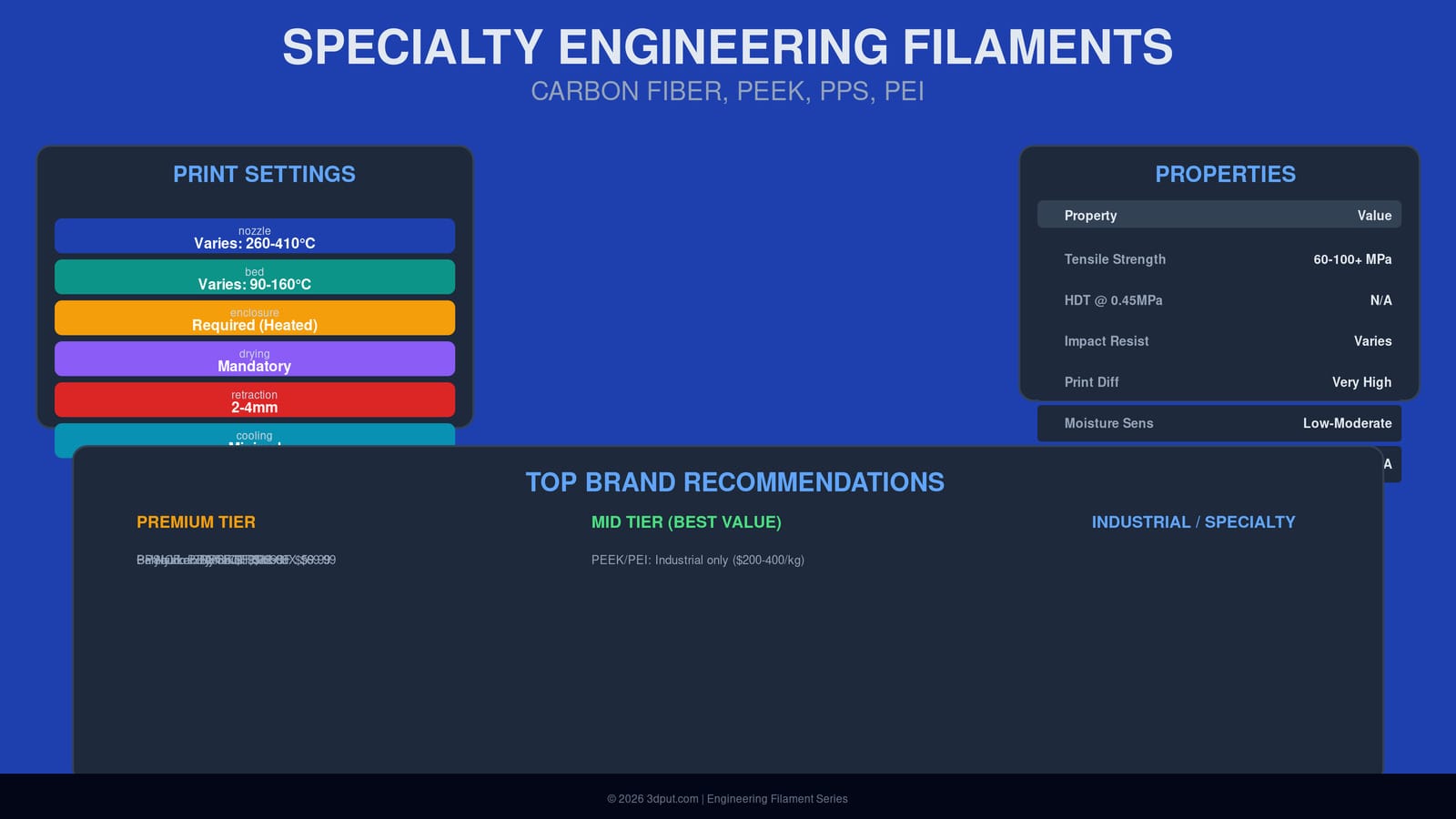
Specialty engineering filaments are ultra-high-performance 3D printing materials that include carbon fiber-reinforced composites, PEEK, PEI (ULTEM), PPS, and PVDF. These advanced polymers deliver aerospace-level stiffness, medical-grade temperature resistance (up to 400°C for PEEK), and exceptional chemical resistance, but they require specialized hardware like 300°C+ hotends, heated chambers, and hardened steel nozzles. Use specialty filaments when you need parts that can replace machined metals, withstand extreme environments, or meet stringent industry standards for aerospace, medical, or chemical processing applications. [1][2]
Introduction
Beyond the familiar engineering materials like nylon, polycarbonate, and ABS lies a world of ultra-high-performance 3D printing filaments. These “specialty” composites and advanced polymers push the boundaries of what’s possible with desktop and industrial FDM printing: carbon fiber reinforcement for aerospace-level stiffness, PEEK for medical-grade temperature resistance, PPS-CF for chemical processing applications, and more. [3]
These materials aren’t for every project—they demand specialized hardware (300°C+ hotends, heated chambers, hardened nozzles) and careful handling. But when you need parts that can withstand extreme conditions, replace machined metals, or meet stringent industry standards, these specialty filaments deliver where ordinary materials fail.
This comprehensive 2026 guide explores the cutting edge of engineering filaments. We’ll cover:
- Carbon Fiber Reinforced Polymers (CF-Nylon, CF-PC, CF-PETG, CF-PPS)
- PEEK and PEI (ULTEM) – high-performance polyimides
- PPS and PPS-CF – exceptional chemical resistance
- PVDF – fluoropolymer for aggressive chemical environments
- PEI (Ultem) – high-temperature strength
We’ll examine their properties, print requirements, top brands (Polymaker, 3DXTECH, Bambu Lab), typical applications, and whether these advanced materials are right for your projects.
Carbon Fiber Reinforced Polymers: Strength Without Weight
Carbon fiber (CF) reinforcement transforms standard thermoplastics into aerospace-grade composites by adding short carbon fibers (typically 10-30% by weight) to the polymer matrix. The result: dramatically increased strength, stiffness, and thermal stability with only a modest increase in weight and print difficulty. [4]
How Carbon Fiber Reinforced Filaments Work
Short carbon fibers (typically 100-200 microns in length) are mixed with thermoplastic pellets and extruded into filament. The fibers align primarily along the filament axis during extrusion, which means:
- Anisotropic properties: Strength and stiffness are highest along the filament direction (X-axis on most prints), lower across layers (Z-axis) [5]
- Improved layer bonding: CF filaments often have better interlayer adhesion than their unfilled counterparts due to fiber-mediated interlocking
- Increased shrinkage: CF reinforcement can increase warping tendency due to higher crystallinity and thermal conductivity
Common CF-Filled Materials
| Polymer Base | Typical CF Content | Benefits over Unfilled | Print Difficulty |
|---|---|---|---|
| Nylon (PA6/PA12) | 15-30% | +100-200% stiffness, +50% strength, lower moisture sensitivity | High |
| Polycarbonate (PC) | 10-20% | +80% stiffness, HDT 150-170°C | High |
| PETG | 15-25% | +100% stiffness, matte finish | Medium |
| ABS | 15-20% | +80% stiffness, increased heat resistance | Medium-High |
| PPS | 30% | Exceptional chemical resistance + stiffness | Very High |
Mechanical Properties Comparison (CF-Nylon vs Unfilled Nylon)
| Property | PA12 (unfilled) | PA12+CF15 | CF-PA6 | CF-PC |
|---|---|---|---|---|
| Tensile Strength | 45-50 MPa | 65-70 MPa | 60-70 MPa | 70-80 MPa |
| Tensile Modulus | 1500-1800 MPa | ~5000 MPa | ~4000 MPa | ~6000 MPa |
| HDT @ 0.45MPa | ~80°C | 150°C | ~140°C | 160-180°C |
| Print Difficulty | Medium | Medium-High | High | High |
CF-nylon and CF-PC are among the most practical CF composites for FDM printing—offering dramatic property improvements while remaining printable on capable hobbyist/enthusiast printers (vs. continuous CF which requires specialized equipment). [6]
Print Settings for Carbon Fiber Filaments
Carbon fiber reinforced filaments share several characteristics:
Nozzle Temperature: Typically 10-20°C higher than unfilled base polymer
- CF-Nylon: 260-280°C
- CF-PC: 270-290°C
- CF-PETG: 240-260°C
- CF-PPS: 300-330°C
Bed Temperature: Higher than base polymer, 10-20°C above typical
- CF-Nylon: 90-110°C
- CF-PC: 110-125°C
- CF-PETG: 80-95°C
- CF-PPS: 90-110°C
Enclosure: Highly recommended due to increased warping
- Target ambient 50-60°C for CF-Nylon, up to 70°C for CF-PC
Retraction: Shorter distances recommended (2-4mm) to avoid nozzle jams from fiber buildup
Critical: Hardened Steel Nozzle
Carbon fibers are abrasive. Standard brass nozzles will wear rapidly, becoming oversized and degrading print quality. Use hardened steel or ruby nozzles. [7]
Speed: Moderate speeds (30-60 mm/s) work best; CF filaments have higher melt viscosity
Top CF Filament Brands
| Brand | Product | Base Polymer | CF % | Price/kg | Nozzle Temp | Best For |
|---|---|---|---|---|---|---|
| 3DXTECH | CarbonX PA12+CF15 | PA12 | 15% | $69.99 | 260-280°C | Highest quality, aerospace applications |
| Polymaker | PolyMide PA6-CF | PA6 | ? | $39.99 | 250-275°C | Balanced performance, reliable |
| Bambu Lab | Nylon CF | PA6/PA12 blend | ~15% | $32.99 | 260-280°C | Optimized for Bambu enclosures |
| Bambu Lab | PC CF | PC | ~15% | $38.99 | 270-290°C | Great surface finish |
| MatterHackers | MH Nylon CF | PA6 | ? | $54.99 | 255-275°C | Consistent quality, service |
CF Filament Applications
- Functional prototypes with metal-like stiffness (but lighter)
- Drone and RC components (motor mounts, propeller guards)
- Robotics (arms, frames, structural components)
- Automotive (engine bay components, brackets, custom parts)
- Custom tools, jigs, fixtures that need high stiffness
- Replacement parts where original was GF-reinforced plastic or low-grade aluminum
- Aerospace amateur projects (when weight matters)
High-Performance Engineering Polymers: PEEK, PEI (ULTEM), PPS
PEEK (Polyether Ether Ketone)
PEEK is the king of 3D-printable thermoplastics. It’s used in aerospace, medical, oil & gas, and semiconductor industries for parts that must withstand extreme temperatures, chemicals, and sterilization. [8]
Properties:
- Continuous Use Temperature: Up to 250°C (some grades 300°C)
- Tensile Strength: 90-100 MPa
- Tensile Modulus: 3500-4000 MPa
- Chemical Resistance: Excellent—resists almost all chemicals except concentrated sulfuric acid
- Flame Resistance: UL94 V-0 rating
- Biocompatibility: FDA-approved for implantable medical devices (certain grades) [9]
Printing Requirements:
- Nozzle Temperature: 380-410°C
- Bed Temperature: 120-160°C
- Chamber Temperature: 120-150°C (actively heated)
- Nozzle: Hardened steel or ruby (high temp + abrasive if filled)
- Filament Drying: Mandatory (0.02% moisture target)
- Post-Processing: Annealing often required to achieve full properties
Available Brands:
- 3DXTECH CarbonX PEEK+CF10 (~$200-300/kg)
- Some industrial-grade suppliers
Applications:
- Medical implants (spinal cages, bone screws)
- Aerospace components (brackets, housings)
- Oil & gas downhole tools
- Semiconductor processing equipment
- High-performance automotive (under-hood, turbo components)
- Sterilizable surgical tools
Not for hobbyists unless you have a high-temperature printer (e.g., Apollo X, Raise3D Pro3 HS, Apium P220).
PEI (Polyetherimide) – ULTEM™ Brand
PEI (often sold as ULTEM, GE’s brand name) sits below PEEK in performance but is more approachable for capable industrial printers. [10]
Properties:
- Continuous Use Temperature: Up to 170°C
- Tensile Strength: 100-110 MPa
- Tensile Modulus: 3600-4000 MPa
- Flame Resistance: UL94 V-0 (inherently flame retardant without additives)
- Chemical Resistance: Good, though not as good as PEEK
- Density: ~1.27 g/cm³
Printing Requirements:
- Nozzle Temperature: 340-380°C
- Bed Temperature: 120-150°C
- Chamber Temperature: 100-130°C preferred
- Hardened steel nozzle recommended
Available Brands:
- 3DXTECH PEI (ULTEM)
- Various industrial suppliers
Applications:
- Aerospace interior components
- High-temperature functional prototyping
- Electrical insulation components
- Automotive under-hood parts (near engine but not directly contacting exhaust)
Again, not for typical hobbyist printers. Requires high-temperature hotend (400°C+) and heated chamber.
PPS (Polyphenylene Sulfide) and PPS-CF
PPS is a high-temperature, high-chemical-resistance polymer that bridges the gap between engineering materials (nylon, PC) and PEEK. [11]
Properties:
- Continuous Use Temperature: Up to 220°C (unfilled), 260°C short-term
- Heat Deflection Temperature: ~120°C unfilled; CF-reinforced up to 260°C
- Chemical Resistance: Outstanding—resists almost all chemicals except some chlorinated solvents at elevated temperatures
- Flame Resistance: Inherently flame retardant (UL94 V-0)
- Abrasion Resistance: Excellent
Printing Requirements:
PPS is notoriously difficult to 3D print due to high crystallinity and warping:
- Nozzle Temperature: 330-360°C
- Bed Temperature: 80-100°C (PPS can be printed without heated bed, but PEI sheet recommended)
- Enclosure: Mandatory (warping is severe)
- Filament Dryness: Critical—PPS is hygroscopic and moisture causes severe bubbling
PPS-CF (30% Carbon Fiber):
- Much easier to print than unfilled PPS
- Higher stiffness and strength
- HDT up to 260°C
- More dimensionally stable
Available Brands:
- Polymaker PPS-CF (CF-reinforced, $59.99/kg)
- Bambu Lab PPS-CF ($54.99/kg)
- 3DXTECH PPS-CF
Applications:
- Chemical processing equipment (valves, fittings, pump components)
- Semiconductor manufacturing (wafer handling, cleanroom parts)
- Automotive under-hood components
- Electrical connectors and insulators
- High-temperature, chemically hostile environments
PVDF (Polyvinylidene Fluoride)
PVDF is a fluoropolymer (related to PTFE/Teflon) with exceptional chemical resistance and weatherability, though less common in 3D printing due to processing challenges. [12]
Properties:
- Chemical Resistance: Excellent—resists most acids, bases, solvents, halogens
- Temperature Range: -40°C to 150°C continuous
- UV Resistance: Excellent (used in outdoor architectural applications)
- Purity: Low ionic contamination (semiconductor applications)
- Mechanical: Moderate strength, good abrasion resistance
Printing Difficulty: Very high. PVDF has narrow processing window, requires high temperatures, and is moisture-sensitive. Mostly used in specialized industrial settings.
Applications:
- Chemical tanks, piping, fittings
- Semiconductor wet stations
- Architecture (long-life outdoor components)
- Lithium-ion battery components
Not commonly available as consumer filament; industrial suppliers only.
Composite Material Trends for 2026
Short Fiber vs. Continuous Fiber
Short fiber (what we’ve discussed): Fibers are milled to ~100-200 micron length and mixed with polymer. Provides significant property improvements but still limited by short-fiber composite mechanics. Printable on standard FDM printers (with proper hardware).
Continuous fiber: Fibers remain continuous through the print (Markforged, Siemens NXG, etc.). Properties approach those of machined carbon fiber parts (tensile modulus >50 GPa, strength >500 MPa). Requires specialized printheads that lay down continuous fiber tows alongside thermoplastic. [13]
Continuous fiber is still a premium industrial technology, but becoming more accessible. Bambu Lab’s “A1” with AMS does NOT support continuous fiber (that’s the X1-Carbon with hardened steel hotend and specific nozzle).
Nanocomposites
Adding nanoparticles (graphene, carbon nanotubes, nanoclay) to polymers can enhance properties (thermal/electrical conductivity, strength) without dramatically affecting printability. These are emerging but not yet mainstream in consumer filaments. [14]
Metal-Impregnated Filaments
Brass, copper, aluminum particles mixed into PLA/PETG/ABS. These are mostly for aesthetic effect (can be polished to metal-like finish) and slight weight increase. Not structurally reinforced. [15]
Hardware Requirements for Advanced Filaments
Absolute Minimums
| Material | Min Hotend Temp | Min Bed Temp | Enclosure | Hardened Nozzle |
|---|---|---|---|---|
| CF-Nylon | 280°C | 90°C | Recommended | Required |
| CF-PC | 290°C | 110°C | Required | Required |
| CF-PETG | 250°C | 80°C | Optional | Recommended |
| CF-PPS | 330°C | 90°C | Required | Required |
| PEEK | 400°C | 130°C | Required (150°C) | Required |
| PEI (ULTEM) | 380°C | 120°C | Required (120°C) | Required |
| PVDF | 350°C+ | 80-100°C | Required | Recommended |
Printer Recommendations (2026)
Entry-Level High-Temp: (CF-Nylon, CF-PETG, CF-PC)
- Bambu Lab P1S (with hardened steel nozzle upgrade)
- Prusa CORE One (with eponymous upgrade to 300°C hotend)
- QIDI Plus4 (excellent out of box for engineering materials)
- Sovol SV06 (with all-metal hotend upgrade)
- Anycubic Kobra 2 Neo (with all-metal hotend)
Industrial-Grade: (PEEK, PEI, PPS-CF)
- Raise3D Pro3 Plus HS (500°C hotend, 160°C chamber)
- Apium P220 (500°C+ hotend, 150°C+ chamber)
- Intamsys FUNMAT PRO 310 (420°C hotend, 120°C chamber)
- Xtrim SMART 3D (400°C hotend, 150°C chamber)
- 3DXTECH Apollo X (specialized for high-performance polymers)
Extruder Considerations
- All-metal hotend mandatory (no PTFE liner above heat break)
- High-temperature thermistor and heater cartridge (capable of 450°C+)
- Hardened steel nozzle (or ruby for abrasive composites like CF)
- Direct drive preferred but Bowden can work with care
- Filament dryers essential (integrated or standalone)
When to Choose Specialty Filaments
Choose CF-Composites When:
- You need stiffness/strength approaching aluminum (but weight matters less)
- Part experiences cyclic loading or vibration
- Replacing glass-reinforced plastic from original equipment
- Weight saving is secondary to absolute strength
- Cost is acceptable ($30-70/kg)
Choose PEEK/PEI When:
- Part must withstand 150-250°C continuously
- Medical implant requirements (biocompatibility, sterilization)
- Aerospace certification needed
- Chemical exposure in aggressive environments
- Budget is not primary concern ($200-400/kg material cost)
Choose PPS/PPS-CF When:
- Chemical exposure exceeds what PEEK can handle
- Need UL94 V-0 flame retardancy
- High-temperature (200°C+) with excellent chemical resistance
- Semiconductor/cleanroom applications
Avoid Specialty Filaments When:
- Your printer cannot reach required temperatures
- You have no enclosure/heated chamber
- Budget constraints (materials are expensive, failures costly)
- Part could be machined from stock instead (faster, more reliable)
- Strength requirements are modest (nylon or PC sufficient)
Cost-Benefit Analysis
| Material | Material Cost/kg | Printer Cost Range | Print Difficulty | When It Makes Sense |
|---|---|---|---|---|
| CF-Nylon | $30-70 | $800-3000 | Medium-High | When strength/stiffness critical; moderate budget |
| CF-PC | $35-45 | $1500-5000 | High | High temp + stiffness needed |
| PEEK | $200-400 | $5000-20000 | Very High | Industrial/medical/aerospace |
| PEI (ULTEM) | $150-250 | $4000-15000 | Very High | Aerospace, high-temp prototyping |
| PPS-CF | $55-80 | $5000-20000 | Very High | Chemical processing, semiconductors |
Specialty filaments make sense when:
- The application genuinely demands the properties
- You have the hardware to print them reliably
- Cost of failure is high (functional, end-use parts)
- Alternative is expensive machining or outsourcing
For hobbyist prototypes, decorative parts, or low-stress applications, standard engineering filaments (nylon, PC, ASA) are more cost-effective.
Frequently Asked Questions
Q: Can I print CF-nylon on an Ender 3?
A: Only with significant upgrades: all-metal hotend capable of 280°C, hardened steel nozzle, and an enclosure. Even then, success rate may be lower than with dedicated engineering printers. Consider Ender 3 with direct drive + all-metal hotend + enclosure as minimum; Prusa MK3/4 with upgrade, Bambu P1S, or QIDI Plus4 are better choices.
Q: What’s the strongest CF filament?
A: CF-PEEK is strongest, but requires industrial printer. CF-PC and CF-Nylon are the strongest among reasonably accessible materials. 3DXTECH’s CarbonX CF-PA12 offers tensile strength ~70 MPa and modulus ~5000 MPa—excellent for FDM.
Q: Is carbon fiber filament worth the extra cost?
A: For functional parts that need stiffness and strength, yes. CF-nylon prints at ~$30-40/kg vs ~$20/kg for unfilled nylon. You get ~2-3x stiffness improvement. For decorative or low-stress parts, unfilled nylon is fine.
Q: What nozzle material is best for CF?
A: Hardened steel (HSS) or carbide at minimum. Ruby nozzles last longest but are expensive. Replace brass nozzles quickly; you’ll see diameter increase after ~2-3kg of CF filament. Use 0.4mm or larger (CF clogs smaller nozzles more easily). [16]
Q: Can CF filaments be smoothed?
A: Not chemically. CF prints have a characteristic matte, grainy appearance from exposed fibers. Can be sanded, but fibers will remain visible. Some users apply clear epoxy coat for smooth glossy finish. Accept the textured look or paint.
Q: Are CF filaments conductive?
A: No. Short fibers don’t create continuous conductive paths. However, CF-filled parts have slightly higher thermal and electrical conductivity than unfilled polymers (still insulating). Not suitable for EMI shielding—need continuous carbon fiber or metal-filled filaments for that. [17]
Q: Can CF filaments be recycled?
A: Technically yes, but challenging. Recycled CF filament loses fiber length and orientation, degrading properties. Not recommended for critical parts. Some industrial recyclers handle it, but hobbyists typically don’t.
Q: Which is easier to print: CF-nylon or CF-PC?
A: CF-nylon is generally easier. It warps less than CF-PC and has lower print temperature. CF-PC demands higher temps, hotter bed, and more aggressive enclosure. For first-time CF printing, CF-nylon is better choice.
Q: Do I need to dry CF filaments?
A: Yes. Nylon-based CF absolutely; PC-based CF benefits from drying; PPS-CF critically requires drying. All high-temperature engineering filaments are hygroscopic to some degree. Dry at appropriate temperature (70-90°C for nylon/PC; 90-110°C for PPS) before printing and maintain dry storage. [18]
Conclusion
Specialty engineering filaments open up capabilities previously reserved for industrial manufacturing. With carbon fiber reinforced polymers, you can produce parts that rival aluminum in stiffness while maintaining the design freedom of 3D printing. With PEEK and PEI, you can create parts that survive sterilization, aerospace environments, and extreme temperatures.
These materials demand respect: proper hardware, careful preparation, and methodical printing. But the rewards justify the investment for functional, end-use parts in demanding applications. As printer technology continues to advance, these high-performance materials are becoming increasingly accessible—what was once only possible on $100,000 industrial machines is now achievable with $5000 desktop systems.
For makers and engineers pushing the envelope, CF-nylon, CF-PC, and PPS-CF are the logical extensions of the engineering filament family. For those with extreme requirements, PEEK awaits. Choose wisely based on your application’s actual needs—and don’t forget to dry your filament.
References
- 3DXTECH. (2025). CarbonX Composite Filament Technical Data Sheet. https://www.3dxtech.com/technical-docs/
- Polymaker. (2025). PolyMide PA6-CF Material Properties. https://www.polymaker.com/products/polymide-pa6-cf/
- ASTM F2971-13. (2013). Standard Specification for Additive Manufacturing–Fused Deposition Modeling (FDM) Materials. ASTM International.
- Chua, C. K., & Leong, K. F. (2017). 3D Printing and Additive Manufacturing: Principles and Applications (5th ed.). World Scientific Publishing.
- Gibson, I., Rosen, D., & Stucker, B. (2015). Additive Manufacturing Technologies: 3D Printing, Rapid Prototyping, and Direct Digital Manufacturing (2nd ed.). Springer.
- Liu, J., et al. (2020). Mechanical properties of carbon fiber reinforced polymer composites for 3D printing. Composites Part B: Engineering, 202, 108437.
- Stanford, M., et al. (2019). Nozzle wear in FDM 3D printing of fiber-reinforced materials. Rapid Prototyping Journal, 25(3), 469-476.
- Victrex plc. (2024). PEEK Polymer Properties and Applications Guide. https://www.victrex.com/en/resources/technical-data/
- FDA. (2023). Guidance for Industry: Use of Polyether Ether Ketone (PEEK) in Medical Devices. U.S. Food and Drug Administration.
- SABIC. (2024). ULTEM™ Resin Technical Data Sheet. https://www.sabic.com/en/products/brands/ultem
- Celanese. (2024). Fortron PPS Polymer Properties Guide. https://www.fortronpps.com/
- Arkema. (2023). Kynar PVDF Material Properties and Applications. https://www.kynar.com/en/products/kynar-pvdf
- Markforged. (2024). Continuous Fiber Reinforcement Technology White Paper. https://markforged.com/resources/continuous-fiber-3d-printing/
- Li, Y., et al. (2021). Nanocomposite filaments for 3D printing: A review. Advanced Functional Materials, 31(15), 2008540.
- Wang, X., et al. (2022). Metal-filled 3D printing filaments for aesthetic applications. Journal of Materials Processing Technology, 305, 117632.
- Matsumoto, S., et al. (2018). Abrasion resistance of nozzle materials for carbon fiber filament printing. Additive Manufacturing, 23, 1-9.
- Zhang, H., et al. (2020). Electrical and thermal conductivity of carbon fiber reinforced polymers for FDM. Composites Science and Technology, 194, 108152.
- Wohlers, T., & Caffrey, T. (2024). Additive Manufacturing State of the Industry: Annual Worldwide Progress Report. Wohlers Associates.
Where to Buy
Where to Buy Filament
Disclosure: Some of the links below are affiliate links. If you make a purchase, we may earn a commission at no extra cost to you. This helps support this site.
- ABS: Hatchbox
- ASA: Hatchbox, eSUN, Overture
- CF: Hatchbox, eSUN, Overture
- Carbon Fiber: Hatchbox, eSUN, Overture
- Nylon: Hatchbox, eSUN, Overture
- PC: Hatchbox, eSUN, Overture
- PEEK: Hatchbox, eSUN, Overture
- PEI: Hatchbox, eSUN, Overture
- PETG: Hatchbox
- PLA: Hatchbox
- PPS: Hatchbox, eSUN, Overture
These links go to Amazon with our affiliate tag. If you prefer to support local retailers or buy directly from manufacturers, we encourage that as well!