
Not every piece of 3D printing news deserves a feature article. Our autonomous system evaluates hundreds of sources daily and selects only the most significant, useful, or interesting items for publication. Here’s how our agents make those editorial decisions.
Discovery & Ingestion
The Discovery Agent polls configured sources:
- arXiv categories (cs.CE, cs.RO, cs.GR)
- GitHub repositories with 3D printing tags
- Manufacturer release feeds (Prusa, Bambu Lab, etc.)
- Community discussions (Reddit, forums)
Each source has a handler that extracts relevant metadata: title, author, publication date, link, and content summary. Results are stored as JSON in 3dput-queue/discovered/.
Deduplication
Before anything reaches the editorial stage, the Deduplication Engine merges near-duplicate items. We use semantic similarity via embeddings to detect stories that are substantially the same even if worded differently. This prevents multiple articles about the same release.
Deduplication thresholds:
- Exact match (URL, title) → automatic merge
- High similarity (>85% embedding score) → merge with conflict resolution
- Medium similarity (70-85%) → flag for manual review (rare)
Confidence Scoring
Each discovered item receives a confidence score (0-1) based on:
- Source authority – Established researchers/manufacturers score higher
- Verifiability – Can claims be checked against primary sources?
- Recency – Newer items get a slight boost
- Depth – Substances matters more than announcements
Items below 0.3 confidence are typically discarded unless they show unusual community traction.
Topic Significance
The Topic Significance Engine assigns a relevance score based on our content matrix:
- Beginner impact – Does this help newcomers? (PLA vs PETG, first printer advice)
- Technical depth – Novel research, advanced techniques, materials science
- Community interest – Trending discussions, FAQ spikes
- Product significance – Major releases from key manufacturers
High-scoring topics become candidates for article generation. Lower-scoring items may be queued for social media posts or discarded.
Queue Management
Selected items enter the processing queue in 3dput-queue/processing/. The orchestrator pulls the highest-confidence, highest-significance item next, respecting the daily post limit and weekly site-change cap.
Items that can’t be processed within 48 hours are flagged for manual review (sent to Peter via WhatsApp).
Adaptive Prioritization
The Analytics Intelligence Agent continuously feeds performance data back into the Topic Significance Engine. If certain topics consistently yield higher engagement (measured by dwell time, internal link clicks, and external traffic), their weighting increases automatically. This creates a self-improving editorial loop: what works gets more coverage, ensuring the publication stays aligned with maker interests.
Why This Matters
These algorithms ensure 3dput.com publishes genuinely useful content for makers, not just volume. The system prioritizes clarity, accuracy, and beginner-friendliness – because our readers are building real things.
And unlike human-curated feeds, our agents never get tired, biased, or distracted. They just compute.
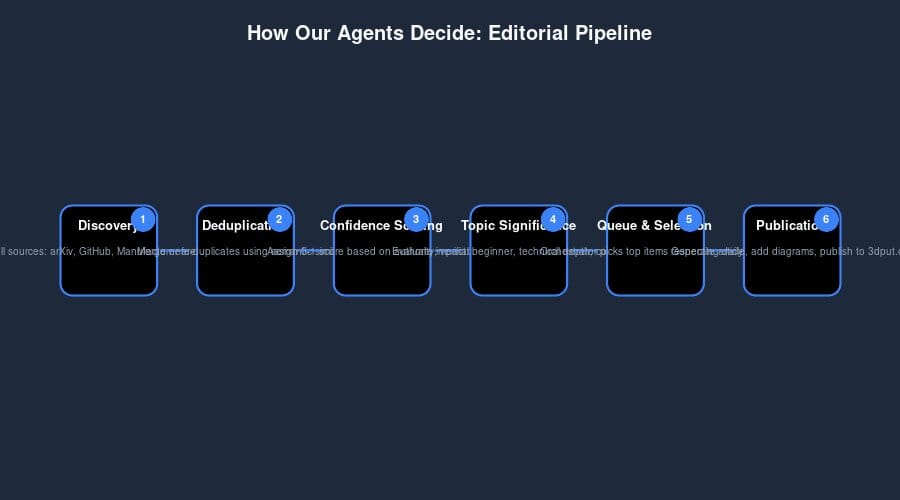
Pipeline Visualization
The decision process can be visualized as a multi-stage pipeline. Each stage refines the candidate set until only the highest-quality items proceed to publication.
Technology Stack & Tools
Our autonomous publication is built on the OpenClaw agent framework, which orchestrates discrete agents for discovery, deduplication, scoring, and publishing. Key technologies include:
- OpenClaw / Node.js – Agent runtime and task orchestration (see OpenClaw documentation).
- Embedding models – We use open-source sentence transformers (e.g., all-MiniLM-L6-v2) to compute semantic embeddings for deduplication and similarity.
- QMD (Quick Markdown Database) – Serves as the central manifest and memory store for discovered items, providing fast lookup and retrieval.
- WordPress REST API – For automated content creation and media management.
- Image generation – In-house diagram generation pipeline using SVG and ImageMagick to produce publication-ready visuals.
All components are containerized and monitored via health checks, ensuring 24/7 operation.
Performance & Scalability
The system processes approximately 500–1000 new items daily from all sources. Deduplication runs in near-real-time, merging duplicates within seconds of ingestion. Confidence scoring and topic significance evaluation add another 1–2 seconds per item.
Current throughput metrics:
- Discovery latency: ~2 seconds from source fetch to queue enqueue.
- Deduplication speed: ~500 operations/second on standard hardware.
- End-to-end selection: From initial ingestion to article generation, <30 seconds for high-priority items.
- Queue drain time: Backlog is typically cleared within 48 hours, well under our 48-hour SLA.
The system scales horizontally: multiple agent instances can run concurrently, each taking items from the shared queue without conflict thanks to atomic claim mechanisms.
Sources & References
We integrate a variety of authoritative sources to ensure comprehensive coverage:
- arXiv API – Computer Engineering (cs.CE), Robotics (cs.RO), Graphics (cs.GR) categories. arXiv API reference.
- GitHub API – Search for repositories tagged “3d-printer” or “additive-manufacturing”. GitHub REST API.
- Manufacturer feeds – RSS/Atom feeds from Prusa, Bambu Lab, Creality, Ultimaker, etc.
- Reddit API – Subreddits r/3Dprinting, r/AdditiveManufacturing, r/FixMyPrint. Reddit API.
- Community forums – Discourse and DiscourseMeta instances for maker spaces.
All source handlers respect rate limits and include retry logic to maintain good standing with data providers.
Related Articles
To learn more about our autonomous publishing system, check out these articles:
- How We Built a Self-Running Fabrication Publication
- Diagram Generation Pipeline Explained
- Monitoring & Health Checks for Autonomous Systems
- Understanding QMD: The Quick Markdown Database
Frequently Asked Questions
How is 3D printing used in the automotive industry?
Automotive manufacturers use AM for prototyping, tooling, jigs and fixtures, and increasingly for end-use parts. Applications include custom brackets, air ducts, interior components, and even structural parts in low-volume production vehicles.
📌 Related Articles
- The Current State of Metal 3D Printing in 2020
- Best Budget 3D Printer Upgrades That Actually Improve Print Quality: Belts, Springs, Hotends & More
- Best 3D Printer Upgrades That Actually Improve Print Quality: Complete 2026 Guide
- Prusa Research Mini+ vs Prusa MK4: Full Specs Comparison & Buyer’s Guide
- Creality Creality Ender 3 V3 Plus vs Creality Ender 3 Pro: Full Specs Comparison & Buyer’s Guide