
Some prefer reading, others would rather binge-watch the latest Netflix show, and then there are the gamers. We often see 3D printing used in the gaming world, with classic board games, newer tabletop games, roleplaying games, and even virtual reality (VR) games. I’d say that VR is already a pretty immersive experience in its own right, but there are always people trying to take this technology to the next level, through grabbing and even feeling things in the VR environment, wearing backpacks for a free-roaming virtual experience, and moving with VR treadmills and shoes. Unfortunately, many reasons abound as to why none of these options seem to offer full immersion, such as large, pricey headsets and non-responsive haptic technology.
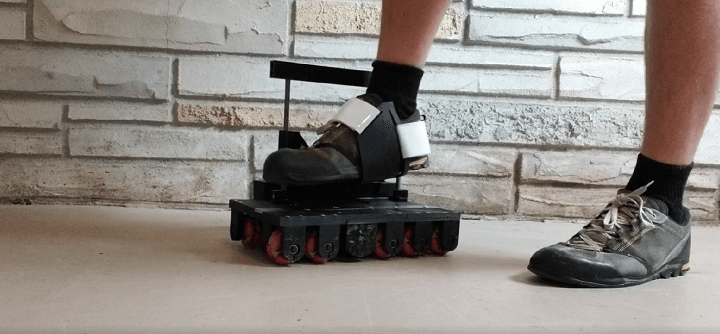
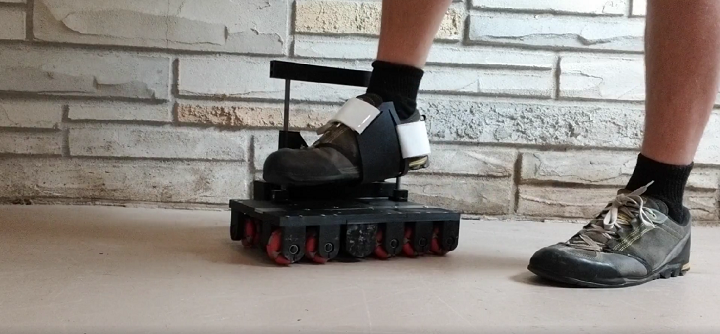
Alexander Evans, a maker and software engineer, could have the answer to completely immersive VR with his motorized shoes that feature mostly 3D printed parts, made on his Prusa systems. The shoes allow users to move omnidirectionally—each one has a track of horizontally facing wheels, and another track of vertically facing wheels. Each battery-powered shoe also features an attached motor, to help control movement.
Understanding Filament Properties
Leg binding
“I’m making motorized shoes to be used with virtual reality games. The shoes keep you in the same spot as you walk, like a treadmill. You can walk infinitely in the game while staying in the same spot in the real world. The shoes are omni-directional so you can turn, strafe, and walk in any direction,” Evans wrote in his blog.
When wearing the heavy shoes, users can glide in multiple directions, and don’t even have to lift their feet off the ground. But, in order to wear them to play VR games, Evans says you also need to wear a safety harness that’s mounted to the ceiling or a strong, stable structure; this way, you don’t have to worry about rolling into a wall or, God forbid, out of a window.

Material Comparison and Selection
First test with sideways motion
“These are basically roller skates that you wear with your eyes covered,” Evans commented on his Reddit post about the shoes. “If there is no safety structure in place, the user will fall and get hurt.”
They’re not so much shoes as they are motorized, wheeled platforms onto which you can strap your shoe-wearing feet. It would probably be pretty uncomfortable to put your bare feet on top of all that metal.
The way the design works is really interesting. Check out the image below:
Print Settings and Optimization
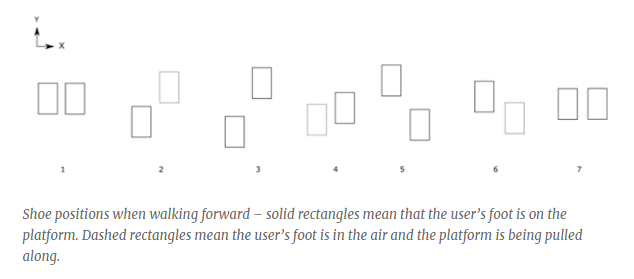
The darker rectangle denotes a foot that is on the motorized platform, while the lighter rectangle signifies that the user is bringing the shoe forward or to the side with their foot. When the right foot is moved, a sensor in the platform detects an acceleration in the Y direction, which then triggers the motor on the left platform to turn on. The second shoe will begin moving backward at the same speed the first is moving forward.
“The speed to use can be calculated by using the accelerometer data (integrating to get the velocity) or by using motor encoders,” Evans wrote. “…When the user takes a step forward with his right foot, the left foot is moved at the same speed in the opposite direction.”
Strength and Durability Testing
In terms of braking, when the user is standing still, both feet on the platform, the motors should resist any motion until one of the shoes is moved again. Check out the blog post if you want the nitty gritty details of the algorithms Evans is using for these shoes.

Right now, an Android app manually controls the shoes, but Evans is currently tweaking the software so movement can be automated and integrated within VR games. In the future, he hopes to add support for crouching and jogging to his design, though doesn’t believe that the shoes will be able to handle full-speed sprinting.
Evans doesn’t plan on licensing or patenting his shoes, though he wouldn’t mind selling them in the future once he’s perfected the design. In fact, he is a fan of the open source movement, and has added all the 3D printing files for the shoes onto GitHub, so others can download them and try to make their own pair of motorized shoes for immersive VR play.
“I plan on continuing to develop an open-source prototype while I build a YouTube channel. Once I have a sellable version, I plan on using the version for a couple months to see how well they last,” he explained on his blog. “I need to look into any safety regulations I need to meet, and get product liability insurance. I can produce a small batch of DIY kits and sell them. If they sell well, I can get another 3D printer or two and continue producing small batches and continue to build a 3D printer farm.”
Cost and Availability Considerations
(Source: Gizmodo)
The post Motorized, 3D Printed Shoes Could Make Virtual Reality Truly Immersive appeared first on 3DPrint.com | The Voice of 3D Printing / Additive Manufacturing.
from Your daily news from 3DPrint.com https://bit.ly/3gXE5pz
Related Articles
Frequently Asked Questions
What is the best 3D printing filament for beginners?
PLA is the best starting filament — it prints easily at 190-220°C without an enclosure and produces good results. Once comfortable, PETG offers better strength and temperature resistance for functional parts.
How do I choose the right filament?
Consider the application: PLA for display models, PETG for functional parts, ABS/ASA for heat/sunlight exposure, TPU for flexible parts, and specialty filaments for engineering applications. Each has specific printer requirements.
What temperature should I print different filaments at?
PLA: 190-220°C nozzle / 50-60°C bed. PETG: 220-250°C / 70-80°C. ABS: 230-260°C / 100-110°C (enclosure needed). Nylon: 240-270°C / 70-90°C. Always check manufacturer recommendations for specific brands.
📌 Related Articles
- The Current State of Metal 3D Printing in 2020
- ABS 3D Printing Settings Guide: Temperature, Enclosure, and Cooling for Strong Parts
- Best 3D Printer Upgrades That Actually Improve Print Quality: Complete 2026 Guide
- Prusa Research Mini+ vs Prusa MK4: Full Specs Comparison & Buyer’s Guide
- 3D Printing Safety Equipment Guide: Respirators, Gloves, and Ventilation for 2026