
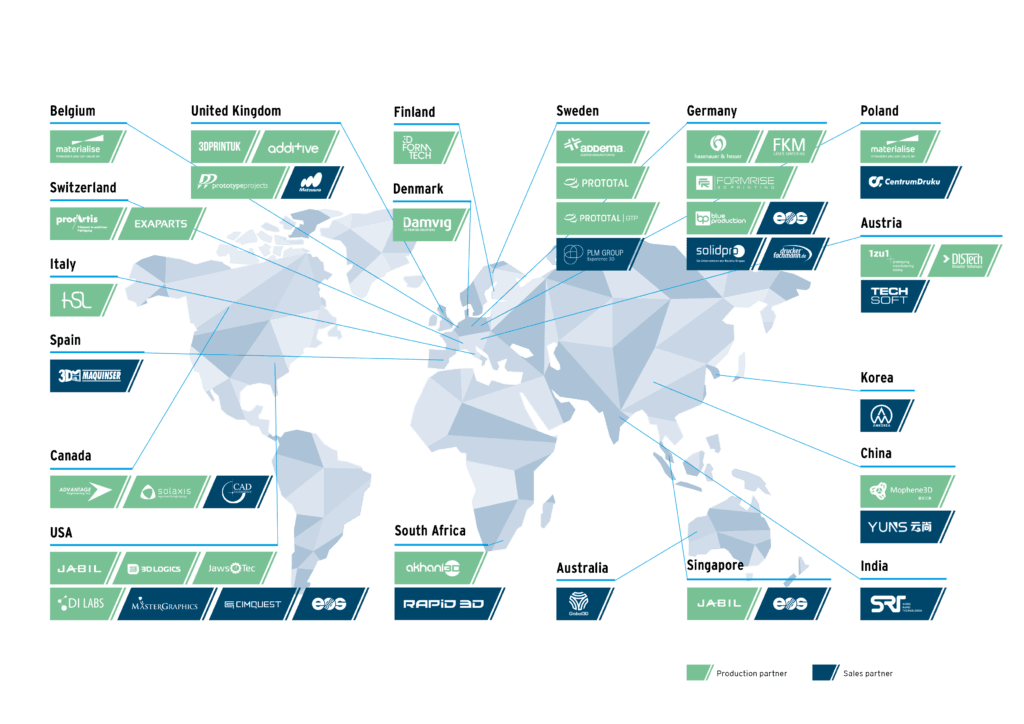
German post-processing equipment manufacturer DyeMansion has announced the creation of a global partner network. The group is made up of 46 of DyeMasion’s sales and service partners across 19 different nations worldwide. The alliance unites companies such as 3DPrintUK, Materialise, FKM, and Jabil on the service side and resellers such as MasterGraphics and CIMQuest.
DyeMansion makes post-processing systems such as the Powershot C parts cleaning system, for Multi Jet Fusion and selective laser sintering (SLS), and DM60 unit for dyeing and coloring parts. By reducing labor costs in parts post-processing, firms can reduce the part cost for manufacturing and service companies. This is crucial since around 30% of component costs may come from manual labor. We’re talking about digital manufacturing but, in reality, it’s two-thirds digital and one-third Bob-with-a-brush manufacturing.
Automated post-processing can also increase yield and improve repeatability of manufacturing operations, especially in dyeing. By industrializing the dyeing of sintered (SLS, powder bed fusion) parts, DyeMansion has allowed people to partially automate the dye-coloring of parts, which was, until then, done by hand by an individual stirring in a pot. With sintering previously, you either had to try your luck with manual dyeing, paint parts by hand, or had to swap out all of the powder in your machine, which was super not-fun and required more quality time with a vacuum cleaner than you would probably like. This gave users uneven results with colors varying in batches. By making dye batches uniform,DyeMansion has allowed companies to make tens of thousands of colored parts with a reliable dye application. This in turn led to the increased ability of firms to mass manufacture colored parts.
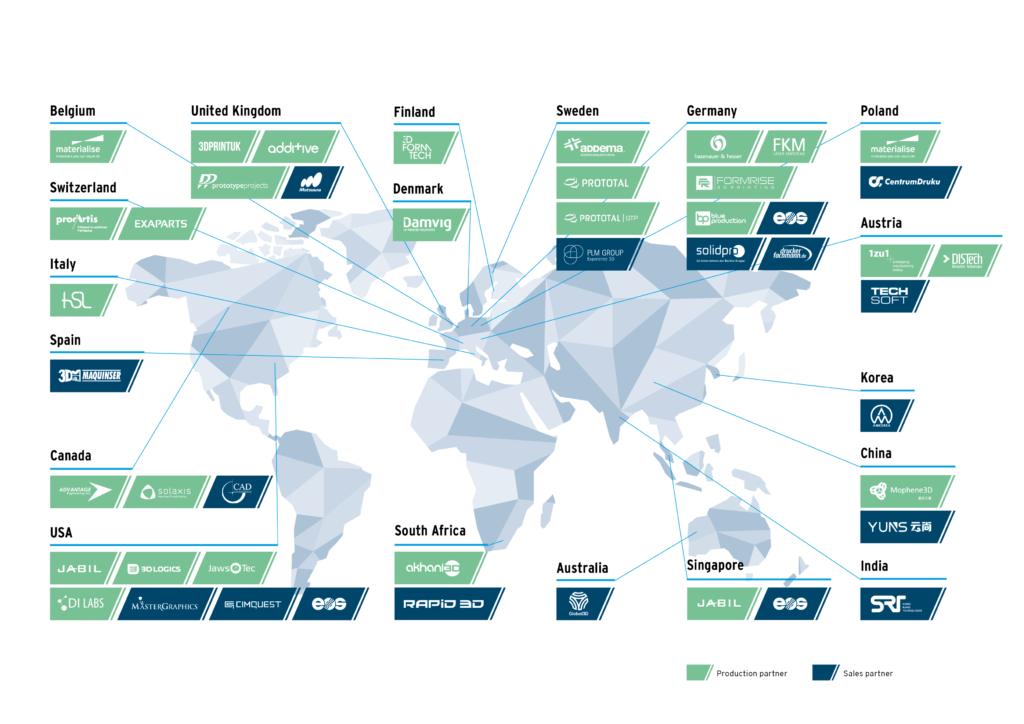 DyeMansion’s new partner network is meant to connect those making 3D-printed polymer parts with those who can process them through an online platform, which users can navigate to find profiles of the various businesses involved.
Understanding Filament Properties
Kai Witter, Chief Customer Officer at DyeMansion, said of the new network:
“Alliances are the basis to transform the manufacturing industry together. See also: ABS 3D Printing Settings Guide: Temperature, Enclo…. Those and the final touch that our solutions provide are key drivers to produce high-value products at scale. We are proud to have built such a strong platform with partners worldwide, offering DyeMansion technology and sharing the same vision,”
Material Comparison and Selection
Oscar Klassen, CEO & Co Founder of JawsTec, contributed:
“With a partnership between DyeMansion and JawsTec, we will be able to provide our customers with the highest quality 3D printed parts after post-processing on the market for a cost effective price. Making it easier to access for small and large businesses in developing and production line products in the manufacturing industry. 3D printing provides flexibility with instant production and will be the way of future manufacturing because of its ability to make changes to the parts and finishes that are now achievable with the DyeMansion solutions.”
Print Settings and Optimization
Through this alliance, an industrial firm is touting and promoting its partner network through an integrated platform. Along with DyeMansion’s services of On Demand Finishing, and TryMansion to evaluate the service this means that the firm is undertaking an “Intel Inside” kind of push. OEMs have partner networks, of course, but presenting them all as an integrated platform and promoting it together is new for post-processing. For DyeMansion, the network means that the business can perhaps continually pass on post-processing orders to its service customers through its own marketing. Any of its marketing efforts could lead to machine sales or machine leads, but could also result in leads for a service that would mean extra revenue for itself and its partners.
On some level, this could, if successful, increase the value of owning a DyeMansion machine as opposed to those from competitors. See also: Best 3D Printer Upgrades That Actually Improve Pri…. Any leverage or investment in DyeMansion marketing may, therefore, give the company more of an edge over competitors who do not do this. Service revenue is also nice to have as a machine builder and this could make their revenue less clunky and more constant.
Moreover from a sales perspective, you can now track the customer throughout their entire life cycle from lead to service customer, to prospect for a reseller, to customer. In many companies, information gets fragmented when people use resellers and partner networks. The OEM often won’t know if a company tried a service for three months (or nine) and then grew to a machine. The OEMs thinking on its own pipeline and sales cycles could be incomplete. Here DyeMansion is in the driving seat and “owns the customer” throughout more of the life cycle and can develop an edge in market knowledge as well.
Strength and Durability Testing
I find DyeMansion work along with the efforts of AMT, Rosler (AM Solutions), and Post Processing crucial for the health of our industry. If these firms grow in 3D printing they will lower individual part costs and enable more business cases. On the hardware side, the growth of their installed base and the further development of more efficient post processing technologies will be one of the things that takes us from a cottage industry to a manufacturing industry.
The post DyeMansion Launches Global Post-Processing Partner Network for 3D Printing appeared first on 3DPrint.com | The Voice of 3D Printing / Additive Manufacturing.
from Your daily news from 3DPrint.com https://bit.ly/2Cw9nEA
Frequently Asked Questions
What is the best 3D printing filament for beginners?
PLA is the best starting filament — it prints easily at 190-220°C without an enclosure and produces good results. Once comfortable, PETG offers better strength and temperature resistance for functional parts.
How do I choose the right filament?
Consider the application: PLA for display models, PETG for functional parts, ABS/ASA for heat/sunlight exposure, TPU for flexible parts, and specialty filaments for engineering applications. Each has specific printer requirements.
What temperature should I print different filaments at?
PLA: 190-220°C nozzle / 50-60°C bed. PETG: 220-250°C / 70-80°C. ABS: 230-260°C / 100-110°C (enclosure needed). Nylon: 240-270°C / 70-90°C. Always check manufacturer recommendations for specific brands.
📌 Related Articles
- ABS 3D Printing Settings Guide: Temperature, Enclosure, and Cooling for Strong Parts
- Best 3D Printer Upgrades That Actually Improve Print Quality: Complete 2026 Guide
- 3D Printing Tungsten Carbide: How Hot-Wire Laser Technology Creates Metal Harder Than Steel
- Best Budget 3D Printer Upgrades That Actually Improve Print Quality: Belts, Springs, Hotends & More
- 3D Printing Safety Equipment Guide: Respirators, Gloves, and Ventilation for 2026