
After a stroke, many patients must travel a long hard road before regaining a sense of normalcy. In the US alone, nearly 7 million individuals have survived from strokes, but around half will experience some sort of disability due to residual effects.
Now, a group of researchers from the University at Buffalo and Georgia State University have released the developments from an innovative new study in the recently published ‘RehabPhone: A Software-Defined Tool Using 3D Printing and Smartphones for Personalized Home-based Rehabilitation.’
Current programs for rehabilitation are often grim endeavors, with patients left bored and disengaged during what are considered to be required, important exercises for regaining function. Technology is rarely customized toward the individual either; however, as 3D printing continues to impact the medical realm, patient-specific treatment continues to become available in surprising ways—often leading to a better quality of life for individuals worldwide.
Categorized as the ‘fifth largest cause of death’ in the US, stroke does weigh in as the unfortunate top cause for motor disability—usually in the form of paralysis on either the left or right side (hemiplegia). Rehab exercises, meant to improve oxygen to the brain, may be performed while working with a professional, or they may be prescribed for at-home practice. Elastic band therapy is common, but they may not be realistic for a patient who has lost a great deal of mobility:
“Moreover, statistics show that exercises that mimic activities of daily living are more meaningful and produce significantly good outcomes, while elastic band exercises are boring [and] cannot achieve the same effective outcomes,” state the researchers.
The Role of 3D Printing in Medicine
In attempting to return to normal daily life, performing tasks as simple as opening a door or pouring water, development of a device with built-in sensors and CPU are expected to be effective, along with offering greater opportunity for interaction in the program, especially with 3D-printed tools and expected familiarity with a basic smartphone.
“The built-in speaker allows stroke survivors to perform rehabilitation exercises with acoustic guidelines, and GUI provides feedback,” explain the researchers. “As far as one rehabilitation object is concerned, 3D printing technology can customize the products with different weights and sizes that adapt to stroke survivors with customized demand.”
Biocompatible Materials and Processes
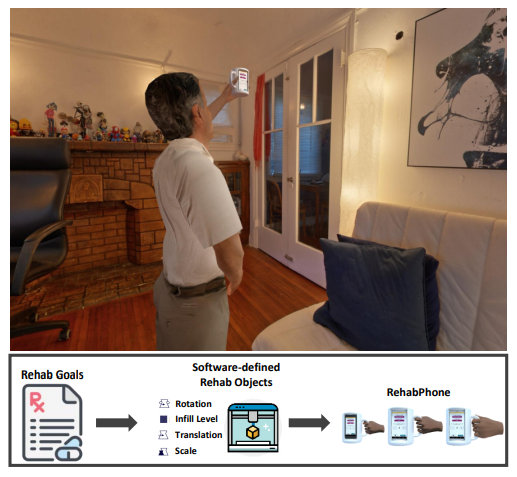
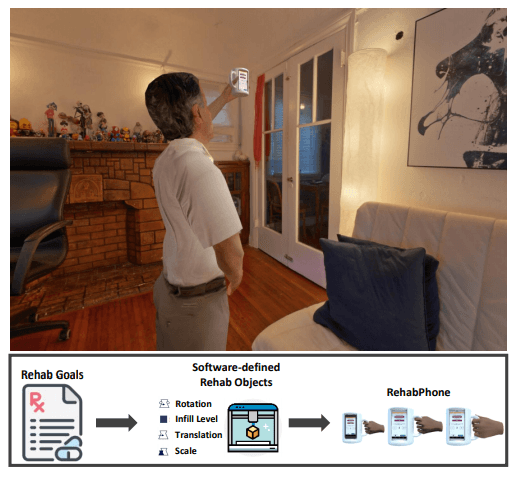
Top Figure: An example of RehabPhone in use. The rehabilitation object is structurally coupled with the user’s smartphone. It allows to mimic daily-life activity and measure eicacy. Bottom Figure: RehabPhone can customize rehabilitation objects according to rehabilitation goals, hand size, smartphone size, and etc.
The RehabPhone allows for in-home rehab, with the potential for customized rehab exercises as the patient works with a computer science researcher in setting up the system. Thirty-two patients participated in the study, including twelve young adults with no signs of impairment, four healthy older adults, and four stroke survivors. Beyond that, 12 other stroke survivors ‘accessed the effectiveness in rehabilitating multiple levels of stroke prognosis.’
“The insights gained from this study indicate that a smartphone-based software-designed solution is possible for in-home stroke rehabilitation,” stated the researchers.
Clinical Applications and Case Studies
Design goals included:
- Scalability—for different types and severity of stroke
- Usability—depending on the level of disability
- Feasibility—efficacy should be calculated automatically from the home, and occupational therapists should be able to track progress
Regulatory Considerations and Safety
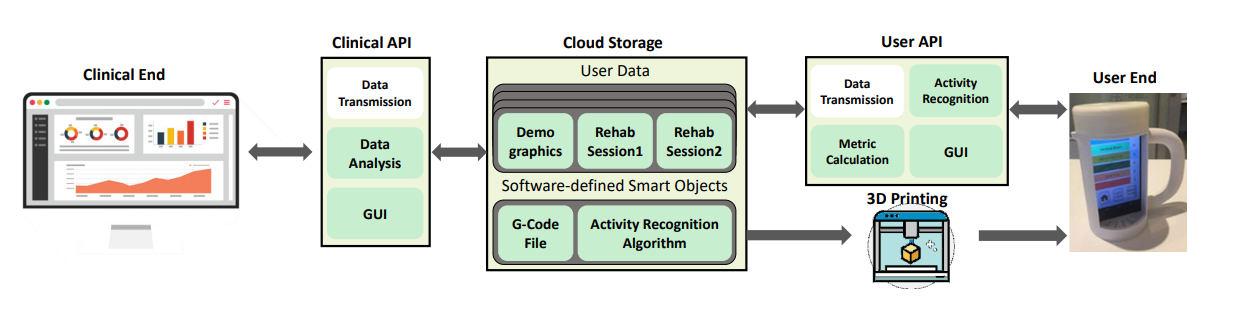
The overall system diagram including a clinician end, a user end, and a cloud storage. Sensory data are collected in the smartphone and analyzed by real-time computing unit to detect if an event happens and then measure the duration and repetitions of this event. After that, the raw data will be uploaded and stored in the cloud server. Clinical research is able to download the data, perform data analysis and give user feedback.
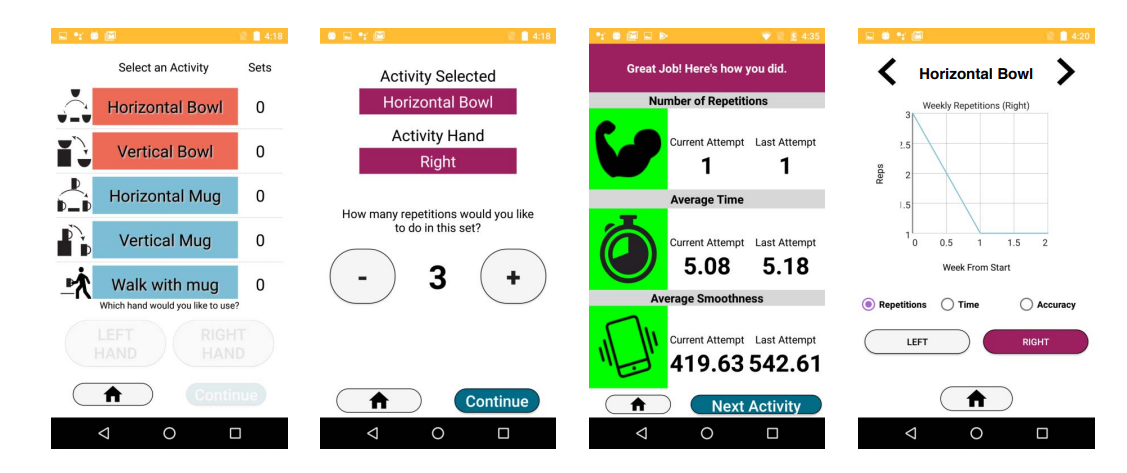
The implementation of RehabPhone at the smartphone end. See also: Best Budget 3D Printer Upgrades That Actually Impr…. It includes the exercise selection, real-time computation and feedback, and cloud integration.
Although the researchers were previously armed with the knowledge that physical therapists tend to avoid rehabilitation with technology (due to tech failure, a difficult learning curve, lack of affordability, and non-scalability), they did see that the patients showed ‘high adherence’ for using the smartphones and 3D printed tools—although usability issues did emerge as participants might break parts like 3D printed keys due to erratic movements from the stroke.
“We believe this issue can be addressed when 3D printing technology becomes more accessible. Stroke survivors can quickly re-print their damaged objects,” stated the researchers.
Research Breakthroughs and Innovations
“Currently, each software-defined object is pre-printed in the lab. Then, all the objects are packaged into a 12” x 12” x 12” box that is delivered to homes of the participants. This issue can also be addressed when the 3D printer is popularized in the future.”
Smartphones have been used in a variety of 3D printing studies related to science and medicine, to include clip-on microscopes for scientists, cases for diagnosing high blood pressure, and adapters for ophthalmology diagnostics. What do you think of this news? Let us know your thoughts! Join the discussion of this and other 3D printing topics at 3DPrintBoard.com.
[Source / Images: ‘RehabPhone: A Software-Defined Tool Using 3D Printing and Smartphones for Personalized Home-based Rehabilitation’]
The post RehabPhone: 3D Printing & SmartPhones Effective in Customized Therapy for Stroke Patients appeared first on 3DPrint.com | The Voice of 3D Printing / Additive Manufacturing.
The Future of Bioprinting and Medical AM
from Your daily news from 3DPrint.com https://bit.ly/2NjEqFN
Related Articles
Frequently Asked Questions
How is 3D printing used in medicine?
3D printing is used in medicine for surgical planning models, custom implants, bioprinting tissue scaffolds, drug delivery systems, dental aligners, and prosthetics. It enables patient-specific solutions that improve outcomes and reduce surgery time.
What materials are biocompatible for 3D printing?
Common biocompatible materials include PEEK, titanium alloys (Ti6Al4V), bio-ceramics (hydroxyapatite), medical-grade resins, PLA for temporary implants, and hydrogels for bioprinting. Material choice depends on the application and required mechanical properties.
Is 3D printed medical equipment FDA approved?
Yes, several 3D printed medical devices have FDA clearance, including orthopedic implants, dental restorations, and surgical guides. Each device must go through the appropriate regulatory pathway based on its risk classification.
📌 Related Articles
- Best 3D Printer Upgrades That Actually Improve Print Quality: Complete 2026 Guide
- Best Budget 3D Printer Upgrades That Actually Improve Print Quality: Belts, Springs, Hotends & More
- Prusa Research Mini+ vs Prusa MK4: Full Specs Comparison & Buyer’s Guide
- ABS 3D Printing Settings Guide: Temperature, Enclosure, and Cooling for Strong Parts
- Bambu Lab P1S vs Bambu Lab P2S: Full Specs Comparison & Buyer’s Guide