
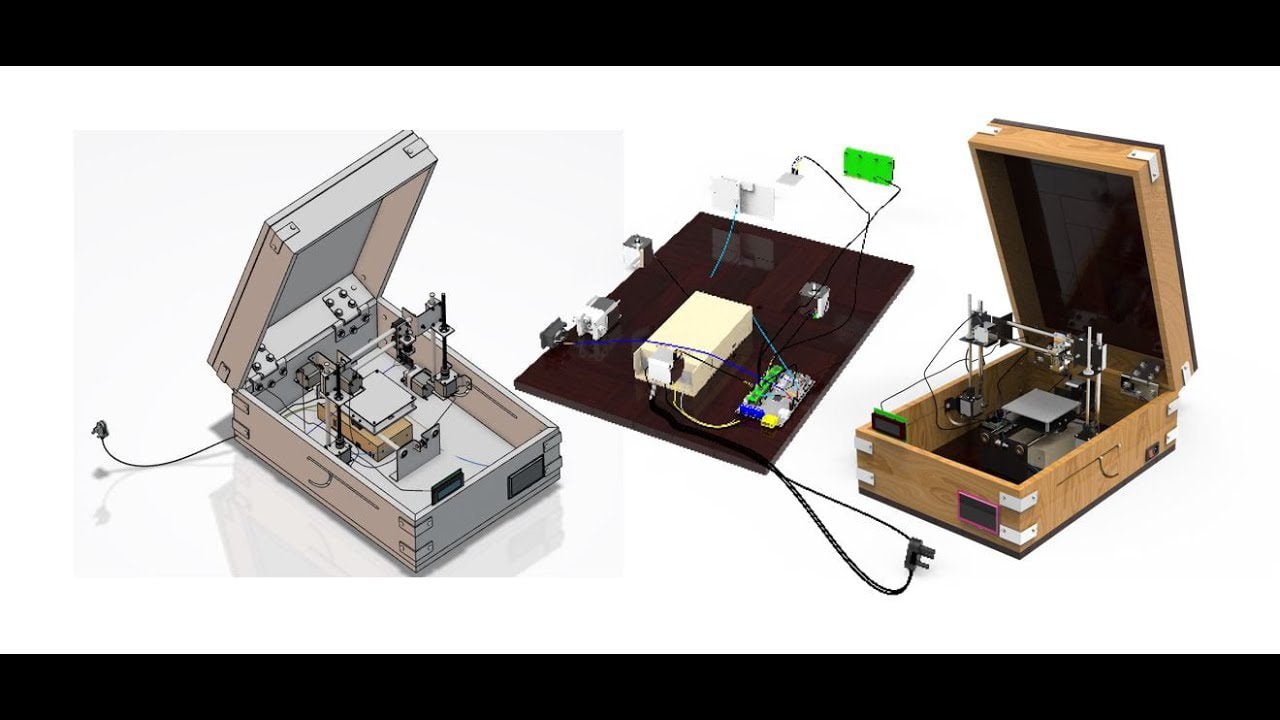
Project Description
The 3D printer is quickly beginning to revolutionise the way people can become their own engineer. 3D printing is a quick and convenient way to create prototypes and models. The fact is that 3D printers are heavyweight and not easily portable. So in this model have focussed on design of portable 3D printer in a wooden briefcase without taking the printer out and it doesn’t need any external support for mounting. Also the choosing of wooden material as briefcase makes it eco-friendly and construct it economically. The bed area of our 3D printer is (120*120*3) mm3. We are using 4 axis mechanism where 3 axis are X-Y-Z and the 4th axis is an extruder. The process adopted by us is FDM technology.
Steps – Methodology
• Market Value And Benchmarking
• Technical Specification Finalise
• 3d Printer Product Design
• System Engineering (Multi Diciplinary) Like ME,EEE,ECE Electrical Wire Hardness
• Product Validation
• Design improvement
• Final design
• Quality control & Inspection
• Manufacturing Bill of Material
• Product Delivered for manufacturing.
Design Process
• Design of various parts of 3D printer
• Assembly of the whole 3D printer.
• Analysis and Simulation of the printer with material addition.
• Wire harnessing and System Engineering
• Live Rendering.
Understanding Filament Properties
Product Functionality
• Foldable- This makes the 3D printer easy to use and portable.
• Portable- Transportable quality makes it work anywhere as per users need.
• Eco-friendly- The wooden briefcase makes it environment friendly as it is disposable.
• Lightweight- The materials used in the printer makes it easy to lift and carry.
• Cost-effective- It is inexpensive and can easily be bought by average income users.
• Low Maintenance- This product doesn’t require much repair cost if any of its part gets damaged.
Market Value & Consumer Need
• 3D printing is the rising technology.
• The demand has grown especially in the field of agriculture, biomedical, architecture, defence etc.
• If given opportunity portable printers can create wonders which can save both time and money.
• People with average income are opting for 3D printing both for self-use and business.
Conclusion
• From a sense to print is a system that can automatically generate ready -to -print 3D CAD models.
• It uses low cost Kinetics sensor.
• The 3D prints currently generated are full models.
• They create replicas in more expensive materials such as other copper and other materials.
Track: Lost Sky – Fearless [NCS Release]
Music provided by NoCopyrightSounds.
Watch: https://youtu.be/9rujCfYXhQc
Free Download / Stream: http://ncs.io/FearlessYO
Related Articles
Frequently Asked Questions
What is the best 3D printing filament for beginners?
PLA is the best starting filament — it prints easily at 190-220°C without an enclosure and produces good results. Once comfortable, PETG offers better strength and temperature resistance for functional parts.
How do I choose the right filament?
Consider the application: PLA for display models, PETG for functional parts, ABS/ASA for heat/sunlight exposure, TPU for flexible parts, and specialty filaments for engineering applications. Each has specific printer requirements.
What temperature should I print different filaments at?
PLA: 190-220°C nozzle / 50-60°C bed. PETG: 220-250°C / 70-80°C. ABS: 230-260°C / 100-110°C (enclosure needed). Nylon: 240-270°C / 70-90°C. Always check manufacturer recommendations for specific brands.
📌 Related Articles
- The Current State of Metal 3D Printing in 2020
- Best 3D Printer Upgrades That Actually Improve Print Quality: Complete 2026 Guide
- Best Budget 3D Printer Upgrades That Actually Improve Print Quality: Belts, Springs, Hotends & More
- 3D Printing News: Multi-Material Breakthrough and Aerospace Market Boom
- ABS 3D Printing Settings Guide: Temperature, Enclosure, and Cooling for Strong Parts