
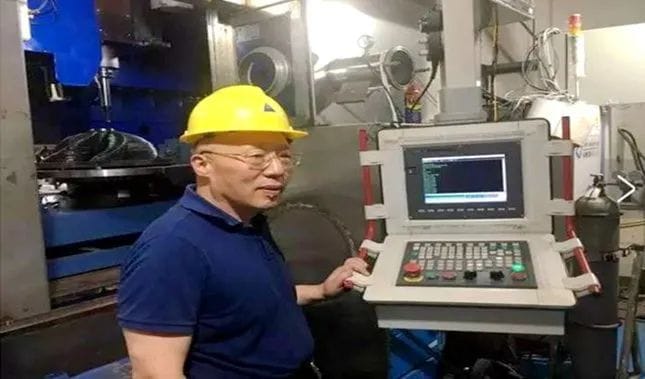
An industrialization team from China’s Huazhong University of Science and Technology, led by Professor Zhang Haiou, is using a relatively new technology with 3D printing to produce heavy, industrial parts like large pump propeller blades. After a request for a substantial order of large jet blades for a shipbuilding unit, the University team began using micro-casting and forging in metal 3D printing for the manufacturing of large parts.

Necessary in ship navigation, pump jet propellers can be made significantly faster with micro-casting and forging, a technological evolution from material manufacturing to subtractive manufacturing to additive manufacturing. Mechanical properties are improved, along with accuracy—elevated from 0.5mm to 0.1mm, with little to no defects like pores or cracks. Haiou explained that without forging, metal fatigue resistance may be inferior, performance of parts may not be sufficient, and defects can occur due to lack of fusion, stability, and porosity.
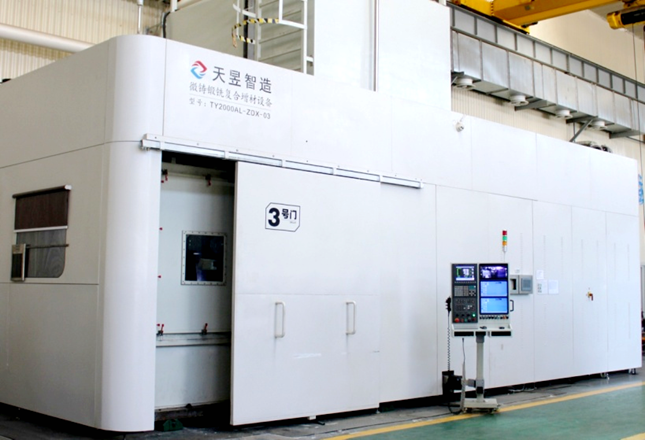
Attempting to improve metal 3D printing for large parts with complex geometries, Haiou and his team moved forward to disrupt industrial production with their novel micro-casting and forging technique. News of Haiou’s system, dubbed the “Micro Forging & Casting Sync Composite Device”, first emerged in 2016, when it was revealed that the technology was being used to create titanium joints for China’s jet fighters. The process consists of:
- Metal deposition, using metal wire
- Continuous cold forging and rolling
- Cooling down
“The micro-casting and forging technology can carry out the above steps simultaneously,” explained Zhang Haiou. “When the printing is completed, the casting and forging are completed at the same time, and the deposition efficiency is three times that of the former.
The State of Metal 3D Printing
“We reduced the action that originally required 80,000 tons of force to 1/80,000, that is, less than one ton of force, and at the same time, one equipment completed the work that many large equipment used to complete. See also: 3D Printing Tungsten Carbide: How Hot-Wire Laser T…. The power of the equipment is only 50 kilowatts, and the energy consumption per unit time is two-thousandths of that of a giant press. It is green and efficient.”
In 2016, the system made parts up to 5.5 × 4.2 × 1.5 m in size, with a surface roughness of 0.02 mm, and could use eight types of materials, including titanium and steel. The goal with the technology is to magnify the advantages of 3D printing and additive manufacturing processes, especially for industrial applications in building aircraft, engines, turbines, parts for railways, and nuclear power plants.
“Taking aircraft manufacturing as an example, the number of body structure parts of a large passenger aircraft is currently tens of thousands. If 3D printing technology can be used to produce large, complex, integral, high-performance, and lightweight components in the future, then number of body structure parts for a large passenger aircraft may only be hundreds.
Technical Challenges and Solutions
“Not only that, in the future, using metal 3D printing technology and simulation technology will reduce the development and production cycle of the aircraft by an order of magnitude,” said Zhang Haiou.
This is not the only process to combine 3D printing and forging. See also: The Current State of Metal 3D Printing in 2020. Arconic developed a technique called Ampliforge that combines directed energy deposition with forging for the same reasons, but it lacks the built-in milling capabilities.
What do you think of this news? Let us know your thoughts! Join the discussion of this and other 3D printing topics at 3DPrintBoard.com.
[Source / Images: NetEase News]
Material Properties and Performance
The post China: Microcasting Technology in Metal 3D Printing to Produce Large Pump Propeller Blades appeared first on 3DPrint.com | The Voice of 3D Printing / Additive Manufacturing.
from Your daily news from 3DPrint.com https://bit.ly/3e8NIAg
Related Articles
Frequently Asked Questions
What is metal 3D printing?
Metal 3D printing (additive manufacturing) builds metal parts layer by layer using techniques like laser powder bed fusion, directed energy deposition, and binder jetting. It enables complex geometries impossible with traditional manufacturing while reducing material waste significantly.
How strong are 3D printed metal parts?
3D printed metal parts can achieve mechanical properties comparable to traditionally manufactured metals. Tensile strength and fatigue resistance depend on the process and post-processing, but many meet or exceed ASTM standards for wrought materials.
What are the main metal 3D printing technologies?
The primary technologies include Laser Powder Bed Fusion (LPBF), Electron Beam Melting (EBM), Directed Energy Deposition (DED), Binder Jetting, and Metal FDM (with bound filaments). Each has different strengths in terms of resolution, speed, and material options.
📌 Related Articles
- 3D Printing Tungsten Carbide: How Hot-Wire Laser Technology Creates Metal Harder Than Steel
- The Current State of Metal 3D Printing in 2020
- ABS 3D Printing Settings Guide: Temperature, Enclosure, and Cooling for Strong Parts
- Best 3D Printer Upgrades That Actually Improve Print Quality: Complete 2026 Guide
- 3D Printing Safety Equipment Guide: Respirators, Gloves, and Ventilation for 2026