
Pawel Zmarzly, Damian Gogolewski, and Tomasz Kozior present their findings from a recent study in ‘Design guidelines for plastic casting using 3D printing.’ While 3D printing is used for many different applications related to casting and molds, in this research the authors investigated the potential for 3D printing prototypes, as well as looking into production of existing models.
In analysis of prototypes, the authors evaluated accuracy, quality, and ‘intermediate elements’ from the actual printing process. The benefits of using 3D printing and additive manufacturing processes in the foundry industry continue to be more widely recognized, allowing industrial users the chance to save on the bottom line significantly with reduced production and testing times. Changes can be made easily, and with virtually no wait.
There may be some molds or patterns that are challenging to produce via 3D printing though, due to issues with low melting points in materials:
“The combination of additive manufacturing technologies and widely used silicone mold casting can address these challenges, enabling the casting from casting materials or high melting point materials such as aluminum, tin, copper, or bronze alloys,” stated the researchers.
For this study—with more of a focus on applications like the chemical industry—the authors performed tests on 3D printed models made with PLA, along with electrospinning and polymer nanofibers too. Such measurements allow for better ‘corrective action,’ and improved quality in finished castings.
“The modern foundry industry strives to create precise castings, which in many cases do not require further processing. Therefore, in addition to determining the size of defects that occurred at each stage of the molding and casting process, it is necessary to determine how the given deviations affected the individual stages of model development.”
Ultimately, the goal of the researchers was to measure the true potential of AM processing with polymeric resins, evaluating models for accuracy and surface texture. While many research studies have centered around 3D printing of molds—from lung-on-a-chip prototypes to sand molds, and testing molds—what makes the testing in this study unique is the level of dimensional, shape, and surface layer analysis.
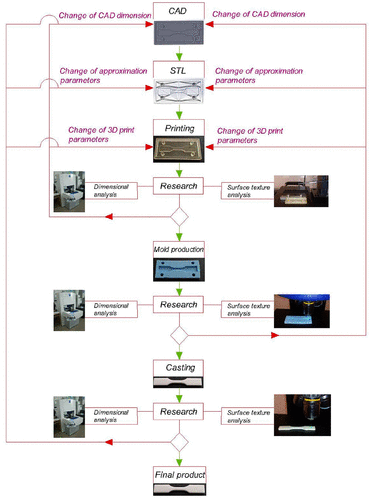
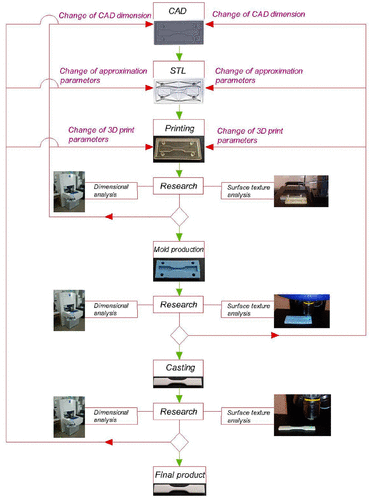
Block diagram of the testing procedure.
The research team printed each model in five pieces, after which they measured linear dimensions and surface texture.

A silicone mold was then cast, with tests performed after curing.
“One of the last stages of the testing was pouring of RenCast FC-52 liquid casting resin into the silicone mold,” stated the authors. “The last stage of the testing procedure was to perform metrological analysis of analogous features of the sample using the above-mentioned measuring instruments (O-INSPECT Multisensor Coordinate Measurement Machine and Talysurf CCI optical profilometer).”
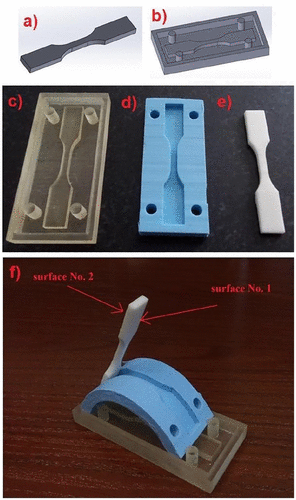
(a) CAD design of the sample, (b) CAD design of the mold, (c) CM1 mold, (d) CM2 mold, (e) finished sample, and (f) completed elements.

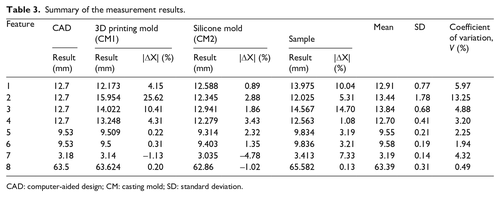
Geometrical features of the model.
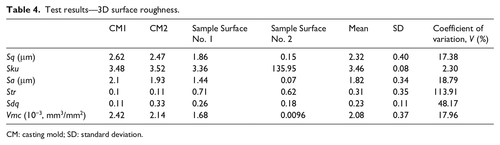
“The obtained values of individual 3D surface roughness and waviness parameters change at subsequent stages of sample production. Attention should be paid to the fact that in the case of height parameters and volumetric parameter of 3D roughness, it was noted that the values decrease with the progress of the production process. A contrary phenomenon was observed for the 3D surface waviness. Nevertheless, the values of individual indexes vary slightly,” concluded the researchers.
“Analyzing the change in linear dimensions of the casting mold made with the PJM technology and that cast from silicone, it can be concluded that in relation to the assumed nominal dimensions (CAD), they became lower. However, when considering the dimensions of the final casting, it can be stated that in relation to the nominal dimensions, the results increased by an average of 5%. The smallest change was noted for the dimension determining the sample length. Dimensional analysis of the test results is an indication to designers that when designing a casting mold using CAD software, the dimensions of the sample width should be reduced by approximately 5%.”

Topography images of CM1 mold surface: (a) roughness and (b) waviness.

Topography images of CM2 mold surface: (a) roughness and (b) waviness.
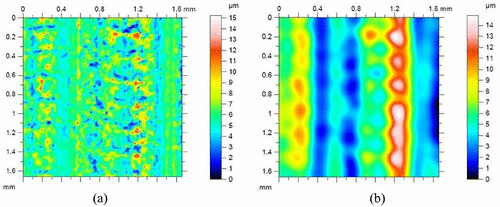
Topography images of Surface No. 1 of the sample: (a) roughness and (b) waviness.

Topography images of Surface No. 2 of the sample (on the top): (a) roughness and (b) waviness.
What do you think of this news? Let us know your thoughts! Join the discussion of this and other 3D printing topics at 3DPrintBoard.com.
[Source / Images: ‘Design guidelines for plastic casting using 3D printing’]
The post Modern Foundry: Analysis & Design Guidelines for 3D Printed Plastic Casts appeared first on 3DPrint.com | The Voice of 3D Printing / Additive Manufacturing.
from Your daily news from 3DPrint.com https://bit.ly/2XBvlOG
Where to Buy Filament
Disclosure: Some of the links below are affiliate links. If you make a purchase, we may earn a commission at no extra cost to you. This helps support this site.
- PLA: Hatchbox
Looking for Filament? Check the best deals on Amazon:
These links go to Amazon with our affiliate tag. If you prefer to support local retailers or buy directly from manufacturers, we encourage that as well!
Related Articles
Frequently Asked Questions
What is the best 3D printing filament for beginners?
PLA is the best starting filament — it prints easily at 190-220°C without an enclosure and produces good results. Once comfortable, PETG offers better strength and temperature resistance for functional parts.
How do I choose the right filament?
Consider the application: PLA for display models, PETG for functional parts, ABS/ASA for heat/sunlight exposure, TPU for flexible parts, and specialty filaments for engineering applications. Each has specific printer requirements.
What temperature should I print different filaments at?
PLA: 190-220°C nozzle / 50-60°C bed. PETG: 220-250°C / 70-80°C. ABS: 230-260°C / 100-110°C (enclosure needed). Nylon: 240-270°C / 70-90°C. Always check manufacturer recommendations for specific brands.
📌 Related Articles
- Best 3D Printer Upgrades That Actually Improve Print Quality: Complete 2026 Guide
- The Current State of Metal 3D Printing in 2020
- Best Budget 3D Printer Upgrades That Actually Improve Print Quality: Belts, Springs, Hotends & More
- Prusa Research Mini+ vs Prusa MK4: Full Specs Comparison & Buyer’s Guide
- Bambu Lab P1S vs Bambu Lab P2S: Full Specs Comparison & Buyer’s Guide