
Belgian scientsits have taken on a unique study in evaluating AM parts, releasing their findings in ‘Influence of Conventional Machining on Chemical Finishing of Ti6A14V Electron Beam Melting Parts.’ Acknowledging the positive impacts additive manufacturing has made in a wide range of industries—from medicine to aerospace, construction, and so much more—the authors point out that there is still much to learn as challenges continue to arise in the face of ongoing innovation.
In this study, titanium alloy printing (Ti6Al4V) with electron beam melting (EBM) is the focus, along with challenges in production—mainly dealing with roughness that reduces necessary resistance to fatigue. Such defects can be common and may discourage users from branching out into using new technology.
Finishing is often required to ensure optimum performance, with numerous processes available for refining the surface further:
- Shot peening
- Tribofinishing
- Vibratory finishing
- Conventional machining
- Laser polishing
- Shape adaptive grinding
- Electrochemical treatments such as chemical etching, electrochemical polishing, and plasma electrolytic polishing
The State of Metal 3D Printing
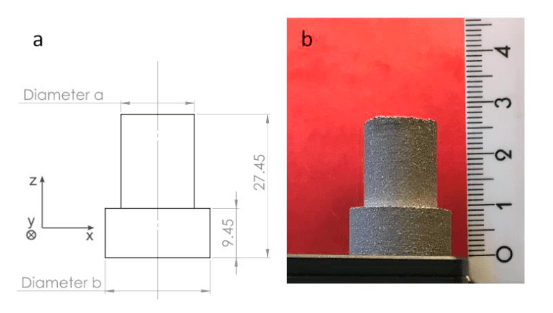
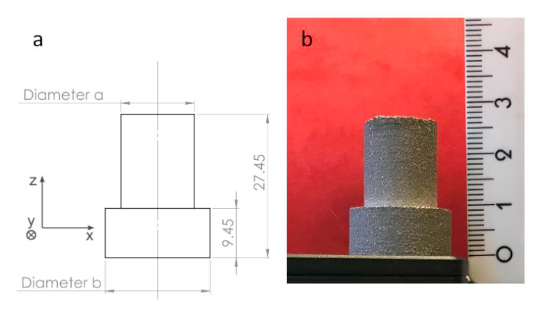
(a) Sample design and coordinate axis; (b) Resulting part geometry
Samples were printed and then evaluated, as the researchers compared the roughness of Ti6Al4V EBM parts that were chemically finished before and after robotic machining. An Arcam A2 machine was used for printing, and part and core surfaces were evaluated, using cylindricity and roughness measurements.
Technical Challenges and Solutions
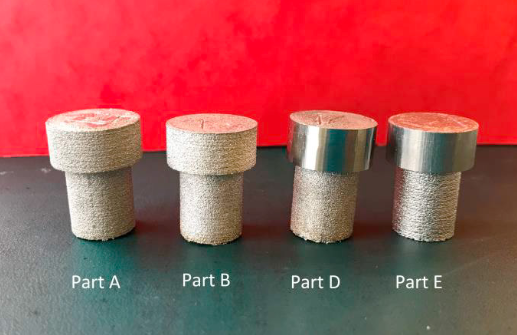
Witnesses of the experimental steps
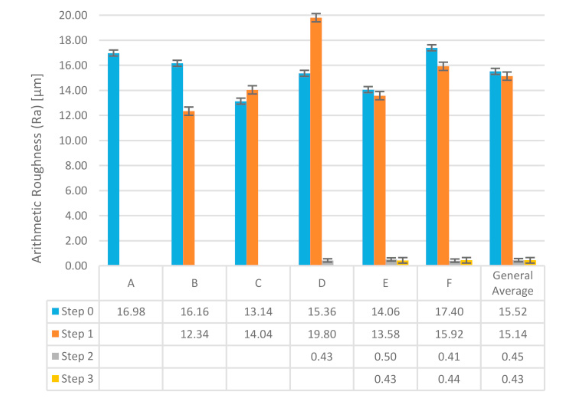
Arithmetic Roughness [μm]
In experimenting and comparing the effects of conventional machining on chemical finishing, the researchers employed four steps:
- Preliminary analysis
- First chemical etching
- Robotic milling
- Second chemical etching
Arithmetic roughness was minimally affected by the first chemical etching, showing a decrease of 2.5 percent.
“Roughness decreases dramatically after robotic milling and reaches results < 0.5 μm for some parts (reduction of 97%),” stated the authors. “This last roughness result allows to foresee demanding application of the treated part cylinder according recommendation of Ra < 1.6 μm for contact surface.”
Material Properties and Performance
Ultimately, total roughness measurement conclusions were the same as RA in the initial chemical etching, showing a decrease of 6.5 percent, and 95 percent for robotic milling:
“These measurements have been only made on two parts. So, it would be interesting to pursue analysis and make a chemical etching with more parts robotically milled beforehand to assess this influence of chemical etching on robotic milling in terms of Rt,” stated the researchers.
Industrial Applications and Use Cases
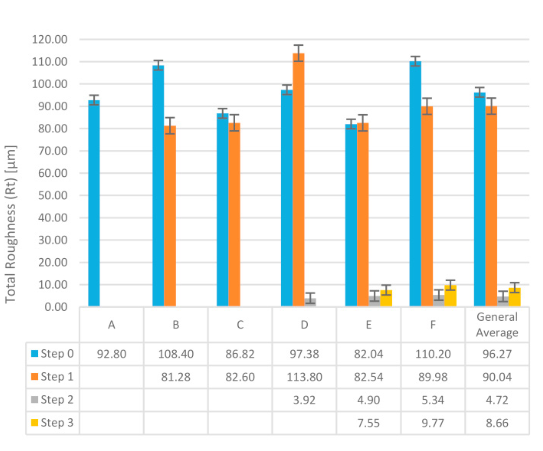
Total Roughness [μm]
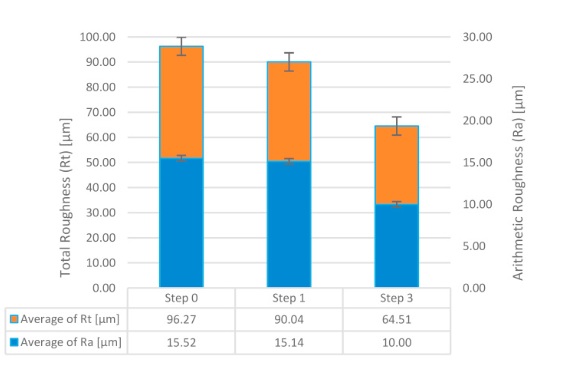
Complementary measurements of Ra [μm] and Rt [μm]
Comparing Metal AM to Traditional Manufacturing
“Even if the parts were coming from the same region of the building plate, cylindricity of raw parts were heterogeneous (σ = 0.027 mm for an average cylindricity of 0.062 mm). The first chemical etching did not change these results. However, robotic milling degraded cylindricity of the part by 300% due to the process itself. Chemical etching does not degrade cylindricity while robotic milling does,” concluded the researchers.
“This process is very promising since it allows to treat the part regardless of its geometry and without inducing stresses on the part surface. However, it was not possible to reach an arithmetic roughness as good as after robotic milling. Moreover, after having applied a chemical etching on the core material of the part, Rt increased and the shiny surface became dull. More analysis will be required to assess if this aspect modification is linked to a metallurgical change of the part surface material.”
Titanium has been the source of much research to date, from evaluation of scaffolds in bioprinting to testing medical devices, improving 3D-printed implants, and more. What do you think of this news? Let us know your thoughts! Join the discussion of this and other 3D printing topics at 3DPrintBoard.com.
[Source / Image: ‘Influence of Conventional Machining on Chemical Finishing of Ti6A14V Electron Beam Melting Parts’]
Future Developments in Metal Additive Manufacturing
The post The Effects of Machining on Chemical Finishing of Titanium EBM Parts appeared first on 3DPrint.com | The Voice of 3D Printing / Additive Manufacturing.
from Your daily news from 3DPrint.com https://bit.ly/3cnZepy
Related Articles
Frequently Asked Questions
What is metal 3D printing?
Metal 3D printing (additive manufacturing) builds metal parts layer by layer using techniques like laser powder bed fusion, directed energy deposition, and binder jetting. It enables complex geometries impossible with traditional manufacturing while reducing material waste significantly.
How strong are 3D printed metal parts?
3D printed metal parts can achieve mechanical properties comparable to traditionally manufactured metals. Tensile strength and fatigue resistance depend on the process and post-processing, but many meet or exceed ASTM standards for wrought materials.
What are the main metal 3D printing technologies?
The primary technologies include Laser Powder Bed Fusion (LPBF), Electron Beam Melting (EBM), Directed Energy Deposition (DED), Binder Jetting, and Metal FDM (with bound filaments). Each has different strengths in terms of resolution, speed, and material options.
📌 Related Articles
- The Current State of Metal 3D Printing in 2020
- 3D Printing Tungsten Carbide: How Hot-Wire Laser Technology Creates Metal Harder Than Steel
- 3D Printing News: Multi-Material Breakthrough and Aerospace Market Boom
- ABS 3D Printing Settings Guide: Temperature, Enclosure, and Cooling for Strong Parts
- The Complete 3D Printing Filament Guide: Types, Properties & When to Use Each