
Today, users around the world have made at least a noticeable foray into nearly every industry with 3D printing, and the world of optics and lenses is no exception. In the recently published ‘Manufacturing and analyzing of cost-efficient Fresnel lenses using stereolithography,’ German researchers explore the creation of optical lens prototypes using SLA 3D printing.
3D printing optical lenses is still a ‘growing technique,’ but one that offers numerous benefits—with greater affordability at the top of the list. Used as a converging lens, the Fresnel option is a more basic yet optimized form, featuring the need for less volume and less material.
Understanding Filament Properties
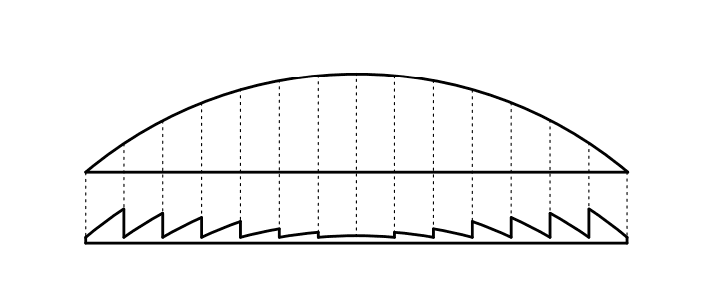
Comparison of convex lens with fresnel lens of similar properties
Conventionally, Fresnel lenses are produced with a combination of glass and polymer pressed into molds. Quality is dependent on the materials used in production, as the lenses must be able to transmit light beams on specified wavelengths.
Material Comparison and Selection
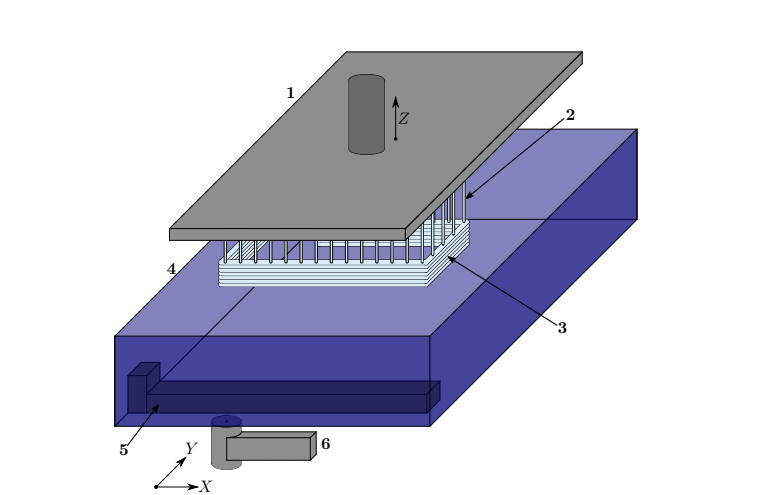
SLA based machine
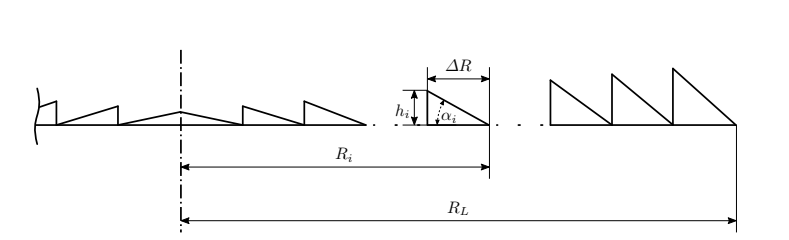
Design of a fresnel lens
“The manufactured and post-processed fresnel lenses are evaluated to measure the attenuation of the light beam and focal length. A four-channel fiber-coupled benchtop laser source from Thorlabs is used as light source for the experiments. It emits the light beams of wavelengths 635 nm, 850 nm and 1550 nm. Additionally, the refractive index of the unprocessed material and lacquered material is also analyzed using Snell’s law,” explained the researchers.
Print Settings and Optimization
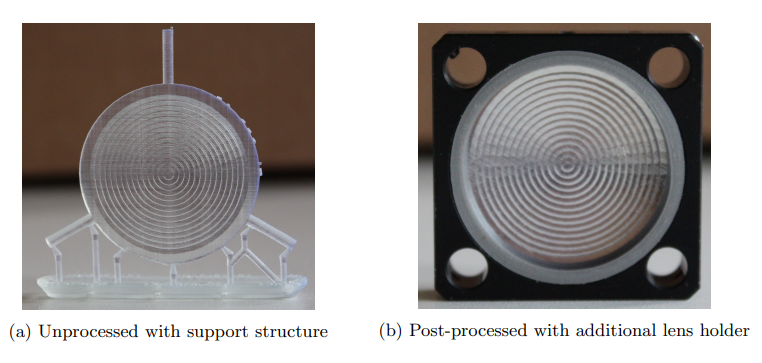
Comparison of an unprocessed and post-processed fresnel lens
A Form 2 was used for 3D printing with transparent resin (PMMA). Lenses were printed with supports to be removed afterward, with post-processing required via hand polishing and then lacquering for a smoother surface.
Strength and Durability Testing
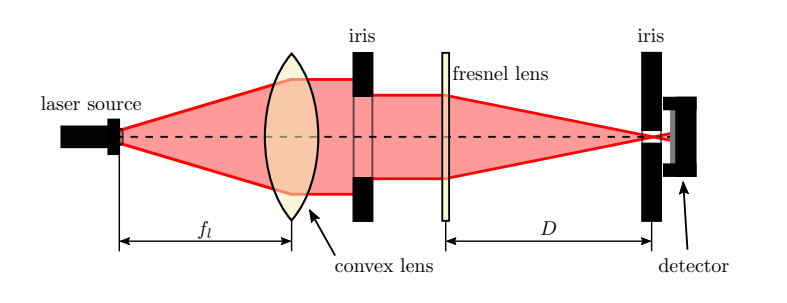
Experimental setup for measurement of focal length
The researchers just performed numerous experiments to establish focal length, attenuation, refractive index of the material being used, and then further calculations.

Cost and Availability Considerations
Experimental setup for measurement of attenuation
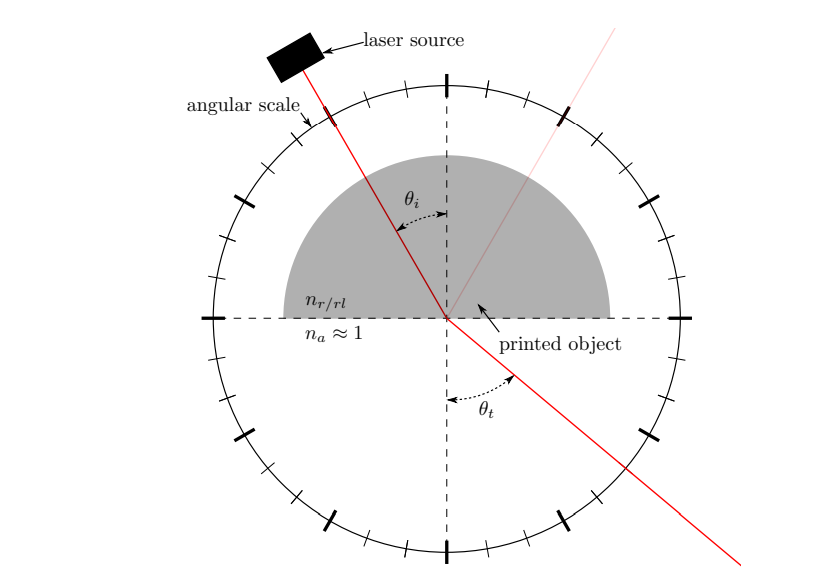
Experimental setup to calculate the refractive index of the material
“As expected, the attenuation of the printed fresnel lens is higher than the attenuation of the convex lens,” concluded the researchers. “For every measured wavelength, the attenuation of the convex lens is same but in case of printed fresnel lens the attenuation decreases gradually with respect to increase in wavelength. The focal length of the fresnel lens prototype shows 10 mm deviation as compared to the focal length of the convex lens.”
Advanced and Specialty Filaments
“The use of fresnel lenses in optical wireless communication applications is being tested. The further tests on the fresnel lenses include the post-processing using dip/resin coating. AM of optics and hence the fresnel lenses will be a mainstream production technique in the coming decades. It is necessary to manufacture and test the fresnel lenses using different AM techniques. After the analysis of manufactured fresnel lenses and the evaluation of results, it can be concluded that it is feasible to manufacture the fresnel lenses cost-effectively using SLA and post-processing.”
3D printing has played a part in the production of lenses from deposition heads in 3D printing, to camera lenses, and customized optics. What do you think of this news? Let us know your thoughts! Join the discussion of this and other 3D printing topics at 3DPrintBoard.com.
[Source / Images: ‘Manufacturing and analyzing of cost-efficient Fresnel lenses using stereolithography’]
The post Germany: Researchers Evaluate SLA 3D Printing of the Fresnel Lens appeared first on 3DPrint.com | The Voice of 3D Printing / Additive Manufacturing.
Frequently Asked Questions
What is the best 3D printing filament for beginners?
PLA is the best starting filament — it prints easily at 190-220°C without an enclosure and produces good results. Once comfortable, PETG offers better strength and temperature resistance for functional parts.
How do I choose the right filament?
Consider the application: PLA for display models, PETG for functional parts, ABS/ASA for heat/sunlight exposure, TPU for flexible parts, and specialty filaments for engineering applications. Each has specific printer requirements.
What temperature should I print different filaments at?
PLA: 190-220°C nozzle / 50-60°C bed. PETG: 220-250°C / 70-80°C. ABS: 230-260°C / 100-110°C (enclosure needed). Nylon: 240-270°C / 70-90°C. Always check manufacturer recommendations for specific brands.
📌 Related Articles
- 3D Printing Tungsten Carbide: How Hot-Wire Laser Technology Creates Metal Harder Than Steel
- The Complete 3D Printing Filament Guide: Types, Properties & When to Use Each
- Bambu Lab P1S Review: The Enclosed CoreXY Speed Demon That Just Works
- Creality K2 Plus Combo Review: Multi-Color Mastery with Room to Spare
- Best Budget 3D Printer Upgrades That Actually Improve Print Quality: Belts, Springs, Hotends & More