
UK researchers from Queen’s University Belfast are focused on how 3D printing can assist in serious healthcare issues, releasing the findings of their latest study in the recently published ‘Additive Manufacturing Can Assist in the Fight Against COVID-19 and Other Pandemics and Impact on the Global Supply Chain.’
No one was prepared for a pandemic that would shut down much of the world for months, not to mention what would also grow into further horror as devices like ventilators and protection for medical professionals were in short demand globally. Resourceful students and makers took to their 3D printers quickly, offering items like face shields and masks, as well as open-source ventilators. For this study, the researchers delved further into the effects on the supply chain, as well as the potential outcome for patients, studying the ‘unprecedented situation’ of a community coming together to begin providing much-needed personal protective equipment (PPE).
The Role of 3D Printing in Medicine
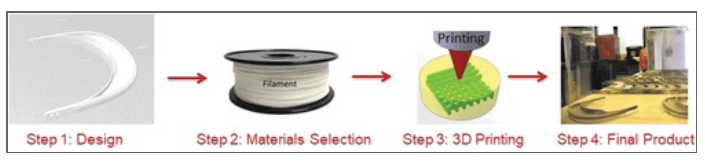
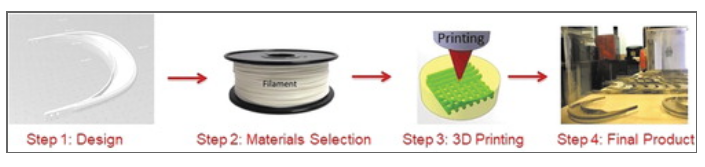
Fused deposition modeling 3DP process of a face shield. 3DP, three-dimensional printing.Fused deposition modeling 3DP process of a face shield. 3DP, three-dimensional printing.
“The ‘maker’ or ‘citizen supply chain’ community across the world, with collaborators from industrial and academic institutions, organized and established enormous networks in a short period, to distribute 3D-printed items to health care professionals,” stated the researchers.
“This initiative is the biggest “collaborative project” in the modern history following the spirit of the “RepRap2” initial project.”
It is clearly true also, that 3D printing has been in the headlines almost daily, in association with the creation of medical devices and peripheral parts for hospitals and patients in dire need.
Biocompatible Materials and Processes
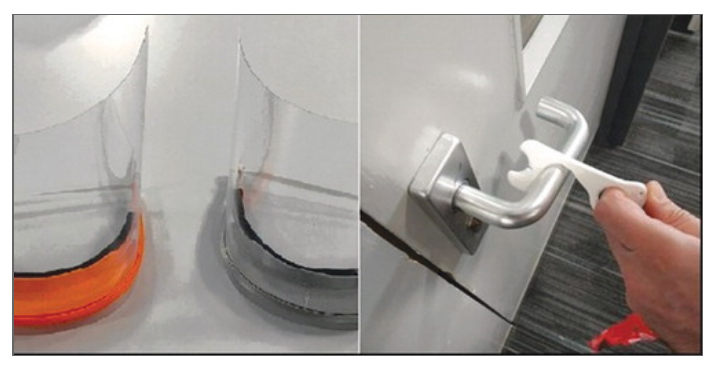
Examples of 3D-printed face shield and door openers prepared by the School of Pharmacy Queen’s University Belfast, donated to health care professionals. The face shields were made of a 3D-printed part (gray/orange part), an acetate sheet as visor, an elastic band, and foam to protect the forehead. These designs were approved by the infection control unit of the Belfast Health & Social Care Trust.
As we have covered at 3DPrint.com also, the question of materials and what is safe for use must continue to be examined:
“It is very important to emphasize that not all 3DP items that have been reported are appropriate to be used in COVID-19 health centers before getting approval by a regulatory body (e.g., U.S. Food and Drug Administration [FDA]), as they have to provide a certain degree of protection to these health care professionals and/or have to be safe for the patients (e.g., use of valves and ventilators).
Clinical Applications and Case Studies
Surgical masks and N95 respirators have been in demand worldwide also, creating much controversy as governments have been criticized for not backing faster production or distribution of such items when they are so badly needed. Manufacturers are focused on producing them, but such items are also highly regulated; because of that, 3D printed items may not be safe in terms of giving enough protection against fluids and potential germs. Copper and a variety of composites that may be able to offer antimicrobial properties within 3D printed materials are being examined for use.
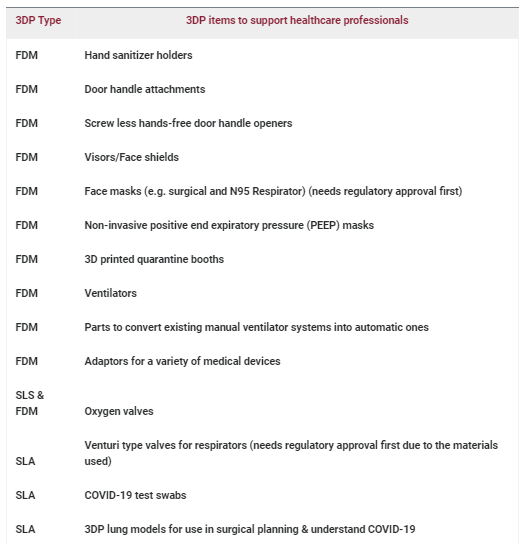
‘Printing farms’ are becoming more common too, as large 3D printing companies offer facilities to assist in keeping up with the need for medical devices, focusing on FDM 3D printing, SLS, and SLA. Companies such as Volkswagen, Ferrari, and BMW have also been using their manufacturing sites for 3D printed medical products.
“All these examples have shown that 3DP is nowadays an emergent valuable technology to support in a pandemic and boost supply chain. Very soon, every hospital will have a 3DP department that will be responsible for manufacturing bespoke items in-house,” concluded the researchers.
Regulatory Considerations and Safety
“The “citizen supply chain” has proven to be a strong initiative/solution to unlock the potential of 3DP in future supply chains and be a game changer in many industrial sectors. However, it is very important that all safety considerations/regulations are to be followed when a 3DP item is proposed to be used in a hospital environment as not all designs or/and materials used can provide an appropriate physical barrier.”
What do you think of this news? Let us know your thoughts! Join the discussion of this and other 3D printing topics at 3DPrintBoard.com.
Research Breakthroughs and Innovations
3D Printed Examples, Reported in the News, in the Fight Against COVID-19
[Source / Images: ‘Additive Manufacturing Can Assist in the Fight Against COVID-19 and Other Pandemics and Impact on the Global Supply Chain’]
The Future of Bioprinting and Medical AM
The post 3D Printing in the Fight Against COVID-19 “The Citizen Supply Chain’’ appeared first on 3DPrint.com | The Voice of 3D Printing / Additive Manufacturing.
Related Articles
Frequently Asked Questions
How is 3D printing used in medicine?
3D printing is used in medicine for surgical planning models, custom implants, bioprinting tissue scaffolds, drug delivery systems, dental aligners, and prosthetics. It enables patient-specific solutions that improve outcomes and reduce surgery time.
What materials are biocompatible for 3D printing?
Common biocompatible materials include PEEK, titanium alloys (Ti6Al4V), bio-ceramics (hydroxyapatite), medical-grade resins, PLA for temporary implants, and hydrogels for bioprinting. Material choice depends on the application and required mechanical properties.
Is 3D printed medical equipment FDA approved?
Yes, several 3D printed medical devices have FDA clearance, including orthopedic implants, dental restorations, and surgical guides. Each device must go through the appropriate regulatory pathway based on its risk classification.
📌 Related Articles
- The Current State of Metal 3D Printing in 2020
- ABS 3D Printing Settings Guide: Temperature, Enclosure, and Cooling for Strong Parts
- 3D Printing Safety Equipment Guide: Respirators, Gloves, and Ventilation for 2026
- Best Budget 3D Printer Upgrades That Actually Improve Print Quality: Belts, Springs, Hotends & More
- How Divergent Technologies Is 3D Printing Cruise Missiles for the U.S. Military