
According to SmarTech Analysis, aluminum alloys accounted for nearly 10% of 3D printed metal content last year, leading to a 43% growth in shipments of aluminum powder. This is due both to the technological advancements being made in aluminum 3D printing and in the utility of the material, which offers remarkable lightweight characteristics at a fraction of the cost of titanium. As the market it expands, aluminum has grown beyond aerospace applications and is increasingly being adopted by the automotive market.
However, aluminum AM has been the domain of laser powder bed fusion (PBF) technologies, with directed energy deposition (DED) of aluminum typically used for materials research and the exploration of printing large aerospace structural parts. In particular, powder DED, as opposed to wire DED, has played a less significant role in aluminum printing.
The State of Metal 3D Printing
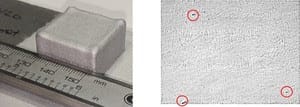
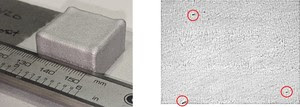
An aluminum alloy block deposited with LENS DED (left). Optomec highlights “the very smooth surface finish. Optical micrograph of polished and unetched sample from the same block” (right) and “the low fraction of gas porosity (circles) measured at ~0.1% using image analysis with gray scale thresholding.” Image courtesy of Optomec.
Powder DED leader Optomec is aiming to change that by announcing the use of its LENS DED systems for printing and repairing aluminum parts. This new material now complements Optomec’s existing material portfolio, which includes steels, titanium, nickel and copper.
The company suggests that its LENS process can be used to print or repair parts for the transportation and aerospace sectors, with its simultaneous five-axis system capable of doing so without support structures. To ensure stable deposition of aluminum, printing takes place within an argon gas atmosphere with low oxygen and moisture levels. David Otazu, LENS Applications Engineer, said, “Our engineers have developed process parameters for aluminum alloys to provide an excellent surface finish, high deposition rates and a density of ~99.9 percent.”
Within aerospace, where DED and aluminum for AM are both most highly represented, DED is most widely being explored for use in producing large near-net shape fuselage components and turbine blades, in which wire-based DED is usually more advantageous, and for repairing or adding features to existing parts, where powder DED is more advantageous.
Technical Challenges and Solutions
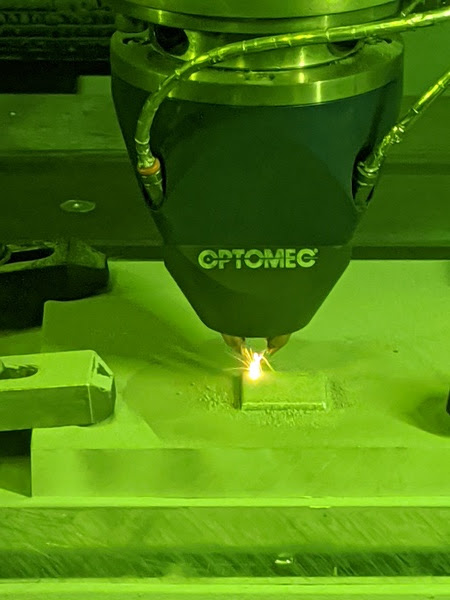
An Optomec deposition head 3D printing an aluminum block onto a substrate. Image courtesy of Optomec.
As for the automotive space (which SmarTech values at $9B for AM by 2029), aluminum, as well as lightweight steels and composites, is expected to be used increasingly to lower the density of vehicles in order to reduce emissions—though this has been offset by larger and greater numbers of vehicles. See also: 3D Printing News: Multi-Material Breakthrough and …. Aluminum printing is already used for prototyping in the industry; however, this is mostly via PBF, with metal binder jetting on the horizon. PBF has been used able to produce some impressive end use parts, due to DED’s ability to produce large, near net-shape parts, it has so far been limited to tooling.
While Optomec suggests that its LENS systems can process “any” aluminum alloy, it lists aluminum 4047 alloy on its site specifically. Al4047 is typically a brazing or filler alloy made up of 11 to 13 percent silicon, often used for repairs in aerospace and the automotive industry. So, it wouldn’t be surprising if the company’s customers were looking to use it for these purposes.
If the technology can handle a wide variety of aluminum alloys, there’s the likelihood that applications can expand beyond repair and tooling. This latest material development follows on the qualification of copper for printing with Optomec’s LENS technology, is a part of the company’s gradual growth overall, which includes the acquisition of Huffman (bringing it further into the aerospace and energy markets).
Material Properties and Performance
The post Optomec Introduces Aluminum to DED Metal 3D Printing appeared first on 3DPrint.com | The Voice of 3D Printing / Additive Manufacturing.
Related Articles
Frequently Asked Questions
What is metal 3D printing?
Metal 3D printing (additive manufacturing) builds metal parts layer by layer using techniques like laser powder bed fusion, directed energy deposition, and binder jetting. It enables complex geometries impossible with traditional manufacturing while reducing material waste significantly.
How strong are 3D printed metal parts?
3D printed metal parts can achieve mechanical properties comparable to traditionally manufactured metals. Tensile strength and fatigue resistance depend on the process and post-processing, but many meet or exceed ASTM standards for wrought materials.
What are the main metal 3D printing technologies?
The primary technologies include Laser Powder Bed Fusion (LPBF), Electron Beam Melting (EBM), Directed Energy Deposition (DED), Binder Jetting, and Metal FDM (with bound filaments). Each has different strengths in terms of resolution, speed, and material options.
📌 Related Articles
- 3D Printing Tungsten Carbide: How Hot-Wire Laser Technology Creates Metal Harder Than Steel
- 3D Printing News: Multi-Material Breakthrough and Aerospace Market Boom
- The Current State of Metal 3D Printing in 2020
- How Divergent Technologies Is 3D Printing Cruise Missiles for the U.S. Military
- ABS 3D Printing Settings Guide: Temperature, Enclosure, and Cooling for Strong Parts