

The National Aeronautics and Space Administration (NASA) is calling it “the start of the Artemis generation of astronauts.” The Artemis program plans to take the first woman and next man to the lunar surface by 2024 and is turning out to be one of the most ambitious programs of the agency as well as a significant milestone for space history of this decade. To accomplish their goal, NASA has been partnering with the US industry and on April 30, announced the three companies that were selected to design and develop the human landing systems (HLS) for the program.
Aerospace manufacturers Blue Origin and SpaceX, along with applied sciences company Dynetics, have been chosen to design and build three lunar landing systems that can take humans to the surface of the Moon. We have also learned that the Dynetics team will be composed of a broad and diverse set of businesses as well as academical experts, among them, a multidisciplinary faculty research team from Tuskegee University’s College of Engineering that will test and evaluate additively manufactured (AM) materials and parts, namely, those produced through 3D printing processes.

Dynetics, a wholly-owned subsidiary of Leidos, is one of the prime contractors and system integrators of the HLS awards under the Next Space Technologies for Exploration Partnerships (NextSTEP-2), with a total combined value for all awarded contracts at almost one billion dollars for the 10-month base period. Dynetics claims that its mission in designing the HLS will ensure affordability by leveraging habitat, power, thermal, and other subsystems from heritage spaceflight programs. Dynetics expects to provide a robust, commercially supported lander capability that is easily adaptable for civil and commercial exploration, by using modern technology to enable near-term reusability and sustainability.
Understanding Filament Properties
Moreover, as the project’s only university-based research team, Tuskegee engineering faculty researchers will test and evaluate AM materials and parts, this includes tensile and fatigue testing studies to assess their quality and durability in meeting the environmental demands on the HLS Integrated lander. They expect the metallurgical evaluation to also help establish the microstructure-processing-property relationship of these 3D printed materials and parts that have different challenges in standardization, qualification, and certification compared to standardly manufactured ones.
“Tuskegee University is proud to join this illustrious team helping the nation land astronauts on the moon by 2024,” said Heshmat Aglan, dean of Tuskegee’s College of Engineering, in Alabama. “Our College of Engineering’s state-of-the-art facilities in additive manufacturing and materials processing and characterization have placed us in a strong position to join such a significant undertaking. This project provides real-time engineering opportunities as the College of Engineering educates the next generation of scientists and engineers.”
Material Comparison and Selection
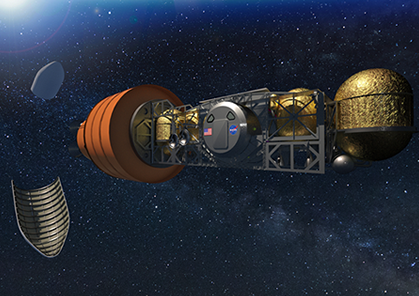
Tuskegee asserted that the Dynetics approach enabling near-term reusability and sustainability of the HLS will be ideal for the system’s crew module, which is designed to accommodate two crew members for nominal missions from lunar orbit to the lunar surface and back, including surface habitation for about a week. And that, alternatively, it can ferry up to four suited crew members to or from the lunar surface.
Dynetics is working on a “single structure” system to land on the moon. Its vehicle would be sent aloft on the Space Launch System (SLS), Block 1B vehicle, a new super heavy-lift expendable rocket that has been under development for NASA’s future deep-space exploration missions by Boeing since its announcement in 2011. The SLS is expected to provide the foundation for human exploration beyond Earth’s orbit. And the next planned evolution of the SLS, the Block 1B crew vehicle, will use a new, more powerful Exploration Upper Stage (EUS) to enable more ambitious missions. The Block 1B vehicle can, in a single launch, carry the Orion crew vehicle along with exploration systems like a deep space habitat module. Moreover, Tuskegee indicated that for commercial launches, the Dynetics HLS could be flown aboard United Launch Alliance (ULA)’s Vulcan Centaur rocket.
“Dynetics is excited to lead this expert team of subcontractors that will return Americans to the lunar surface,” said Kim Doering, vice president of Space Systems at Dynetics. “This team has a proven history of technical excellence, and their contributions will greatly benefit the future of space exploration.”
Print Settings and Optimization
Based in Huntsville, Alabama, Dynetics has a team of 25 subcontractors working with it on the project including, ULA, Italian company Thales Alenia Space, Paragon Space Development, and Sierra Nevada Corporation.
Developing the lander is crucial to the Artemis moon program. The three contractors will work on their designs through next February when the agency will evaluate which of them will perform an initial demonstration mission. NASA will later select the firms for the development and maturation of sustainable lander systems followed by sustainable demonstration missions. After these demonstrations are complete, the agency intends to procure transportation to the lunar surface as commercial space transportation services. During each phase of development, NASA along with its partners will use critical lessons from earlier phases to hone the final concepts that will be used for future lunar commercial services.
NASA administrator, Jim Bridenstine said yesterday that “America is moving forward with the final step needed to land astronauts on the Moon by 2024,” which is one of the White House space objectives for this decade. Known as the President’s Space Policy Directive-1, it will “lead an innovative and sustainable program of exploration with commercial and international partners to enable human expansion across the solar system.” With the agency’s budget for next year at $25.2 billion dollars, the 12% increase from the previous year will be used to support an accelerated lunar program with the 2024 crewed landing goal in mind.
Strength and Durability Testing
The last lunar landing by humans, the Apollo 17 mission, took place in 1972. See also: ABS 3D Printing Settings Guide: Temperature, Enclo…. As the next step towards the long-term goal of returning astronauts to the Moon and establishing a sustainable presence on-site, NASA is quickly moving onward with their plan. The Moon has remained a great interest and now top tier companies will help lead the next generation of American astronauts to the Moon and beyond.
Cost and Availability Considerations
Human Lander (Credit: Dynetics)
The post NASA’s Lunar Lander: Tuskegee Will Test AM Parts for the Dynetics Team appeared first on 3DPrint.com | The Voice of 3D Printing / Additive Manufacturing.
Related Articles
Frequently Asked Questions
What is the best 3D printing filament for beginners?
PLA is the best starting filament — it prints easily at 190-220°C without an enclosure and produces good results. Once comfortable, PETG offers better strength and temperature resistance for functional parts.
How do I choose the right filament?
Consider the application: PLA for display models, PETG for functional parts, ABS/ASA for heat/sunlight exposure, TPU for flexible parts, and specialty filaments for engineering applications. Each has specific printer requirements.
What temperature should I print different filaments at?
PLA: 190-220°C nozzle / 50-60°C bed. PETG: 220-250°C / 70-80°C. ABS: 230-260°C / 100-110°C (enclosure needed). Nylon: 240-270°C / 70-90°C. Always check manufacturer recommendations for specific brands.
📌 Related Articles
- The Current State of Metal 3D Printing in 2020
- ABS 3D Printing Settings Guide: Temperature, Enclosure, and Cooling for Strong Parts
- Best Budget 3D Printer Upgrades That Actually Improve Print Quality: Belts, Springs, Hotends & More
- 3D Printing News: Multi-Material Breakthrough and Aerospace Market Boom
- Best 3D Printer Upgrades That Actually Improve Print Quality: Complete 2026 Guide