
Dayton Phillip Street recently presented his doctoral dissertation, ‘Enhancing the Macroscopic Properties of Parts Printed via Fused Filament Fabrication by Incorporating Nanoscopic Additives,’ at the University of Tennessee. With a focus on creating additives for fused filament fabrication (FFF), Street strives to improve the ‘inferior performance’ of 3D printed polymeric materials.
Polymers are widely used today in many manufacturing applications, and commonly within the 3D printing and additive manufacturing realm. Challenges abound though, which is why the use of additives has becomes so prevalent, along with composites that feature materials like TPU and PLA, carbon fiber and epoxy, antioxidants, and many more.
Understanding Filament Properties
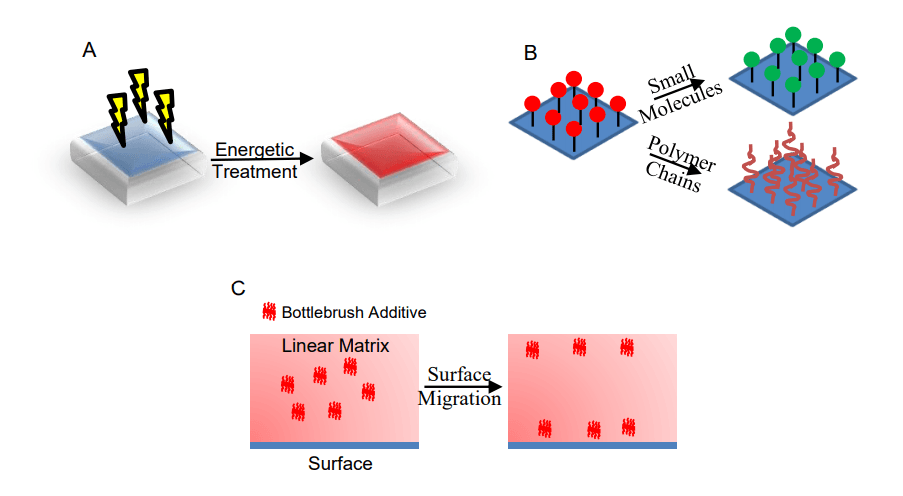
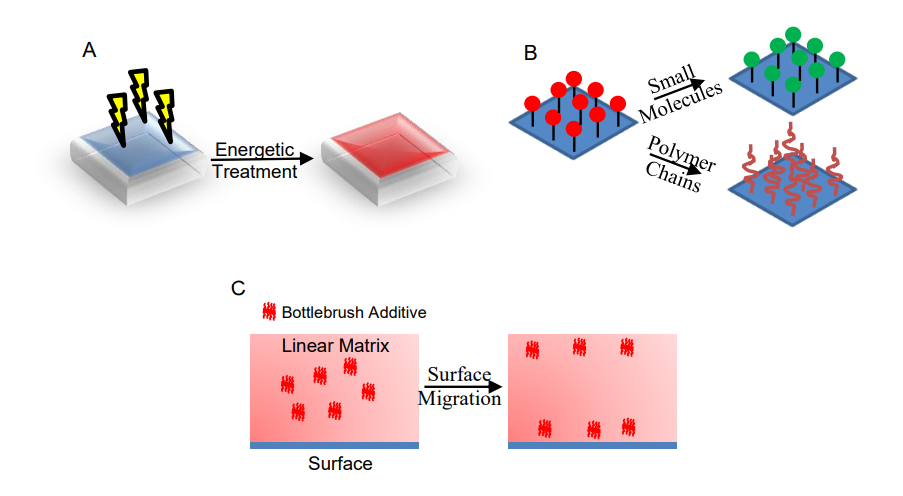
The surface properties of polymeric materials can be altered using myriad
methods such as (A) energetic treatments, (B) chemical modification, and (C) surface active additives.
Many FFF 3D printed parts are prone to issues related to adhesion, cavities, or beads. While these types of problems are common within FFF printing, Street believes that with polymer nanocomposites and ‘active’ additives, mechanical properties can be improved significantly.
Part of the problem in using polymers for FFF 3D printing is that they are already limited in terms of performance—leaving many researchers to delve further into the study of composites. There has been a focus on nanocomposites specifically. These materials are comprised of inorganic additives that possess at least one dimension on the nanoscale, according to Street.
Material Comparison and Selection
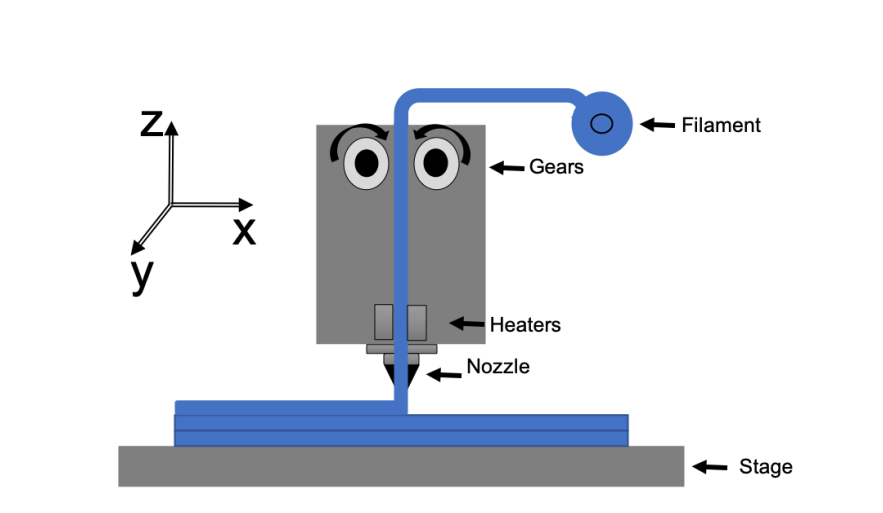
Illustration of how FFF can be used to generate polymeric scaffolds from
polymer feedstock. FFF operates by heating a thermoplastic filament to a semi-molten state and extruding it in a layer-by-layer, or “bottom-up”, build process.
Polymer nanocomposites display excellent mechanical properties in comparison to original polymers without additives.
“By blending the properties of hard and soft matter, polymer nanocomposites allow one to retain the processability associated with polymers while improving the material performance,” explains Street. “However, it is well-known that the material properties of polymer nanocomposites depend significantly on interfacial interactions between the inorganic additive and polymer matrix.”
Print Settings and Optimization
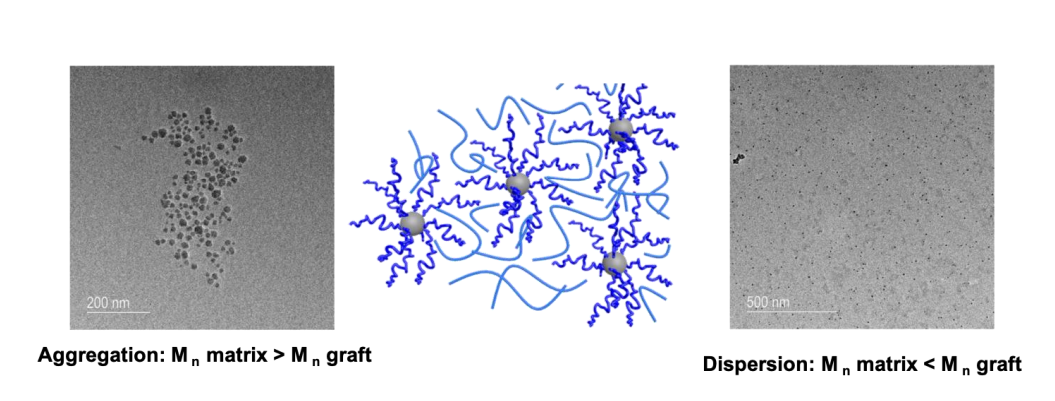
The nanoscale organization of densely-grafted nanoparticles in a symmetric, athermal, system is controlled by entropic interactions. Specifically, when the matrix chain molecular weight is larger than the graft chain molecular weight particle clusters are observed, while dispersed particles are observed when the matrix chain molecular weight is smaller than the graft chain molecular weight.
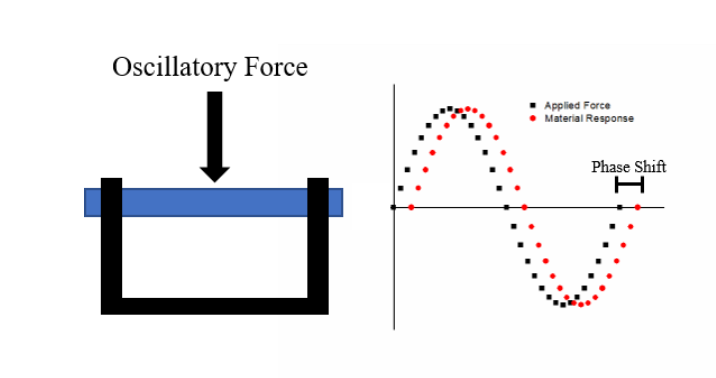
DMA works by applying an oscillating force to a sample and measuring the sinusoidal response. By observing differences in the phase shift and/or amplitude one can investigate the thermomechanical properties of polymeric materials.
Strength and Durability Testing
At least five samples were created for each measurement type on a LulzBot Mini 3D printer:
“Each sample was printed in the X-Y plane at 230 °C with a +45/−45 raster angle. The bed temperature was set to 110 °C. In a typical print, the printer settings were as follows: 0.5 mm nozzle size, 0.425 mm initial layer thickness, 0.25 mm layer height with a 100% fill density, and all other settings were left at standard values set by the Cura software for ABS,” explained Street.
Cost and Availability Considerations
“After each print and in order to minimize sample deformation, the bed was allowed to cool to room temperature prior to removing the sample.”
In evaluating how nanoscopic additives would affect macroscopic properties of parts fabricated via FFF printing, Street performed rheological assessments, tensile testing, and dynamic mechanical analysis (DMA). By measuring the response of a material after DMA applies force, Street was able to determine ‘myriad thermomechanical properties.’ In studying the rheology (involving deformation and flow), Street was better able to understand polymer melt characteristics and effects on performance.
“Macroscopic assessments coupled with rheology measurements suggest that these interconnected sheet-like nanostructures effectively dissipate stress throughout the nanocomposite through graft chain interactions with matrix chains and graft chains on neighboring particles. Additionally, the mechanical performance of FFF-printed parts described in this work surpass those obtained when bare Si NPs were used, which further highlights how manipulating interfacial interactions in polymer nanocomposites, conveyed here by grafted polymer chains, controls organization on the nanoscale and affects the performance of polymer nanocomposites,” concludes Street.
Advanced and Specialty Filaments
“Results from this research show that the properties of parts printed from these multicomponent blends depend on the self-dimerization strength of the hydrogen bonding groups and the number density of non-bonded interactions. This work is impactful because it demonstrates how the strength and number density of non-bonded, physical interactions can tuned to effectively manage the properties of FFF-printed materials at use and production temperatures.”
What do you think of this news? Let us know your thoughts! Join the discussion of this and other 3D printing topics at 3DPrintBoard.com.
[Source / Images: ‘Enhancing the Macroscopic Properties of Parts Printed via Fused Filament Fabrication by Incorporating Nanoscopic Additives’]
The post FFF 3D Printing at University of Tennessee: Enhancing Macroscopic Properties with Nanoscopic Additives appeared first on 3DPrint.com | The Voice of 3D Printing / Additive Manufacturing.
Understanding Filament Properties
from Your daily news from 3DPrint.com http://bit.ly/2IUaBtp
Frequently Asked Questions
What is the best 3D printing filament for beginners?
PLA is the best starting filament — it prints easily at 190-220°C without an enclosure and produces good results. Once comfortable, PETG offers better strength and temperature resistance for functional parts.
How do I choose the right filament?
Consider the application: PLA for display models, PETG for functional parts, ABS/ASA for heat/sunlight exposure, TPU for flexible parts, and specialty filaments for engineering applications. Each has specific printer requirements.
What temperature should I print different filaments at?
PLA: 190-220°C nozzle / 50-60°C bed. PETG: 220-250°C / 70-80°C. ABS: 230-260°C / 100-110°C (enclosure needed). Nylon: 240-270°C / 70-90°C. Always check manufacturer recommendations for specific brands.
📌 Related Articles
- The Complete 3D Printing Filament Guide: Types, Properties & When to Use Each
- The Current State of Metal 3D Printing in 2020
- ABS 3D Printing Settings Guide: Temperature, Enclosure, and Cooling for Strong Parts
- Best 3D Printer Upgrades That Actually Improve Print Quality: Complete 2026 Guide
- Best Budget 3D Printer Upgrades That Actually Improve Print Quality: Belts, Springs, Hotends & More