
Hyeonjun Park and Donghan Kim of Kyung Hee University in Korea are innovating within the robotics realm, detailing their efforts in the recently published ‘An open-source anthropomorphic robot hand system: HRI hand.’
The HRI hand system is open source and affordable, allowing users to 3D print the system for around $500. Developed with a five-finger structure, the authors created the hand with collaborative robotics in mind. This is an idea that continues to grow in manufacturing, allowing robots to partner in completing tasks with human industrial workers. End-effectors are becoming more widely used too, used for gripping and assembly ‘beyond the simple pick-and-place operation of parts.’
How 3D Printing Responded to COVID-19
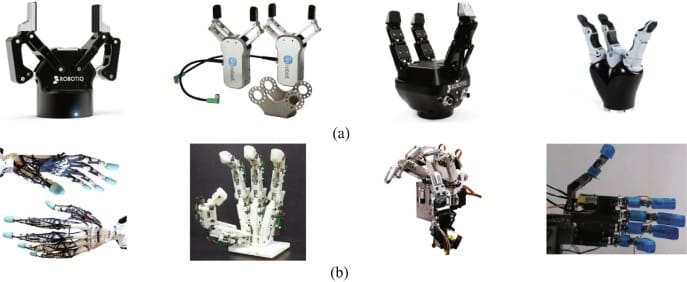
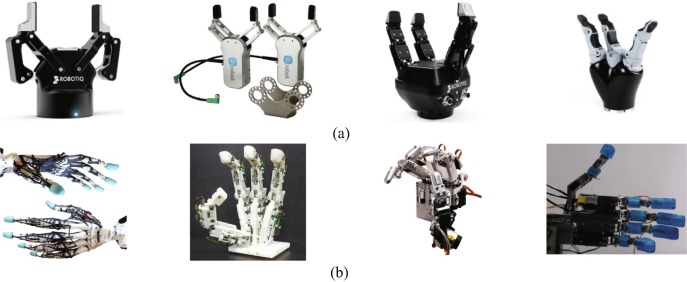
Two types of fingered end-effectors: (a) gripper type [9], [21], (b) anthropomorphic type
The typical robotic hand is available in both the gripper (the most common) type and the anthropomorphic, multi-finger type. While the gripper is most often employed by industrial users, it is only capable of the most basic tasks and incapable of providing support for operating machines or any jobs requiring precision. On the other ‘hand,’ the anthropomorphic type imitates the human hand in both form and function, featuring five fingers, and the ability to perform ‘broader applications than the simple gripper type.’
With more complex functions, however, comes the necessity for more complex parts and software such as actuators, a variety of mechanisms, and control algorithms that must be written.
HP and the Pandemic Manufacturing Shift
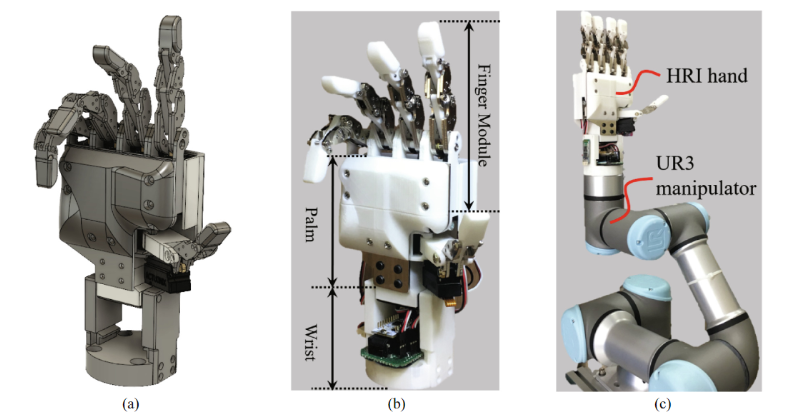
HRI hand: (a) 3D modeling, (b) proposed robot hand, and (c) HRI hand with UR3 manipulator
The anthropomorphic hand, designed after a typical male hand, has four fingers which include:
- Distal interphalangeal (DIP)
- Proximal interphalangeal (PIP)
- Metacarpophalangeal (MCP)joints
The thumb consists of:
- Interphalangeal (IP)
- Metacarpophalangeal (MCP)
- Carpometacarpal (CMC) joints
The thumb part “… operates MCP and CMC joints with two motors. The motor is controlled based on the control signal received by the micro-controller unit (MCU) via Bluetooth communication. A URDF, python node, and rviz package is also provided to support the Robot Operating System (ROS). All hardware CAD design files and software source codes have been released and can be easily assembled and modified,” explained the authors.
Supply Chain Disruptions and Digital Solutions
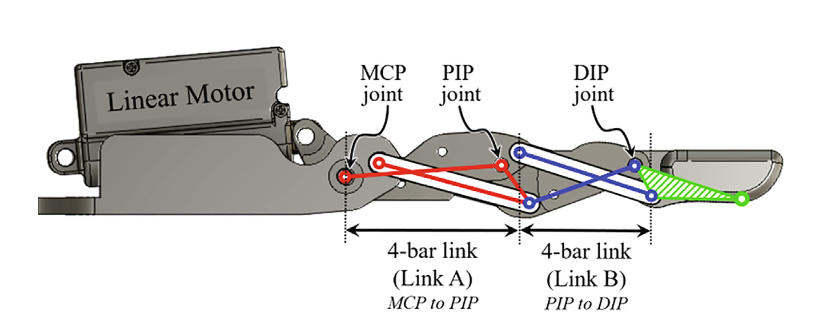
Finger modules include four links and three joints (MCP, PIP, and DIP joints).
Medical PPE and Equipment Production
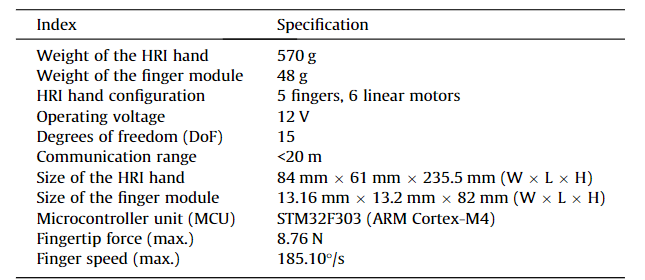
Specifications of the HRI hand
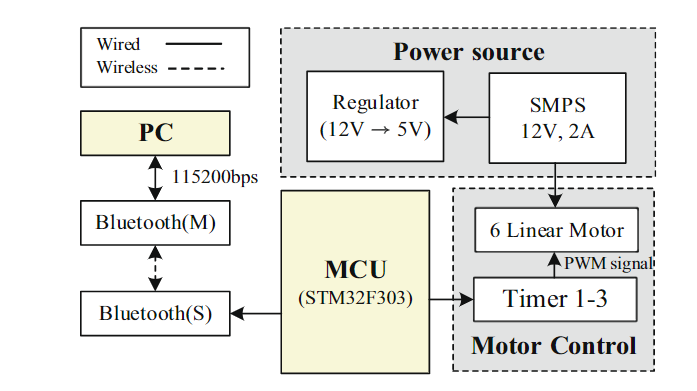
The architecture of the HRI hand system. Data protocol for controlling HRI hand.
Lessons Learned for Future Emergencies
Design of the finger module.
The research paper also includes all the details for hardware files, software files, assembly, electronics configuration, operation procedures, robot operating system procedure, and more.

How 3D Printing Responded to COVID-19
Assembly procedures for the HRI hand: (a) front of the finger, (b) back of the finger, (c) thumb part, (d) palm and palm cover, (e) wrist part, (f) back of the HRI hand cover and ISO 9409-1-50-4-M6 part
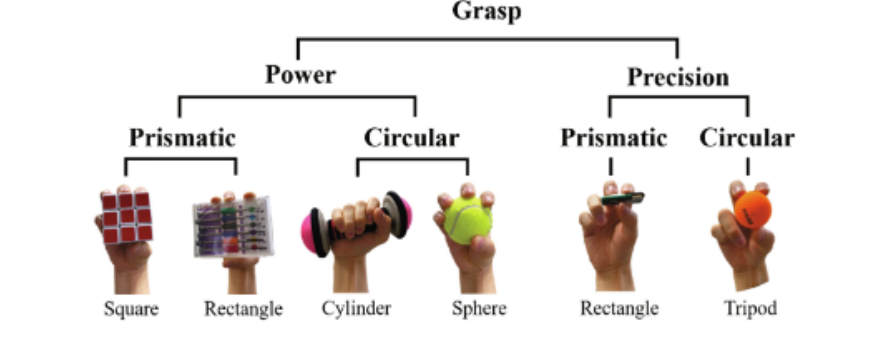
The grasp taxonomy
“The system proposed in this paper is developed with a five-finger structure, but each finger is modularized, so it can be developed with end-effectors of various shapes depending on the shape of the palm. For example, it is possible to construct various types of end-effectors depending on the researcher’s purpose, such as two-fingered grippers with two fingers or three-fingered grippers with three fingers,” concluded the authors.
HP and the Pandemic Manufacturing Shift
“For those interested in implementing a variety of robot applications using the pro-posed system, we would strongly encourage contacting the corresponding author to discuss potential collaboration.”
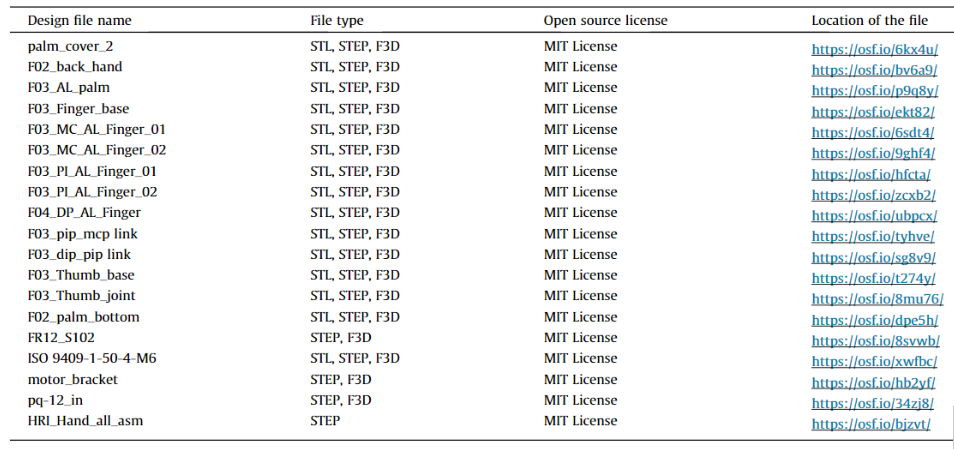
Design file summary for the HRI hand

Supply Chain Disruptions and Digital Solutions
The Bill of materials for the HRI hand system
[Source / Images: ‘An open-source anthropomorphic robot hand system: HRI hand’]
The post Korea: The 3D Printable Open-Source Anthropomorphic Robot Hand System (HRI) appeared first on 3DPrint.com | The Voice of 3D Printing / Additive Manufacturing.
from Your daily news from 3DPrint.com http://bit.ly/2W4cgEo
Frequently Asked Questions
How did 3D printing help during COVID-19?
During the COVID-19 pandemic, 3D printing enabled rapid production of critical medical supplies including face shields, ventilator components, nasal swabs, and PPE. Distributed manufacturing allowed makers worldwide to produce items locally without waiting for traditional supply chains.
What was the pandemic digital manufacturing shift?
The pandemic accelerated adoption of digital manufacturing including 3D printing, as companies sought more resilient supply chains. Organizations shifted from centralized to distributed production, using digital files to produce parts locally on demand.
Can 3D printing supply chains be resilient in emergencies?
Yes, 3D printing provides supply chain resilience through distributed manufacturing — designs can be shared digitally and produced anywhere with compatible equipment, eliminating the need for physical inventory and shipping of parts.
📌 Related Articles
- ABS 3D Printing Settings Guide: Temperature, Enclosure, and Cooling for Strong Parts
- cura 5.11.0 released
- The Complete 3D Printing Filament Guide: Types, Properties & When to Use Each
- Best Budget 3D Printer Upgrades That Actually Improve Print Quality: Belts, Springs, Hotends & More
- The Current State of Metal 3D Printing in 2020