
As 3D printing continues to offer a host of benefits in the manufacturing of components like antennas, researchers Shaker Alkaraki and Yue Gao explore new applications, outlining their findings in the recently published ‘mm-Wave Low Cost MIMO Antennas with Beam Switching Capabilities Fabricated Using 3D Printing for 5G Communication Systems.’
One of the greatest advantages 3D printing and additive manufacturing processes offer is the potential to save exponentially on the bottom line in manufacturing certain parts—as well as being able to create them on demand and in many cases, much faster than by conventional methods. In this study, the authors investigate 3D printing of prototypes for multiple input multiple output (MIMO) antennas for 5G and millimeter-wave (mm-wave) applications.
With comprehensive standardization in place by 2020, 5G wireless technology for mobile technology is meant to expand in capacity enormously—by several hundred times over in comparison to previous processes, as it will be used over several frequency bands. So far, most countries have agreed with the proposal to use the following millimeter-wave (mm-wave) frequencies:
- 24 GHz to 29.5 GHz
- 37 GHz to 42.5 GHz
- 2 GHz to 48.2 GHz
- 64 to 71 GHz
Along with speed and affordability, 3D printing also allows the researchers to develop complex shapes; in this case, however, the process is more effective when used with new metallization techniques that are significantly lower in cost. In the MIMO system, multiple antennas are to be used, although there are challenges such as signal losses in higher atmospheres and high cost for system components.
“The attenuation of the signal at mm-wave mainly depends on the propagation distance, weather conditions and operating frequency,” stated the authors. “Shadowing is another important source of signal losses.”
The goal is to 3D print high-performance antennas that are steerable and more efficient but without the typically associated high expense.
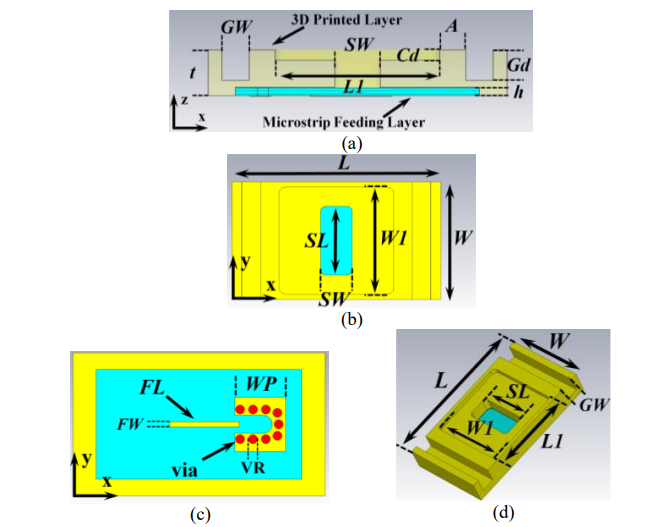
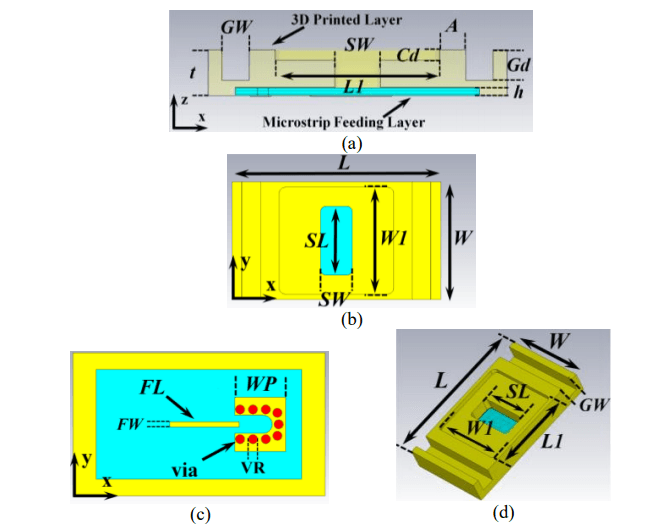
The schematic of the proposed single element antenna. (a) Cross section of front view, (b) top view, (c) bottom view, and (d) perspective view.
The MIMO antenna prototypes developed for this study are:
- Compact in design, measuring 2×2 and 4×3
- More affordable
- More efficient
- Offers beam-switching abilities without phased array technology

The dimension of the proposed single element antenna
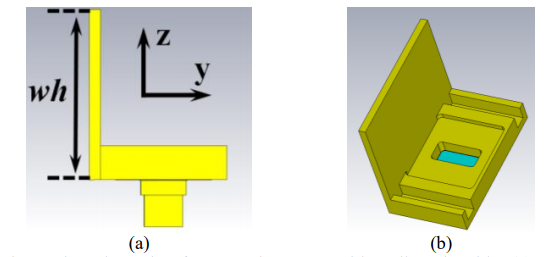
The schematic of proposed antenna with wall on its side. (a) Front view and (b) perspective view.
The antennas are comprised of two main parts:
- Feeding structure – microstrip made up of mini-smp ground plane/pad, vias and transmission line fabricated using RO4003C substrate with a dielectric constant of 3.38.
- Radiating structure – the 3D printed component, made up of a central slot surrounded by a rectangular cavity and two corrugations.
Creating both an asymmetric electric field and asymmetric surface current, one side of the antenna features a metallized wall. These elements steer the antenna beam, dependent on the wall height. The researchers note that ‘further increment within the wall height’ increases gain up to the point of saturation.
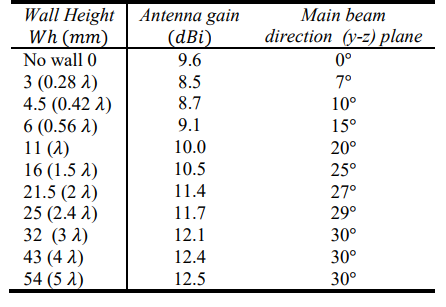
The relationship between wall height (𝑊ℎ), directivity and beam direction at 28 GHz. (𝜆 = 10.71 𝑚𝑚)
While the smaller antenna is made up of four elements providing radiation in the boresight direction, the larger prototype offers six elements just for providing radiation—and then another six for steering.

The effect of wall height (𝑤ℎ) on the radiation patterns of the antenna. See also: 3D Printing Tungsten Carbide: How Hot-Wire Laser T…. (a) 2D radiation patterns of H-plane (y-z plane) for different wall height in 𝑚𝑚, (b) 3D radiation patterns of the antenna with no wall 𝑊ℎ = 0 𝑚𝑚, (c) 3D radiation pattern for 𝑊ℎ = 4.5 𝑚𝑚, (d) 𝑊ℎ = 11 𝑚𝑚 and (e) 𝑊ℎ =25 𝑚𝑚.
“The beam of the 4 × 3 MIMO is steered mechanically through introducing a metallic wall with different height on the side of the radiating single element structure. The sidewall creates asymmetric electric field on the surface of the antenna, which reflects the beam of the antenna to the opposite direction.”
“The proposed sidewall is able to steer the beam of the MIMO up to 30° in the elevation plane. Finally, the performance of the proposed MIMO antennas are measured and found to operate as predicted by the numerical simulation tool,” concluded the authors.
3D printing is often a catalyst for greater innovation in creating parts like antennas, encouraging new concepts and expansion of traditional applications as researchers bring forth new projects featuring antennas for biomedical monitoring, polymer antennas for SAR systems, nanoantenna arrays, and more.
What do you think of this news? Let us know your thoughts! Join the discussion of this and other 3D printing topics at 3DPrintBoard.com.
[Source / Images: ‘mm-Wave Low Cost MIMO Antennas with Beam Switching Capabilities Fabricated Using 3D Printing for 5G Communication Systems’]
The post 5G Networks Benefit from 3D Printed Multiple Input Multiple Output (MIMO) Antennas appeared first on 3DPrint.com | The Voice of 3D Printing / Additive Manufacturing.
from Your daily news from 3DPrint.com http://bit.ly/2xhQNxf
Where to Buy Filament
Disclosure: Some of the links below are affiliate links. If you make a purchase, we may earn a commission at no extra cost to you. This helps support this site.
These links go to Amazon with our affiliate tag. If you prefer to support local retailers or buy directly from manufacturers, we encourage that as well!
Frequently Asked Questions
What is the best 3D printing filament for beginners?
PLA is the best starting filament — it prints easily at 190-220°C without an enclosure and produces good results. Once comfortable, PETG offers better strength and temperature resistance for functional parts.
How do I choose the right filament?
Consider the application: PLA for display models, PETG for functional parts, ABS/ASA for heat/sunlight exposure, TPU for flexible parts, and specialty filaments for engineering applications. Each has specific printer requirements.
What temperature should I print different filaments at?
PLA: 190-220°C nozzle / 50-60°C bed. PETG: 220-250°C / 70-80°C. ABS: 230-260°C / 100-110°C (enclosure needed). Nylon: 240-270°C / 70-90°C. Always check manufacturer recommendations for specific brands.
📌 Related Articles
- The Current State of Metal 3D Printing in 2020
- 3D Printing Tungsten Carbide: How Hot-Wire Laser Technology Creates Metal Harder Than Steel
- The Complete 3D Printing Filament Guide: Types, Properties & When to Use Each
- ABS 3D Printing Settings Guide: Temperature, Enclosure, and Cooling for Strong Parts
- Best Budget 3D Printer Upgrades That Actually Improve Print Quality: Belts, Springs, Hotends & More