
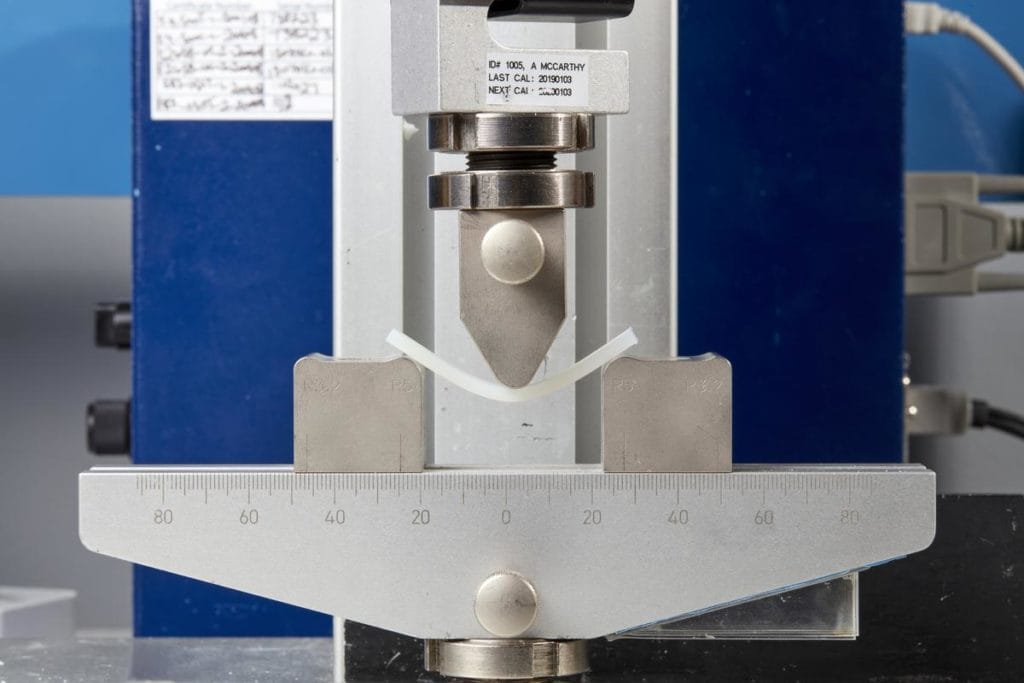
Formlabs is expanding its portfolio of 3D printing resins. The latest is Tough 1500, a stiff and pliable polymer that can bend and return to its former shape. Formlabs is targeting the material at engineers, product designers and manufacturers who need pliable parts.
In response to customer feedback, Formlabs developed Tough 1500 Resin as a middle ground between the two ends of the elasticity-toughness spectrum in Formlabs’ existing product range, which already includes durable materials on one end and elastic and flexible photopolymers on the other. Marketed applications include springs, snap fits, press fits and hinges that need to bend and rapidly bend back to shape. It can also be used for jigs and fixtures that must absorb impact and undergo continuous deflection. Formlabs also suggests that it can be used to prototype polypropylene parts.
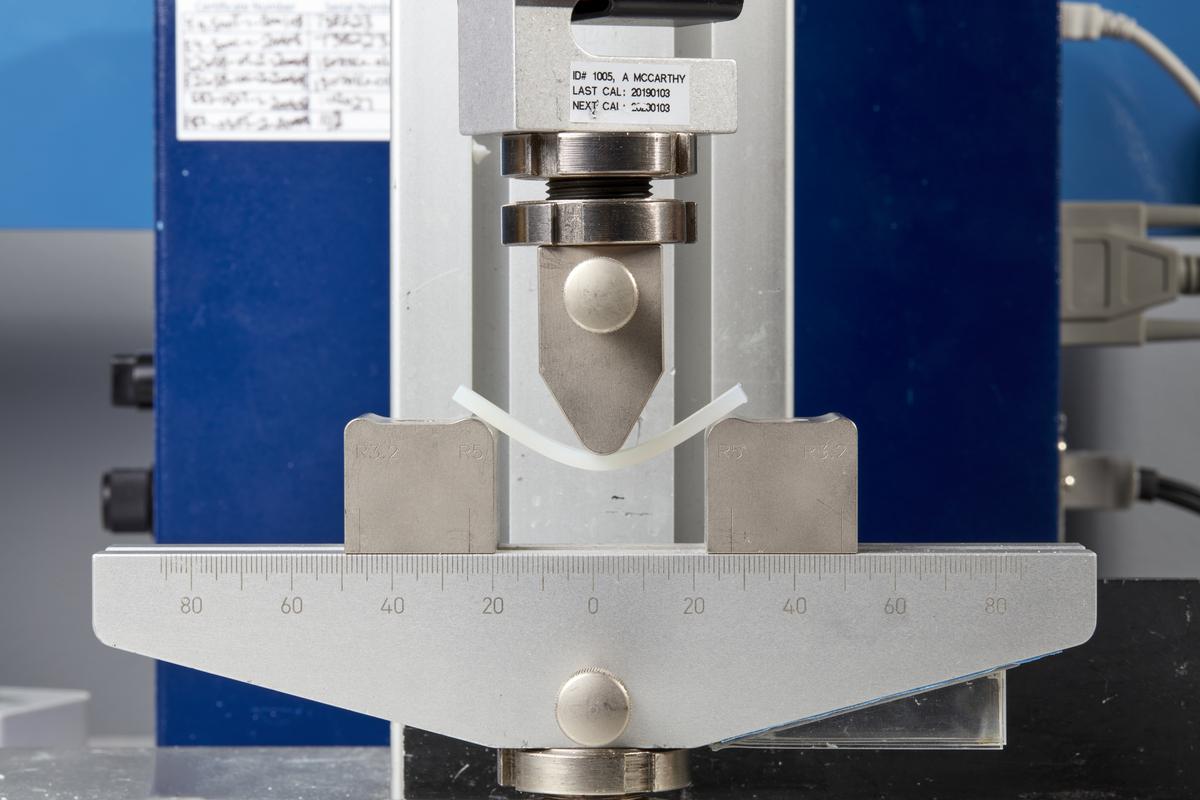
The “1500” in Tough 1500 represents the 1500 MPa tensile modulus of the material.
One customer using the material is Unplugged Performance, which offers upgrades to Tesla cars. Unplugged Performance is currently deploying Tough 1500 parts to install carbon fiber car bumpers onto vehicles. Without 3D printing, it would take about 45 minutes to remove each sensor mount from a bumper and then another 10 minutes to attach it onto the new one. With six such sensors on a car, this process, along with the other upgrades, would take about a day-and-a-half.
Now, the firm 3D prints new sensor mounts from Tough 1500 in 30-unit batches, meaning that the old sensor mounts do not need to be removed from the old bumpers and reattached. Unplugged workers simply bond the new, 3D-printed mounts directly to the vehicles, aiding the company in improving throughput to three cars per day.
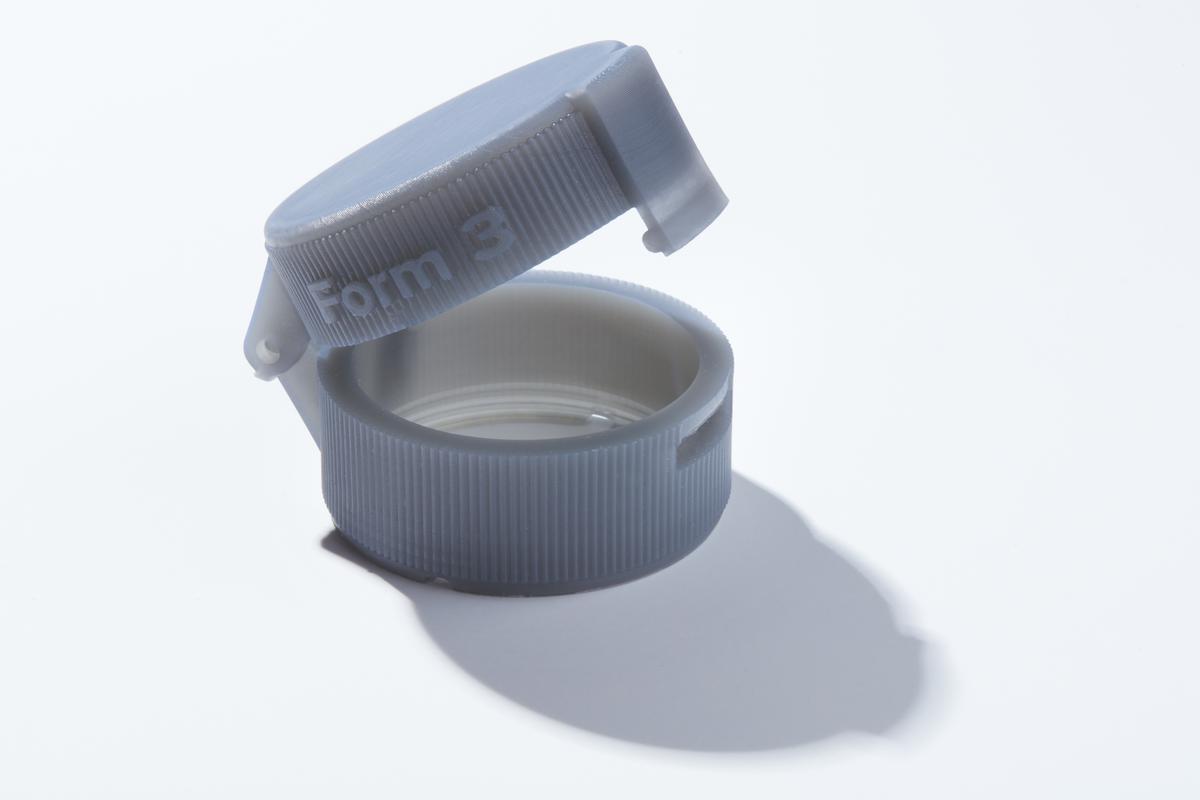
A 3D-printed prototype for a polypropylene cap.
Formlabs’ range of materials is growing slowly but steadily. By manufacturing its own photopolymers, the company is able to ensure the quality of the resins and that it works with its hardware. For hardware companies that sell their feedstock directly to their users, a continuous stream of revenue is generated. However, it also constrains the material range that users can rely on.
While companies such as Formlabs retain this razor-and-blade model, others like HP and Origin have adopted “open materials” platforms in which chemical companies work more or less directly with the hardware manufacturers to qualify their materials for use in their 3D printers. This frees up the material partners to develop their own feedstocks. The concept of open materials is being increasingly championed in a space that has previously been dominated by closed systems. Consider Jabil’s moves last year into material development, for instance.
As Formlabs continues to develop new materials, it will also have to do so for its new 3D printing technology line: low-cost selective laser sintering (SLS). The Fuse 1 3D printer should begin shipping mid-2020, at which point we will get a chance to see the material development strategy the company has for SLS powders, as well.
The post Formlabs’ Tough 1500 Resin: Stiff, Yet Pliable appeared first on 3DPrint.com | The Voice of 3D Printing / Additive Manufacturing.
from Your daily news from 3DPrint.com http://bit.ly/2OLUt0i
Where to Buy Filament
Disclosure: Some of the links below are affiliate links. If you make a purchase, we may earn a commission at no extra cost to you. This helps support this site.
These links go to Amazon with our affiliate tag. If you prefer to support local retailers or buy directly from manufacturers, we encourage that as well!
Related Articles
Frequently Asked Questions
What is the best 3D printing filament for beginners?
PLA is the best starting filament — it prints easily at 190-220°C without an enclosure and produces good results. Once comfortable, PETG offers better strength and temperature resistance for functional parts.
How do I choose the right filament?
Consider the application: PLA for display models, PETG for functional parts, ABS/ASA for heat/sunlight exposure, TPU for flexible parts, and specialty filaments for engineering applications. Each has specific printer requirements.
What temperature should I print different filaments at?
PLA: 190-220°C nozzle / 50-60°C bed. PETG: 220-250°C / 70-80°C. ABS: 230-260°C / 100-110°C (enclosure needed). Nylon: 240-270°C / 70-90°C. Always check manufacturer recommendations for specific brands.
📌 Related Articles
- The Current State of Metal 3D Printing in 2020
- Best Budget 3D Printer Upgrades That Actually Improve Print Quality: Belts, Springs, Hotends & More
- Best 3D Printer Upgrades That Actually Improve Print Quality: Complete 2026 Guide
- 3D Printing News: Multi-Material Breakthrough and Aerospace Market Boom
- 3D Printing Tungsten Carbide: How Hot-Wire Laser Technology Creates Metal Harder Than Steel