
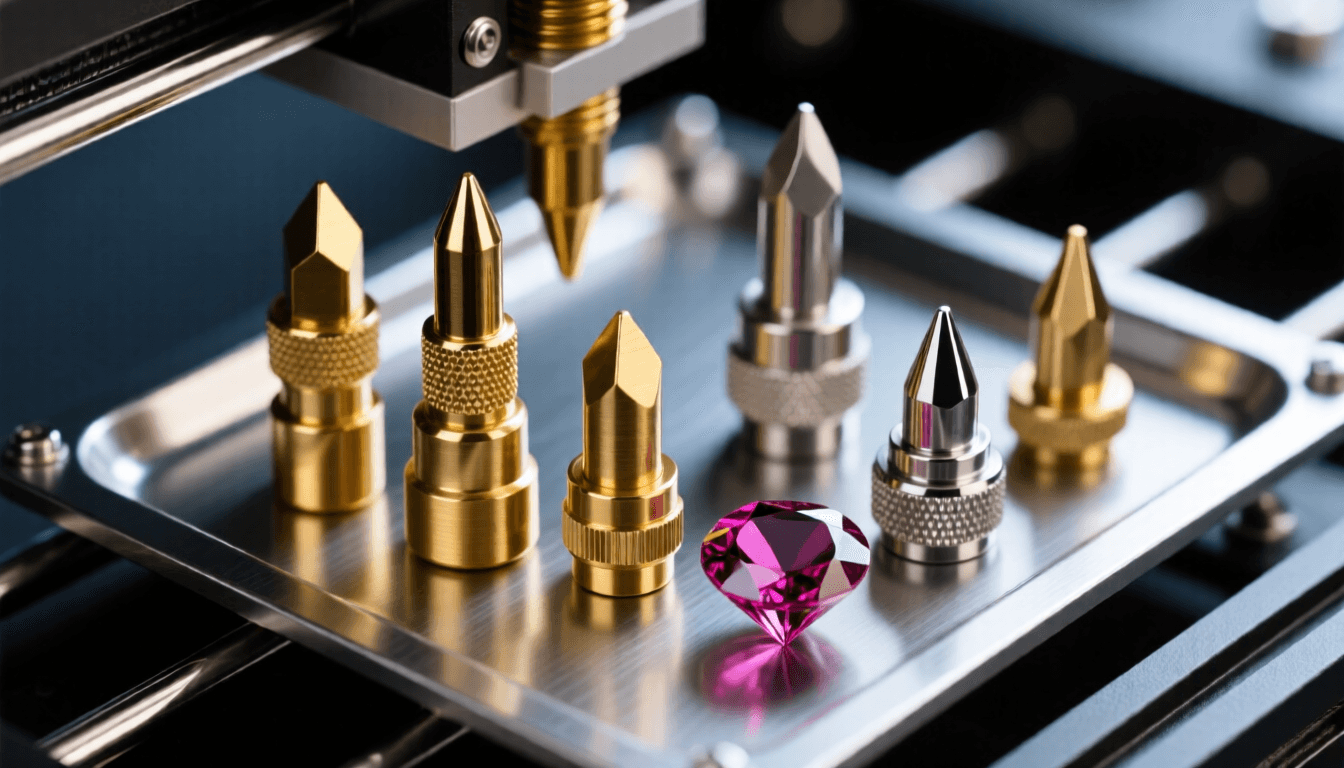
3D Printer Nozzles Explained: Brass vs Steel vs Ruby – Which One Do You Actually Need?
The ultimate guide to choosing the right nozzle material for your filaments
This article contains affiliate links. If you purchase through these links, we may earn a small commission at no extra cost to you. This helps support our site and allows us to continue creating valuable content for 3D printing enthusiasts.
What Filaments Do You Print? Start Here
The single most important factor in nozzle selection is your filament type. Different materials have dramatically different abrasive properties, and choosing the wrong nozzle leads to rapid wear, poor print quality, or clogs.
PLA, PETG, ABS, TPU
Use brass nozzles. These standard filaments are not abrasive and will not wear down brass. Brass provides excellent thermal conductivity for consistent printing at a budget price.
Carbon Fiber, Wood-Fill, Metal-Fill, Glow, Ceramic-Fill
Use hardened steel, ruby, or tungsten nozzles. These abrasive filaments contain particles that grind down brass in just 1-2 spools. Upgrade immediately to avoid constant nozzle replacement.
Brass Nozzles: The Standard Choice
Brass nozzles are the default for most 3D printers for good reason. They offer excellent thermal conductivity, smooth internal bores for clean filament flow, and are inexpensive enough to treat as consumables. For standard filaments like PLA, PETG, and ABS, brass delivers reliable results at unbeatable value.
Advantages
- Excellent thermal conductivity: Brass heats up quickly and maintains stable temperature for consistent printing.
- Low cost: At $1-2 per nozzle, brass is cheap enough to replace regularly.
- Smooth internal bore: Precision machining ensures consistent filament flow without catching.
- Easy to install: Standard MK8 size fits most hotends without modification.
Disadvantages
- Wears quickly with abrasive filaments: Visible diameter change after 1-2 spools of carbon fiber filament.
- Lower temperature limit: Maximum 240-250C for most brass nozzles.
- Soft threads: Can strip during installation if overtightened.
Hardened Steel Nozzles: For Abrasive Filaments
Hardened steel nozzles are 10-20 times harder than brass, making them ideal for abrasive filaments. They maintain their diameter precisely through many spools of carbon fiber, wood-fill, metal-fill, and other particle-filled materials. While they have slightly lower thermal conductivity than brass, the trade-off is worth it when filament wear is a concern.
Advantages
- Extreme wear resistance: 10x longer lifespan than brass with abrasive filaments.
- Higher temperature capability: Most rated for 250-300C, suitable for high-temp materials like polycarbonate.
- Maintains dimensional accuracy: Nozzle diameter stays consistent over time.
- Cost-effective upgrade: At $5-15 per nozzle, much cheaper than constantly replacing brass.
Disadvantages
- Lower thermal conductivity: May require +5-10C on your hotend setting.
- Rougher internal finish: Some steel nozzles have slightly rougher bores that affect print quality.
- Higher cost: 5-10x more expensive than brass.
Ruby and Tungsten Nozzles: Premium Extreme Wear Resistance
Ruby (sapphire with ruby tip) and tungsten carbide nozzles represent the pinnacle of nozzle technology. Ruby is second only to diamond in hardness, while tungsten carbide offers exceptional durability at a lower price point. These are ideal for production environments, print farms, or hobbyists printing large volumes of abrasive filaments.
Advantages
- Virtually no wear: Ruby nozzles last years even with constant abrasive filament printing.
- Maintains exact diameter: Nozzle diameter never changes due to wear.
- High temperature capability: Most rated for 300C+, suitable for engineering materials.
- Ideal for production: Zero nozzle wear means consistent print quality day after day.
Disadvantages
- Very expensive: $40-80 per nozzle, significant investment for hobbyists.
- Brittle: Ruby can crack if dropped or mishandled during installation.
- Overkill for standard filaments: Benefits only realized with abrasive materials.
Top Nozzle Recommendations for 2026
1. Gulfcoast Robotics 10-Pack Brass Nozzles MK8 0.4mm
Best for: Standard PLA, PETG, ABS printing on Ender 3 and similar printers
A reliable brass nozzle pack from Gulfcoast Robotics offers excellent value for standard filament printing. These MK8 0.4mm nozzles fit Ender 3, CR-10, and most Creality printers. The precision-machined brass ensures consistent filament flow and smooth prints. At 10 nozzles for the price of one premium nozzle, this pack treats nozzles as the consumables they should be.
- 10-pack value: Brass nozzles at consumable pricing
- MK8 compatibility: Fits Ender 3, CR-10, and Creality printers
- 0.4mm standard: Most common diameter for general printing
- Precision machined: Smooth internal bore for consistent flow
- Excellent thermal conductivity: Fast heating, stable temperature
- Perfect for standard filaments: PLA, PETG, ABS, TPU
2. E3D Hardened Steel Nozzle 0.4mm for V6 HotEnd
Best for: Abrasive filaments like carbon fiber, wood-fill, metal-fill
E3D’s genuine hardened steel nozzle is the gold standard for abrasive filament printing. Designed specifically for the V6 hotend, this nozzle provides excellent wear resistance without sacrificing print quality. The hardening process creates a surface 10x harder than brass while maintaining smooth filament flow. E3D genuine parts ensure proper fit and reliable performance.
- Genuine E3D quality: Trusted brand with proven reliability
- Hardened steel construction: 10x wear resistance vs brass
- V6 hotend compatible: Direct fit for popular hotend
- 0.4mm diameter: Standard size for most prints
- Maintains dimension: Precise bore diameter over long use
- High temperature: Handles demanding abrasive materials
3. Micro Swiss Hardened Steel Nozzle MK8 0.4mm
Best for: Reduced friction and improved filament flow with abrasive materials
Micro Swiss plated hardened steel nozzle offers the wear resistance of steel with the added benefit of nickel plating for reduced friction. The plating provides smoother filament flow than raw steel while maintaining the hardness needed for abrasive filaments. Fits MK8 hotends, making it compatible with Ender 3, CR-10, and many other popular printers.
- Nickel plating: Reduced friction for smoother flow
- Hardened steel core: Extreme wear resistance
- MK8 compatibility: Fits popular Creality printers
- 0.4mm diameter: Standard printing size
- Precision machining: Consistent filament flow
- Abrasive filament ready: Carbon fiber, wood-fill, metal-fill
4. E3D Ruby Nozzle 0.4mm V6
Best for: Production printing and extreme wear resistance
The E3D ruby nozzle represents the pinnacle of nozzle technology. With a ruby tip virtually immune to wear, this nozzle maintains exact 0.4mm diameter indefinitely. Designed for the V6 hotend, it provides industrial-grade performance for demanding applications. While expensive, the ruby tip means never replacing the nozzle due to wear again.
- Industrial-grade ruby tip: Virtually no wear
- Maintains exact diameter: Never changes due to abrasion
- V6 hotend compatible: Direct fit for E3D V6
- 0.4mm diameter: Standard printing size
- High temperature: Rated for 300C and above
- Production quality: Ideal for print farms and professional use
5. Slice Engineering Vanadium Nozzle 0.4mm
Best for: High temperature alloys with improved performance
Slice Engineering vanadium nozzle offers a unique high-temperature alloy with excellent properties. Vanadium provides better wear resistance than plain steel while maintaining good thermal conductivity. This nozzle is ideal for high-temperature materials like polycarbonate, Nylon, and other engineering filaments where standard brass or steel nozzles may struggle.
- Vanadium alloy: Superior high-temperature performance
- Wear resistance: Better than standard steel
- Good thermal conductivity: Better than raw steel alloys
- High temperature: Excellent for engineering materials
- 0.4mm diameter: Standard size
- Advanced alloy: Professional-grade material
6. Genuine E3D Brass Nozzles 5-Pack 0.4mm V6
Best for: Premium quality brass for standard filaments
When you want genuine quality, these E3D brass nozzles deliver. The 5-pack provides excellent value for standard PLA, PETG, and ABS printing. E3D genuine parts ensure precise fit and reliable performance. The smooth internal bore and excellent thermal conductivity make these ideal for everyday printing with non-abrasive filaments.
- Genuine E3D quality: Trusted manufacturer
- Premium brass: Excellent thermal conductivity
- 5-pack value: Good quantity for regular replacement
- V6 compatible: Fits E3D V6 hotends
- 0.4mm diameter: Standard printing size
- Smooth bore: Consistent filament flow
7. Phaetus Tungsten Carbide Nozzle 0.4mm
Best for: Premium wear resistance at lower cost than ruby
The Phaetus tungsten carbide nozzle offers extreme wear resistance similar to ruby but at a lower price point. Tungsten carbide is nearly as hard as ruby but less brittle, making it more forgiving during installation. The diamond-like tip provides virtually infinite life with abrasive filaments while maintaining excellent print quality.
- Tungsten carbide tip: Diamond-like wear resistance
- Less brittle than ruby: More forgiving installation
- Lower cost: More affordable than ruby alternatives
- 0.4mm diameter: Standard printing size
- Extreme durability: Lasts indefinitely with abrasive filaments
- Premium construction: High-quality manufacturing
Nozzle Diameter Guide: What Size Do You Need?
While material selection gets most attention, nozzle diameter dramatically affects print quality and speed:
| Diameter | Best For | Use Cases | Tradeoffs |
|---|---|---|---|
| 0.2mm | Miniatures, jewelry, fine details | Miniatures, architectural models, intricate details | Very slow printing, more prone to clogs |
| 0.4mm (Standard) | General purpose printing | Most prints, balanced speed and quality | Best all-around choice, minimal tradeoffs |
| 0.6-0.8mm | Speed and strength | Functional parts, large objects, draft prints | Less detail, visible layer lines |
Installation Tips
- Heat while hot: Tighten nozzles while hotend is at printing temperature to prevent damage.
- Use thermal paste: Apply small amount to threads for better heat transfer.
- Check alignment: Ensure nozzle is centered and level with bed before printing.
- Use thread sealant: High-temperature thread locker prevents loosening from vibrations.
- Don’t overtighten: Especially with brass, excessive force can strip threads.
Maintenance and Cleaning
- Use cleaning needles: Clear small clogs without removing nozzle.
- Cold pull technique: Heat nozzle, pull filament while hot to clear stubborn clogs.
- Regular replacement: Even brass nozzles wear over time. Replace when print quality degrades.
- Inspect for wear: Check nozzle opening for wear after abrasive filament use.
- Keep spools covered: Prevents dust contamination that causes clogs.
Conclusion
Choosing the right nozzle material is straightforward once you know your filaments. For standard PLA, PETG, and ABS printing, brass nozzles offer unbeatable value with excellent performance. When you start printing abrasive filaments like carbon fiber, wood-fill, or metal-fill, upgrade to hardened steel for dramatically longer nozzle life. Production environments and heavy abrasive printing benefit from premium ruby or tungsten carbide nozzles that never wear.
Start with a pack of Gulfcoast Robotics brass nozzles for everyday printing. Add E3D hardened steel or Micro Swiss plated steel when you venture into abrasive filaments. For production use or maximum durability, the E3D ruby nozzle delivers industrial-grade performance. With the right nozzle for your materials, your prints will be consistent, reliable, and frustration-free.
Where to Buy
As an Amazon Associate, we earn from qualifying purchases.
Frequently Asked Questions
What is metal 3D printing?
Metal 3D printing (additive manufacturing) builds metal parts layer by layer using techniques like laser powder bed fusion, directed energy deposition, and binder jetting. It enables complex geometries impossible with traditional manufacturing while reducing material waste significantly.
How strong are 3D printed metal parts?
3D printed metal parts can achieve mechanical properties comparable to traditionally manufactured metals. Tensile strength and fatigue resistance depend on the process and post-processing, but many meet or exceed ASTM standards for wrought materials.
What are the main metal 3D printing technologies?
The primary technologies include Laser Powder Bed Fusion (LPBF), Electron Beam Melting (EBM), Directed Energy Deposition (DED), Binder Jetting, and Metal FDM (with bound filaments). Each has different strengths in terms of resolution, speed, and material options.
📌 Related Articles
- Best 3D Printer Upgrades That Actually Improve Print Quality: Complete 2026 Guide
- Best Budget 3D Printer Upgrades That Actually Improve Print Quality: Belts, Springs, Hotends & More
- Creality Creality Ender 3 V3 Plus vs Creality Ender 3 Pro: Full Specs Comparison & Buyer’s Guide
- 3D Printing Safety Equipment Guide: Respirators, Gloves, and Ventilation for 2026
- ABS 3D Printing Settings Guide: Temperature, Enclosure, and Cooling for Strong Parts