

Ever since the COVID-19 pandemic began in early 2020, 3D printing has been making major headlines, whether the technology is being used to make PPE, ventilators, and nasal swabs, or researchers are trying to come up with a vaccine…or a test.
The latter is what a multidisciplinary team of researchers from Carnegie Mellon University (CMU), the University of Pittsburgh, and the University of Pittsburgh Medical Center (UPMC) have been working on, using the patented Aerosol Jet process by Optomec to create a novel, inexpensive sensor that takes about ten second to identify COVID-19 antibodies. The team’s sensitive test is said to be the fastest known COVID-19 antibody test available, and it’s all due to an electrochemical reaction and 3D printing.

The Role of 3D Printing in Medicine
Rahul Panat at the 3D aerosol jet printer.
Rahul Panat, Associate Professor of Mechanical Engineering at CMU, researches different AM techniques for producing biosensing devices and human-computer interfaces, and led the team that developed the sensor. He worked with Shou-Jiang Gao, professor of microbiology and molecular genetics at the University of Pittsburgh and leader of the Cancer Virology Program at UPMC Hillman Cancer Center, and Azahar Ali, a postdoctoral researcher in Panat’s Advanced Manufacturing and Materials Lab, was the lead author of the study the team completed, which is currently waiting for peer review.
Panat explained, “We’re sharing these results at the time of preprint and prior to peer review because of the significant, potential impact on public health.”
Biocompatible Materials and Processes
The additional authors of the study were Chunshan Hu, Sanjida Jahan, Bin Yuan, and Mohammad Sadeq Saleh from CMU, and UPMC’s Enguo Ju.

Clinical Applications and Case Studies
Carnegie Mellon Researchers Azahar Ali and Rahul Panat.
“My research team was working on 3D printed high-performance sensors to detect dopamine, a chemical in the brain, when we realized that we could adapt our work for COVID-19 testing,” Panat said. “We shifted our research to apply our expertise to combatting this devastating pandemic. The Aerosol Jet process was critical to producing a sensor with high sensitivity and speed.”

Aerosol Jet printed gold micropillars
Regulatory Considerations and Safety
Aerosol jetting can print both conductive and non-conductive materials that are very precise, with features as fine as ten microns, which is why it’s a perfect technology for an efficient testing device that requires repeatable accuracy. To make the COVID-19 antibody sensor, tiny inexpensive, gold micropillar electrodes are 3D printed at the nanoscale out of aerosol droplets. The droplets are thermally sintered together at high speeds to form an irregular, rough surface, building up a matrix structure of 100 micropillars in 2 mm squares.
The sintering causes an enhanced electrochemical reaction, which causes antibodies to bind to the antigens, using reduced graphene oxide, that coat the gold electrodes.

Research Breakthroughs and Innovations
Antibodies stick to antigens on the 3D printed electrodes that are coated with reduced graphene oxide.
The surface characteristics and specific geometry of the 3D printed structure are what allow the gold micropillars to load more proteins, giving clinicians the ability to accurately detect, in just seconds, if two of the antibodies to the SARS-CoV-2 virus responsible for the novel coronavirus are present, even at very low concentrations.
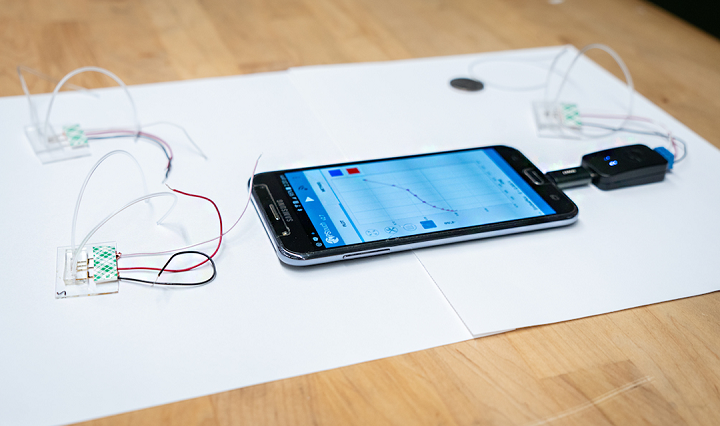
To administer the test, only a very small drop of blood is needed from a person’s fingertip to determine if the spike S1 protein and receptor binding domain (RBD) are present. Detection comes from the electrochemical reaction within the 3D printed, handheld sensor device, which can interface with a smartphone to send the results of the blood draw. If thoughts of false-positives from rapid tests are filling your brain, the researchers explained that their test has a very low error rate, because the binding reaction between the antigen in the 3D printed microfluidic device and the COVID-19 antibodies is “highly selective.”
The Future of Bioprinting and Medical AM
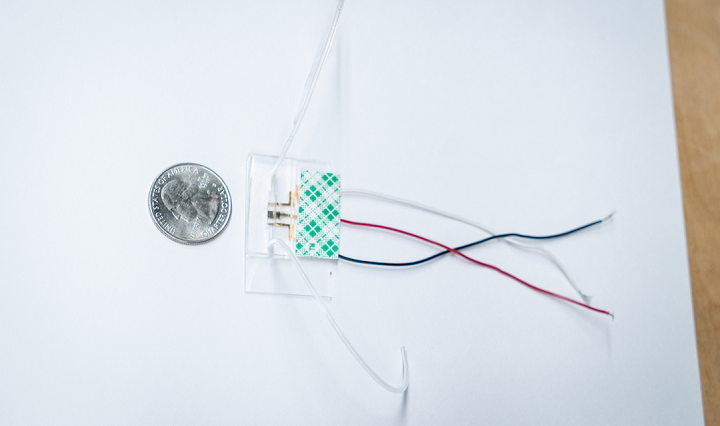
The 3D printed sensing device is about the size of a quarter.
Additionally, it takes less than a minute to clean, or regenerate, the sensing platform with a special chemistry the team discovered that makes it possible to get several successive readings off of the same device. Obviously, an accurate and quick antibody test like this 3D printed one could be a very big deal in terms of pandemic control, and it doesn’t hurt that the device, which already has a provisional patent, costs very little to make as well.
CMU researchers are now starting to focus on whether or not the platform could also detect the active COVID-19 virus, and not just its antibodies.
The Role of 3D Printing in Medicine
An interface with a mobile phone provides the results of the antibody test.
Panat even said, “This sensing platform can also be used to detect other infectious diseases, potentially affecting the course of pandemics.”
Some of these other viruses, according to the research team, include HIV, Ebola, and Zika.
Biocompatible Materials and Processes
(Photos courtesy of College of Engineering, Carnegie Mellon University)
The post 3D Printed Sensor Detects COVID-19 Antibodies in 10 Seconds appeared first on 3DPrint.com | The Voice of 3D Printing / Additive Manufacturing.
from 3DPrint.com | The Voice of 3D Printing / Additive Manufacturing https://bit.ly/3cNuTD0
Related Articles: 6 3D Printed COVID Face Masks Don’t Stand up to Scrutiny · Prellis Biologics Pursues Bioprinted Lymph Nodes for Production of COVID-19 Antibodies · Safety and 3D-Printed COVID-19 Medical Devices: Northwell Health Converts BiPAPs to Ventilators
Frequently Asked Questions
How is 3D printing used in medicine?
3D printing is used in medicine for surgical planning models, custom implants, bioprinting tissue scaffolds, drug delivery systems, dental aligners, and prosthetics. It enables patient-specific solutions that improve outcomes and reduce surgery time.
What materials are biocompatible for 3D printing?
Common biocompatible materials include PEEK, titanium alloys (Ti6Al4V), bio-ceramics (hydroxyapatite), medical-grade resins, PLA for temporary implants, and hydrogels for bioprinting. Material choice depends on the application and required mechanical properties.
Is 3D printed medical equipment FDA approved?
Yes, several 3D printed medical devices have FDA clearance, including orthopedic implants, dental restorations, and surgical guides. Each device must go through the appropriate regulatory pathway based on its risk classification.
📌 Related Articles
- The Current State of Metal 3D Printing in 2020
- Best 3D Printer Upgrades That Actually Improve Print Quality: Complete 2026 Guide
- Best Budget 3D Printer Upgrades That Actually Improve Print Quality: Belts, Springs, Hotends & More
- The Ultimate Guide to 3D Printer Calibration: Complete Step-by-Step Manual
- 3D Printing Tungsten Carbide: How Hot-Wire Laser Technology Creates Metal Harder Than Steel