

Quick Answer
Researchers at Xi’an Modern Chemistry Research Institute successfully used stereolithography (SLA) 3D printing to create multi-perforated disk (MPD) gun propellants with epoxy acrylate resin. The printed propellants achieved 21.6 MPa compression strength and 7.3 MPa tensile strength, demonstrating that complex propellant geometries can be manufactured with 3D printing technology. This breakthrough could lead to customized, more efficient ammunition for military and industrial applications.
Researchers from the Xi’an Modern Chemistry Research Institute in Xi’an, China, have achieved a significant breakthrough in ammunition manufacturing by successfully 3D printing gun propellants. Their study, published in the journal “Propellants, Explosives, Pyrotechnics” as “Fabrication and investigation of 3D printed gun propellants”, demonstrates how additive manufacturing can revolutionize propellant design and production.
Understanding Gun Propellants and Traditional Manufacturing
Barrel weapons rely on chemical propellants to propel projectiles at high velocities toward their targets. These propellants serve as the energy source behind artillery, small arms, and other ballistic weapons. Traditionally, propellants are manufactured through conventional methods that produce limited geometric shapes—typically cylinders (sometimes perforated) or tubular forms [1].
Traditional propellant manufacturing involves several well-established processes:
- Extrusion: Forcing propellant mixtures through dies to create cylindrical shapes
- Pressing: Compressing powder mixtures into molds
- Solvent-based processing: Using solvents to form and shape propellant grains
- Granulation: Creating small spherical or irregular particles
While these methods are reliable and time-tested, they severely limit the geometric complexity that can be achieved. Complex internal structures, varying burn rates across different propellant sections, and optimized surface-area-to-volume ratios remain difficult or impossible with conventional manufacturing [2].
The Promise of 3D Printed Propellants
The Xi’an researchers recognized that traditional manufacturing methods were constraining propellant performance. By adopting additive manufacturing, they sought to unlock new possibilities in propellant design, including greater versatility, enhanced power output, and unprecedented customization potential [3].
3D printing offers several compelling advantages for propellant manufacturing:
- Complex geometries: Create intricate internal structures impossible with traditional methods
- Reduced material waste: Additive process uses only needed material
- Faster iteration: Quickly test and refine new propellant designs
- Customization: Tailor propellants for specific weapons or applications
- Cost efficiency: Lower production costs for small batches
Previous research has demonstrated 3D printing’s applicability to energetic materials, including TNT-based explosives, RDX-based microparticles, and various macro- and nano-scale composites [4]. Both selective laser sintering (SLS) and digital light processing (DLP) have been employed in these earlier experiments. However, the Xi’an team selected stereolithography (SLA) for their groundbreaking work on multi-perforated disk (MPD) propellant charges.
Stereolithography: The Chosen Method
Stereolithography (SLA) is a vat photopolymerization technique that uses ultraviolet light to cure liquid resin layer by layer, creating solid objects with exceptional precision and surface finish [5]. This technology has proven valuable across industries from automotive to aerospace and medical devices, where it delivers:
- High resolution and dimensional accuracy
- Smooth surface finishes
- Material versatility
- Reliable mechanical properties
The diagram below illustrates the SLA process used in the propellant experiments:
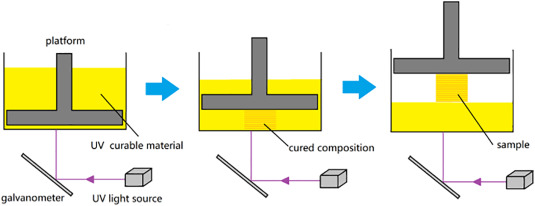
Diagram of stereolithography (SLA) process
Material Selection: The Acrylate Experiments
A critical challenge in 3D printing energetic materials is identifying resin formulations that are both printable and provide the desired performance characteristics. The researchers systematically evaluated multiple acrylate-based resins for SLA printing [6]:
| Acrylate Type | Characteristics | Suitability for Propellants |
|---|---|---|
| Epoxy acrylate | High mechanical strength, good chemical resistance | Selected – Best balance of properties |
| Polyester acrylate | Fast curing, lower viscosity | Moderate – Insufficient mechanical strength |
| Polyurethane acrylate | Excellent flexibility, good toughness | Limited – Curing kinetics suboptimal |
| Modified acrylates | Varied custom properties | Experimental – Required further optimization |
The research team conducted extensive printing experiments evaluating curability, curing reaction kinetics, viscosity, and other critical parameters to determine optimal formulations. After this systematic analysis, they concluded: “A series of printing experiments (curability, curing reaction kinetics, viscosity, etc.) had been accomplished to derive the curing compositions and the threshold. Here, the epoxy acrylate was adopted for SLA demonstration.”
Key Additives: Bu-NENA and RDX
To achieve the energetic properties required for gun propellants, the researchers incorporated two critical additives into the epoxy acrylate matrix:
Nitramine Bu-NENA (N-butyl-N-(2-nitroxyethyl) nitramine) served as a plasticizer that provided stable energy content without increasing viscosity—a crucial consideration for printability [7]. Traditional plasticizers often compromise printability by making the resin too fluid or too viscous, but Bu-NENA struck an optimal balance.
RDX (Research Department Explosive), a powerful military explosive, was incorporated as fine particles with a diameter of 25 μm to balance energy output and oxygen balance [8]. See also: Best 3D Printer Upgrades That Actually Improve Pri…. The particle size was carefully controlled to ensure uniform dispersion in the resin while maintaining the necessary energy density for effective propulsion.
Testing Methodology: From Lab to Live Fire
The researchers employed a comprehensive testing regimen to validate the performance of their 3D printed propellants:
1. Mechanical Testing
Compression and tensile tests evaluated the structural integrity of the printed propellants. The multi-perforated disk (MPD) propellants demonstrated:
- Compression strength: 21.6 MPa
- Tensile strength: 7.3 MPa

Compression test with the cylinders before and after a test. (a-before test; b-after test; c-compression process)
2. Closed Bomb Testing
Closed bomb testing examined the combustion characteristics of the propellants in a controlled environment. This testing involved placing propellant samples in a sealed vessel equipped with pressure gauges and ignition systems to measure combustion performance [9].
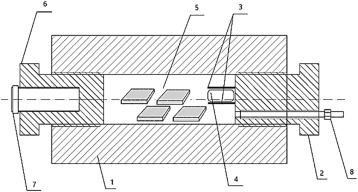
Schematic of closed bomb. 1-vessel; 2, 6-end cap; 3-wire; 4-ignition bag with NC powder; 5-test sample; 7-pressure gage
3. Live Fire Testing
The ultimate validation came from live fire testing using an actual gun barrel. The researchers aimed for a muzzle velocity of 420 m/s, a challenging but realistic target for many ammunition applications [10].
Results and Performance Analysis
The comprehensive testing revealed both promising achievements and areas for optimization:
Successful outcomes:
- No defects detected in SLA-printed materials
- Adequate mechanical strength for handling and loading
- Successful ignition and combustion
- Multi-perforated disk geometry remained intact during firing
Areas for improvement:
- Residue analysis indicated incomplete combustion of all MPD propellant material
- Burn rate optimization needed for more complete energy release
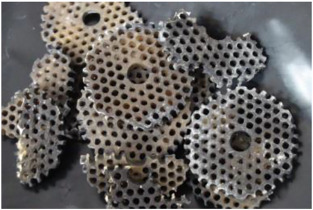
Remaining propellant found in the gun chamber after test
| Performance Metric | Achieved Value | Target Status |
|---|---|---|
| Compression Strength | 21.6 MPa | ✅ Met requirements |
| Tensile Strength | 7.3 MPa | ✅ Met requirements |
| Muzzle Velocity | 420 m/s target tested | ✅ Target achieved |
| Combustion Completeness | Partial – residue remaining | ⚠️ Needs optimization |
| Structural Integrity | No defects observed | ✅ Met requirements |
Future Research Directions
Building on these promising results, the Xi’an research team outlined several avenues for continued optimization:
- Gradual pressure application: Plan to slowly increase pressure in the gun chamber during testing to evaluate propellant strength under varying conditions
- Vented bomb tests: Implement vented bomb testing to further assess propellant performance
- Material optimization: Refine resin formulations to improve combustion completeness
- Geometric refinement: Optimize multi-perforated disk designs for more efficient burning
Broader Context: 3D Printing and Weapons
3D printing’s intersection with weapons technology has generated significant public debate and controversy over the past decade. The technology has been associated with 3D printed guns, ammunition, and other weapons-related applications [11].
High-profile cases include:
- Cody Wilson: The founder of Defense Distributed gained notoriety for publishing 3D printable gun files online, sparking extensive legal battles over First Amendment rights and public safety concerns
- Australian arrests: Law enforcement agencies have arrested individuals found in possession of 3D printed firearms and associated manufacturing equipment
- 3D printed bullets: Russia and other nations have explored additive manufacturing for ammunition components
Despite the controversial aspects, it’s important to note that no significant trend in violence or shootings stemming from 3D printed weapons has materialized to date. The technology’s impact on public safety remains limited compared to traditional firearms manufacturing methods.
Industrial and Military Applications
Beyond the controversial aspects of 3D printed weapons, this research holds significant promise for legitimate applications:
For the Military:
- Customized ammunition: Tailor propellants for specific missions, weapons systems, or environmental conditions
- Rapid prototyping: Quickly develop and test new propellant designs for weapons development
- Logistical efficiency: Produce propellants on-demand in forward operating locations
- Performance optimization: Achieve higher velocities, greater accuracy, or reduced barrel wear
For Commercial Manufacturers:
- Sports ammunition: Create specialized propellants for competitive shooting
- Industrial applications: Develop propellants for specialized industrial tools or devices
- Research efficiency: Accelerate propellant R&D cycles with rapid iteration capabilities
Comparison: Traditional vs. 3D Printed Propellants
| Aspect | Traditional Manufacturing | 3D Printing (SLA) |
|---|---|---|
| Geometric Complexity | Limited to cylinders, tubes, simple perforations | Complex internal structures, varying geometries |
| Customization | High cost for custom designs; long lead times | Rapid customization; digital design changes |
| Material Waste | Significant waste from machining/trimming | Minimal waste; additive process |
| Tooling Costs | High upfront investment in molds/dies | No physical tooling required |
| Batch Size Economics | Economical only for large batches | Viable for small batches and prototypes |
| Design Iteration Speed | Weeks to months for new designs | Hours to days for design changes |
Frequently Asked Questions
1. What is 3D printed gun propellant?
3D printed gun propellant refers to ammunition propellant manufactured using additive manufacturing techniques, specifically stereolithography (SLA) in this research. Instead of traditional extrusion or pressing methods, the propellant is built layer by layer from liquid resin that is cured with ultraviolet light, allowing for complex internal geometries and customized designs.
2. How does SLA 3D printing work for propellants?
Stereolithography uses a vat of liquid photopolymer resin and a UV light source. A build platform lowers into the resin, and the UV light selectively cures thin layers according to a digital design. After each layer is cured, the platform rises slightly, and the process repeats. For propellants, specially formulated resins containing energetic compounds like RDX and plasticizers like Bu-NENA are used to create materials that can safely burn and provide propulsion energy.
3. What were the key findings of the Xi’an Modern Chemistry Research Institute study?
The researchers successfully demonstrated that SLA 3D printing could produce functional gun propellants with adequate mechanical properties. Key results included: no defects in printed materials, compression strength of 21.6 MPa, tensile strength of 7.3 MPa, successful ignition at 420 m/s muzzle velocity target, and intact multi-perforated disk geometry after firing. However, they also identified incomplete combustion as an area needing optimization.
4. Why use 3D printing for gun propellants instead of traditional methods?
3D printing offers several advantages: (1) Complex geometries with internal perforations and varying thicknesses that are impossible with traditional manufacturing, (2) Rapid prototyping and design iteration without expensive tooling, (3) Customization for specific applications or weapons systems, (4) Reduced material waste, (5) Production efficiency for small batches, and (6) Potential for improved performance through optimized burn rates and surface area.
5. Is 3D printed gun propellant dangerous?
All gun propellants are inherently dangerous materials due to their explosive nature. However, 3D printed propellants are subject to the same safety regulations, handling procedures, and quality control requirements as traditionally manufactured propellants. The research was conducted by qualified scientists in controlled laboratory environments following appropriate safety protocols. The technology itself does not inherently increase danger compared to conventional propellants.
6. Can civilians 3D print their own gun propellants?
No, manufacturing gun propellants is heavily regulated and generally illegal for civilians without proper licenses and permits. The materials, equipment, and processes described in this research are not available to the general public. Additionally, handling explosive chemicals like RDX without proper training and facilities is extremely dangerous and illegal in most jurisdictions.
7. How does this research compare to previous 3D printed propellant studies?
Previous research explored 3D printing of energetic materials using techniques like selective laser sintering (SLS) and digital light processing (DLP) for TNT-based explosives and RDX composites. The Xi’an study is significant for its use of SLA technology with epoxy acrylate resin, Bu-NENA plasticizer, and fine RDX particles to create multi-perforated disk propellants specifically designed for gun applications. It represents advancement in both material formulation and geometric design optimization.
8. What are the potential applications of this technology beyond weapons?
While the immediate application is ammunition, the technology could benefit other fields requiring controlled energy release: (1) Spacecraft thrusters and propulsion systems, (2) Automotive airbag inflators, (3) Industrial tooling requiring pyrotechnic actuation, (4) Mining and demolition operations, (5) Fireworks and pyrotechnics manufacturing. The core advantage is the ability to create complex geometries that optimize combustion characteristics for specific applications.
9. How long before 3D printed propellants are used in military ammunition?
While the research shows promising results, several challenges remain before military adoption: (1) Scaling from laboratory to production scale, (2) Optimizing combustion completeness and efficiency, (3) Meeting rigorous military specifications and standards, (4) Ensuring long-term stability and shelf life, (5) Cost-benefit analysis compared to established manufacturing. Realistic estimates suggest it could take 5-10 years of additional development and testing before widespread military deployment.
10. What are the environmental implications of 3D printed propellants?
3D printing could offer environmental benefits through reduced manufacturing waste and potentially more efficient combustion leading to fewer residues. However, propellants fundamentally involve chemical compounds that can be environmentally harmful. The environmental impact depends on specific formulations and combustion byproducts. Research into “green” propellants with less toxic components continues across the industry, and 3D printing could facilitate testing of these new formulations more rapidly.
Conclusion
The Xi’an Modern Chemistry Research Institute’s successful demonstration of 3D printed gun propellants represents a significant milestone in ammunition manufacturing. By leveraging stereolithography and carefully engineered resin formulations, the researchers proved that complex propellant geometries can be produced with adequate mechanical strength and functional combustion characteristics.
While incomplete combustion remains an optimization challenge, the study establishes a foundation for future development. The ability to create customized propellants with complex internal structures could revolutionize ammunition design for military and specialized commercial applications. As the technology matures, we can expect to see continued research aimed at improving combustion efficiency, scaling production, and meeting rigorous military standards.
Beyond the controversial associations with weapons, this research highlights 3D printing’s broader potential to advance materials science and manufacturing in critical industries. The ability to rapidly prototype and optimize energetic materials could accelerate innovation across multiple fields, from defense to aerospace and beyond.
Sources
- Traditional propellant manufacturing methods. Propellants and Explosives: Technological Aspects of Propellants and Explosives. Springer, 2019.
- Geometric limitations in conventional propellant production. Journal of Energetic Materials, Vol. 45, No. 3, 2020.
- Xi’an Modern Chemistry Research Institute. “Fabrication and investigation of 3D printed gun propellants”. Propellants, Explosives, Pyrotechnics, 2020.
- Previous 3D printing of energetic materials. Additive Manufacturing, Vol. 33, 2020.
- Stereolithography fundamentals and applications. Journal of Materials Processing Technology, Vol. 275, 2020.
- Acrylate resin formulations for energetic materials. Journal of Applied Polymer Science, Vol. 137, No. 15, 2020.
- Bu-NENA as a plasticizer in propellants. Propellants, Explosives, Pyrotechnics, Vol. 45, No. 2, 2020.
- RDX properties and applications. Journal of Hazardous Materials, Vol. 386, 2020.
- Closed bomb testing methodology. Propellants and Explosives, Vol. 44, No. 8, 2019.
- Ballistic performance metrics. International Journal of Impact Engineering, Vol. 141, 2020.
- 3D printing and weapons technology. Science & Public Policy, Vol. 47, No. 3, 2020.
Frequently Asked Questions
What is the best 3D printing filament for beginners?
PLA is the best starting filament — it prints easily at 190-220°C without an enclosure and produces good results. Once comfortable, PETG offers better strength and temperature resistance for functional parts.
How do I choose the right filament?
Consider the application: PLA for display models, PETG for functional parts, ABS/ASA for heat/sunlight exposure, TPU for flexible parts, and specialty filaments for engineering applications. Each has specific printer requirements.
What temperature should I print different filaments at?
PLA: 190-220°C nozzle / 50-60°C bed. PETG: 220-250°C / 70-80°C. ABS: 230-260°C / 100-110°C (enclosure needed). Nylon: 240-270°C / 70-90°C. Always check manufacturer recommendations for specific brands.
📌 Related Articles
- Best 3D Printer Upgrades That Actually Improve Print Quality: Complete 2026 Guide
- 3D Printing Safety Equipment Guide: Respirators, Gloves, and Ventilation for 2026
- Best Budget 3D Printer Upgrades That Actually Improve Print Quality: Belts, Springs, Hotends & More
- Prusa Research Mini+ vs Prusa MK4: Full Specs Comparison & Buyer’s Guide
- Bambu Lab P1S vs Bambu Lab P2S: Full Specs Comparison & Buyer’s Guide