
Quick Answer: What is Fused Deposition (FD) 3D Printing?
Fused Deposition (FD) 3D printing, also known as Fused Filament Fabrication (FFF), is the most accessible and widely used 3D printing technology today. It works by melting thermoplastic filament and extruding it layer by layer to build three-dimensional objects. FD 3D printers are ideal for beginners, hobbyists, and professionals due to their affordability, ease of use, and versatility in creating functional prototypes, custom parts, and artistic creations. The technology uses temperatures typically between 180-260°C depending on the material, with build areas ranging from desktop-sized (150×150×150mm) to industrial dimensions (1000×1000×1000mm).
Introduction to Fused Deposition Technology
Fused Deposition 3D printing revolutionized additive manufacturing when it was commercialized in the late 1980s. Unlike older technologies that required expensive equipment and specialized facilities, FD printers brought the power of 3D fabrication to homes, classrooms, and small businesses. The core principle is elegantly simple: a motorized extruder pushes plastic filament through a heated nozzle, melting it and depositing it precisely according to digital instructions from a slicer software.
The term “Fused Deposition” refers to the process of joining melted material layers together. The filament “fuses” with the layer beneath it as it cools, creating strong inter-layer bonds when printing parameters are optimized. This technology democratized manufacturing by allowing anyone to produce complex geometries that would be impossible or prohibitively expensive with traditional subtractive manufacturing methods like CNC machining.
How FD 3D Printers Work: The Technical Process
The FD printing process begins with a 3D model created in CAD software or downloaded from online repositories. This digital file is then processed by “slicer” software, which slices the model into horizontal layers and generates G-code instructions for the printer. The G-code tells the printer exactly where to move, how fast to travel, what temperature to maintain, and how much filament to extrude at each point.
During printing, the filament spool feeds into the extruder assembly, which consists of a drive gear that pushes the filament and a hot end that melts it. The hot end contains a heating cartridge, a thermistor for temperature monitoring, and a nozzle with a small orifice (typically 0.4mm). The extruder moves on the X and Y axes via belts or lead screws, while the build platform moves on the Z axis (or vice versa on some designs), precisely positioning each layer.
The nozzle deposits molten plastic following the toolpath defined by the slicer. After completing one layer, the print head raises (or the bed lowers) by the layer height (usually 0.1-0.3mm), and the process repeats. Layer adhesion is critical for print strength, and factors like nozzle temperature, bed temperature, print speed, and cooling fan settings all influence the quality of the bond between layers.
Common FD 3D Printing Materials
The versatility of FD printing stems from the wide variety of printable materials available. Each material offers unique properties suited to different applications:
PLA (Polylactic Acid) – The most popular filament for beginners. PLA prints at lower temperatures (180-220°C), doesn’t require a heated bed, and produces minimal warping. It’s biodegradable, available in vibrant colors, and offers good detail and surface finish. However, it has low heat resistance and can become brittle over time.
PETG (Polyethylene Terephthalate Glycol) – Combines the ease of printing of PLA with the durability of ABS. PETG prints at 220-250°C, requires a heated bed (70-80°C), and offers excellent chemical resistance, impact strength, and food safety. It’s less prone to warping than ABS and more temperature-resistant than PLA.
ABS (Acrylonitrile Butadiene Styrene) – A strong, heat-resistant plastic ideal for functional parts. ABS requires higher temperatures (230-260°C) and a heated bed (100-110°C). It’s prone to warping and requires an enclosed build chamber for best results. ABS produces fumes during printing, so proper ventilation is essential.
TPU/TPE (Thermoplastic Polyurethane/Elastomer) – Flexible, rubber-like materials for creating shock-absorbing components, phone cases, and wearable items. TPU prints at 210-230°C and requires careful tuning of print speed and retraction settings to avoid stringing.
Nylon – Extremely tough and durable with excellent abrasion resistance. Nylon requires high temperatures (240-260°C) and benefits from a heated bed and enclosed chamber. It’s hygroscopic (absorbs moisture), so it must be dried before printing.
Comparison Table: Popular Filament Types
| Material | Print Temp (°C) | Bed Temp (°C) | Heated Bed Required | Heat Resistance | Difficulty | Best For |
|---|---|---|---|---|---|---|
| PLA | 180-220 | 0-60 (optional) | No | Low (55°C) | Easy | Beginners, prototypes, decorative items |
| PETG | 220-250 | 70-80 | Yes | Medium (70°C) | Easy-Medium | Functional parts, mechanical components |
| ABS | 230-260 | 100-110 | Yes | High (100°C) | Medium-Hard | Functional parts, automotive components |
| TPU | 210-230 | 30-60 | Recommended | Low-Medium | Medium | Flexible parts, phone cases, wearables |
| Nylon | 240-260 | 70-100 | Yes | High (110°C) | Medium-Hard | Gears, functional prototypes, tools |
Key Advantages of FD 3D Printing
Fused Deposition technology offers several compelling advantages that make it the preferred choice for many applications:
Affordability – Entry-level FD printers start under $200, making 3D printing accessible to hobbyists, students, and small businesses. Even professional-grade machines are significantly less expensive than other 3D printing technologies like SLA or SLS.
Material Variety – The extensive range of available filaments allows users to print parts with specific mechanical, thermal, or aesthetic properties. From conductive filaments to wood-filled materials and carbon fiber composites, there’s a filament for almost every application.
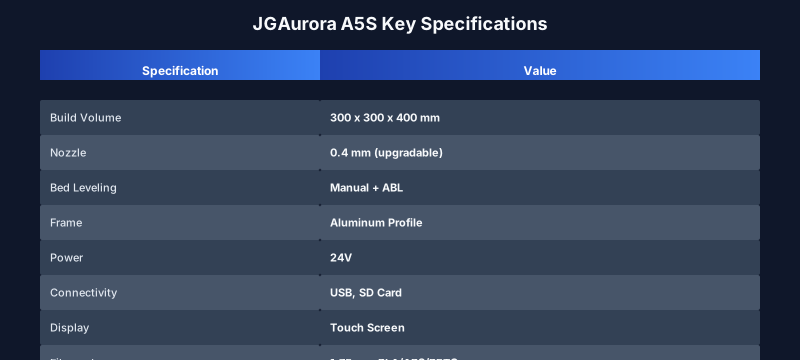
Large Build Volumes – FD printers can be scaled up relatively easily, with many consumer models offering 300×300×400mm build areas and industrial machines reaching dimensions exceeding one meter in each axis. This makes FD printing suitable for large-scale prototyping and production.
Post-Processing Options – FD prints can be easily sanded, painted, glued, machined, or chemically smoothed. Parts can be assembled using standard fasteners or adhesives, and mechanical features like threads and press-fits can be printed directly.
Safety – Unlike resin-based printers that use toxic chemicals, FD printing uses solid thermoplastic filaments that are generally safe to handle when printed with proper ventilation. This makes FD printing suitable for home and educational environments.
Limitations and Challenges
While FD printing offers many benefits, it also has certain limitations that users should understand:
Anisotropy – FD prints have different strength properties in different directions. Parts are strongest in the XY plane (parallel to layers) and weakest in the Z direction (between layers). This anisotropy must be considered when designing parts for mechanical loads.
Surface Finish – Visible layer lines are characteristic of FD printing, and achieving smooth surfaces may require post-processing. Overhangs and bridges can show drooping or sagging if print settings aren’t optimized.
Print Speed – FD printing is relatively slow compared to manufacturing processes like injection molding. A typical print may take several hours to complete, limiting throughput for production applications.
Accuracy and Precision – While modern FD printers can achieve good accuracy (±0.1mm), they cannot match the precision of SLA or other high-resolution technologies. Tight tolerances may require design compensation or post-machining.
Material Properties Variability – The properties of printed parts can vary based on print settings, filament quality, and environmental conditions. Consistent results require careful process control and quality assurance.
Comparison Table: FD vs Other 3D Printing Technologies
| Technology | Resolution | Speed | Material Cost | Machine Cost | Best Applications |
|---|---|---|---|---|---|
| FD (FFF) | 0.1-0.3mm | Medium | $20-50/kg | $200-5000 | Prototyping, functional parts, education |
| SLA (Resin) | 0.025-0.1mm | Slow | $60-150/L | $300-10000 | Jewelry, miniatures, dental, high-detail models |
| SLS (Powder) | 0.1-0.15mm | Medium | $100-200/kg | $5000-500000 | Functional prototypes, end-use parts |
| DLP (Digital Light Processing) | 0.025-0.1mm | Medium-Fast | $60-150/L | $500-10000 | Miniatures, dental, jewelry, detailed parts |
| Material Extrusion (Professional) | 0.1-0.4mm | Fast | $50-100/kg | $5000-50000 | Large parts, tooling, production fixtures |
Essential FD 3D Printer Accessories
To get the most out of FD 3D printing, several accessories can significantly improve print quality and user experience:
Build Surface Treatments – Materials like PEI sheets, BuildTak, or glass surfaces with hairspray or glue sticks improve first-layer adhesion and prevent warping. A high-quality build surface is essential for successful prints, especially with materials like ABS.
Enclosure – An enclosure maintains stable temperatures around the print, reducing warping and improving layer adhesion for materials like ABS and Nylon. Enclosures also help contain fumes and improve safety.
Filament Dryer – Hygroscopic materials like Nylon, PETG, and PVA absorb moisture from the air, which can cause poor print quality. A filament dryer keeps filaments at optimal humidity levels for consistent results.
Nozzle Set – Having multiple nozzle sizes (0.2mm, 0.4mm, 0.6mm, 0.8mm) allows users to balance print speed and detail. Brass nozzles are standard, while hardened steel nozzles are needed for abrasive filaments like carbon fiber composites.
Calibration Tools – A feeler gauge or digital caliper helps ensure proper nozzle-to-bed distance. Accurate calibration is crucial for first-layer quality and overall print success.
Recommended FD 3D Printers for Different Budgets
Budget-Friendly Options ($200-400)
Entry-level FD printers offer excellent value for beginners and hobbyists. These machines typically feature all-metal frames, auto-leveling beds, and heated build plates. While they may have smaller build volumes and fewer advanced features, they’re perfect for learning the basics of 3D printing and producing quality prints for personal projects.
Mid-Range Machines ($400-1000)
Mid-range printers add features like larger build volumes, faster print speeds, dual extrusion capabilities, and better build quality. These machines are suitable for more demanding applications, including small business production, advanced prototyping, and multi-material printing.
Professional and Industrial Models ($1000+)
Professional FD printers offer exceptional reliability, precision, and build quality. Features include enclosed build chambers, industrial-grade components, advanced motion systems, and integrated software suites. These machines are designed for continuous operation in production environments and can produce parts with tight tolerances and excellent surface finish.
Best FD 3D Printing Products on Amazon
Here are some highly-rated FD 3D printers and accessories available on Amazon:
Best 3D Printers for Beginners – Top-rated entry-level models with auto-leveling and heated beds, perfect for those new to 3D printing.
Quality PLA Filament – Premium PLA filaments in various colors, ideal for beginners and general-purpose printing.
PETG Filament for Functional Parts – Durable PETG filaments for creating strong, impact-resistant mechanical components.
Build Surface Accessories – PEI sheets, BuildTak surfaces, and glass plates to improve print adhesion and reduce warping.
3D Printer Nozzle Kits – Multiple nozzle sizes and materials for different printing applications and filaments.
3D Printer Tool Kits – Essential tools including scrapers, tweezers, calipers, and cleaning brushes for 3D printing maintenance.
Frequently Asked Questions (FAQ)
Q: What does FD stand for in FD 3D printing?
FD stands for “Fused Deposition,” which describes the process of melting and depositing thermoplastic material layer by layer to build objects. The technology was originally patented by Stratasys and is now widely used in consumer and industrial 3D printers under the alternative name Fused Filament Fabrication (FFF).
Q: Is FD 3D printing suitable for beginners?
Yes, FD 3D printing is excellent for beginners due to its affordability, ease of use, and low operational costs. Many entry-level printers come with auto-leveling features, touchscreen interfaces, and pre-configured profiles that make it easy to get started. The wide availability of tutorials, community support, and free 3D models further lowers the barrier to entry.
Q: What materials can be used in FD 3D printing?
FD printers can use a wide variety of thermoplastic materials including PLA, PETG, ABS, TPU, Nylon, ASA, PC, and specialty filaments like wood-filled, carbon fiber-reinforced, glow-in-the-dark, and conductive materials. The specific materials supported depend on the printer’s maximum temperature and extruder design.
Q: How strong are FD 3D printed parts?
The strength of FD printed parts varies significantly based on material choice, print settings, and part orientation. PLA parts are relatively brittle, while PETG, ABS, and Nylon offer excellent toughness and impact resistance. Properly printed parts with optimized infill, wall thickness, and layer bonding can be strong enough for functional applications, though they may not match the strength of injection-molded parts.
Q: What is layer height and how does it affect print quality?
Layer height is the thickness of each individual layer deposited by the printer. Smaller layer heights (0.1mm or less) produce smoother surfaces and finer detail but require more time to print. Larger layer heights (0.3mm or more) print faster but show more visible layer lines. The optimal layer height depends on the desired balance between quality and print time.
Q: Do I need a heated bed for FD 3D printing?
A heated bed is not strictly necessary for PLA but is highly recommended for other materials. PETG requires a heated bed (70-80°C) to prevent warping, while ABS needs a heated bed (100-110°C) and an enclosed chamber for best results. A heated bed improves first-layer adhesion and reduces the likelihood of prints detaching during printing.
Q: How do I prevent warping in FD 3D printing?
Warping can be prevented by using a heated bed, an enclosed build chamber to maintain stable temperatures, applying adhesion promoters like hairspray or glue sticks, using a raft or brim, and reducing print speed. Ensuring the build surface is properly leveled and the first layer is well-adhered also helps prevent warping.
Q: What is the difference between FD and FFF 3D printing?
FD and FFF are essentially the same technology. FD (Fused Deposition) was the original term used in the Stratasys patent. FFF (Fused Filament Fabrication) was coined by the RepRap community to avoid trademark issues. Both terms refer to the process of melting and extruding thermoplastic filament to build objects layer by layer.
Q: Can FD 3D printers print with multiple materials?
Yes, many FD printers are equipped with dual or multiple extruders that allow printing with different materials or colors in a single job. This enables applications like dissolvable supports (using PVA or HIPS for supports that can be removed with water or limonene), multi-color prints, and combining materials with different properties in one part.
Q: How long do FD 3D prints take?
Print time varies widely based on the size of the object, layer height, print speed, and complexity. A small 20×20×20mm cube might take 30-60 minutes, while a large 200×200×200mm object could take 20-40 hours or more. Most consumer prints fall in the 2-12 hour range. Print time scales approximately with the volume of the object and inversely with print speed.
Conclusion
Fused Deposition (FD) 3D printing has transformed from an expensive industrial technology into an accessible manufacturing tool available to anyone. Its combination of affordability, material versatility, and ease of use makes it ideal for applications ranging from rapid prototyping and custom manufacturing to education and hobby projects. As the technology continues to evolve with improvements in speed, accuracy, and material properties, FD printing will remain a cornerstone of the additive manufacturing landscape.
Whether you’re a beginner looking to explore 3D printing for the first time or an experienced user pushing the boundaries of what’s possible, FD 3D printing offers a powerful platform for creativity and innovation. With the right printer, materials, and techniques, you can bring your ideas to life with precision and efficiency that were once only possible in specialized facilities.
Where to Buy
As an Amazon Associate, we earn from qualifying purchases.
📌 Related Articles
- ABS 3D Printing Settings Guide: Temperature, Enclosure, and Cooling for Strong Parts
- Best 3D Printer Upgrades That Actually Improve Print Quality: Complete 2026 Guide
- Best Budget 3D Printer Upgrades That Actually Improve Print Quality: Belts, Springs, Hotends & More
- 3D Printing Safety Equipment Guide: Respirators, Gloves, and Ventilation for 2026
- Bambu Lab P1S vs Bambu Lab P2S: Full Specs Comparison & Buyer’s Guide