
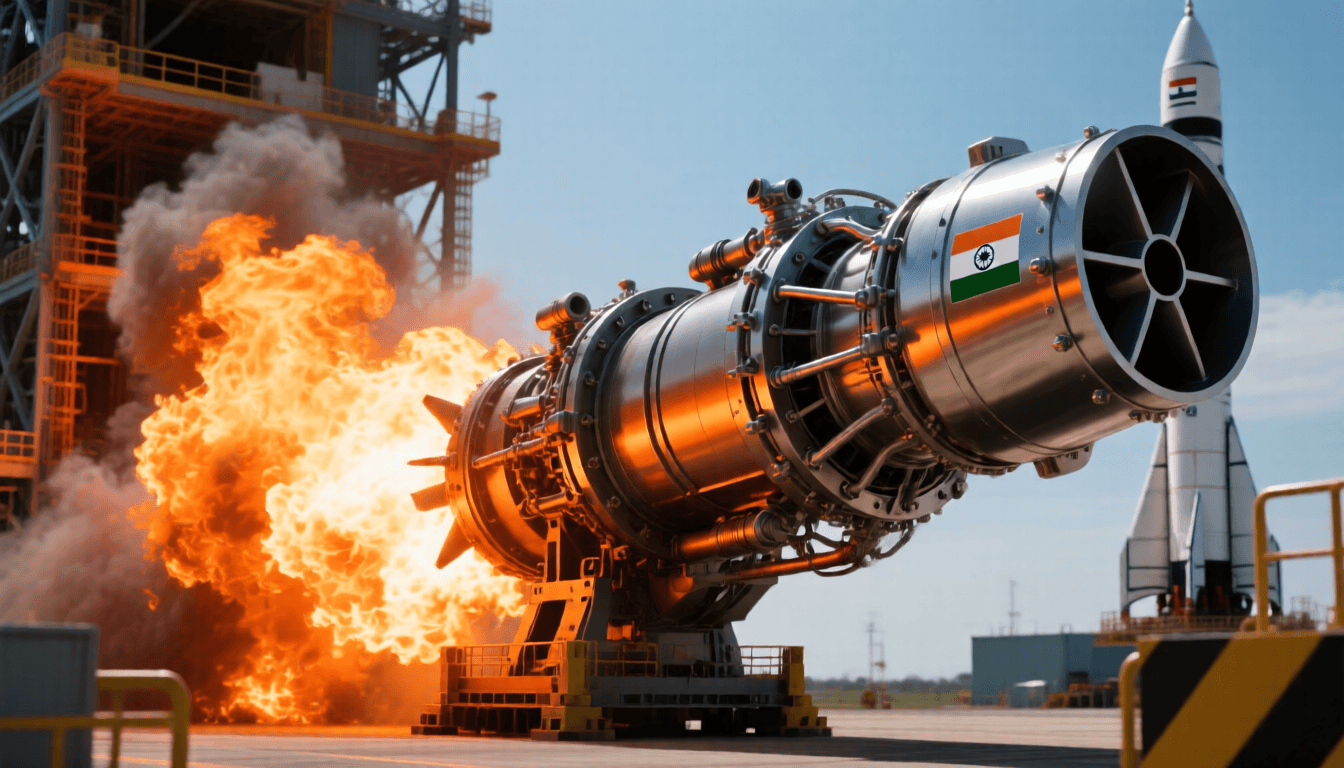
Indian space startup Agnikul Cosmos has achieved a major milestone in rocket propulsion: successfully test-firing Agnite, the world’s largest single-piece 3D-printed booster engine. The engine chamber is a full one meter long, printed as a single piece of Inconel, demonstrating that additive manufacturing can produce rocket hardware at scales previously reserved for traditional manufacturing.
The Agnite Engine
Agnite represents a leap in what’s possible with 3D-printed metal components. Key facts:
- One meter long — printed as a single continuous piece, no assembly or welding required
- Made of Inconel — a nickel-chromium superalloy known for extreme heat and corrosion resistance, widely used in aerospace
- Pump-driven — unlike simpler pressure-fed designs, Agnite uses turbopumps for higher performance
- Rapid production — the engine was manufactured at Agnikul’s Rocket Factory-1 in Chennai
Printing a one-meter rocket engine as a single piece eliminates the joints, welds, and potential failure points that come with assembling multiple components. In rocketry, where every joint is a potential leak point and every weld is a potential stress concentration, this is a significant reliability advantage.
Why Single-Piece Printing Matters
Traditional rocket engine manufacturing is an exercise in extreme precision engineering. A typical booster engine might consist of dozens of individually machined components that must be assembled, welded, or brazed together — each connection adding weight, potential failure points, and manufacturing complexity.
Single-piece 3D printing eliminates these issues:
- No joints to fail — the entire combustion chamber and nozzle throat are one continuous structure
- Optimized internal geometry — cooling channels can be printed directly into the chamber walls with complex conformal shapes impossible to machine
- Dramatically reduced lead time — what takes months of machining and assembly can be printed in days
- Lower cost — less material waste, fewer manufacturing steps, reduced quality inspection overhead
Agnikul Cosmos: India’s Private Space Ambitions
Agnikul Cosmos operates from India’s first private launchpad at the Satish Dhawan Space Centre and its Rocket Factory-1 in Chennai. The company is part of India’s growing private space sector, which has been energized by government policy changes opening the space industry to private companies.
The Agnite test follows Agnikul’s successful launch of the Agnibaan SOrTeD (SubOrbital Technological Demonstrator) mission in 2024, which was the world’s first flight of a semi-cryogenic engine-powered rocket.
Context: 3D Printing in Space
Agnikul joins a growing list of companies using additive manufacturing for rocket propulsion, including U.S. defense contractors, Relativity Space (which 3D prints entire rockets), and Divergent Technologies in the defense sector. The common theme: additive manufacturing enables faster iteration, reduced part counts, and geometries that traditional manufacturing simply cannot produce.
Frequently Asked Questions
What is the Agnite engine?
Agnite is the world’s largest single-piece 3D-printed rocket booster engine, developed by Indian startup Agnikul Cosmos. It is one meter long, made of Inconel superalloy, and was successfully test-fired in March 2026.
Why is single-piece 3D printing important for rocket engines?
Single-piece printing eliminates joints, welds, and assembly points that are potential failure sources. See also: 3D Printing Tungsten Carbide: How Hot-Wire Laser T…. It also enables internal cooling channels with complex geometries impossible to machine, reduces manufacturing time from months to days, and lowers costs.
What material is Agnite made from?
Agnite is printed from Inconel, a nickel-chromium superalloy known for exceptional heat and corrosion resistance. Inconel is widely used in aerospace for components exposed to extreme temperatures.
Who is Agnikul Cosmos?
Agnikul Cosmos is an Indian space startup that operates India’s first private launchpad at the Satish Dhawan Space Centre and Rocket Factory-1 in Chennai. They previously launched the Agnibaan SOrTeD mission in 2024.
How big is the Agnite engine?
The Agnite engine chamber is a full one meter (100 cm) long, printed as a single continuous piece of metal — making it the largest single-piece 3D-printed rocket engine in the world.
📌 Related Articles
- How Divergent Technologies Is 3D Printing Cruise Missiles
- L3Harris Cuts Hypersonic Component Production Time by 90%
- The Current State of Metal 3D Printing
- 3D Printing Method Creates Metal Stronger Than Steel
Sources: Economic Times India, Business Today, Interesting Engineering, Agnikul Cosmos, MTDCNC, Wikipedia