
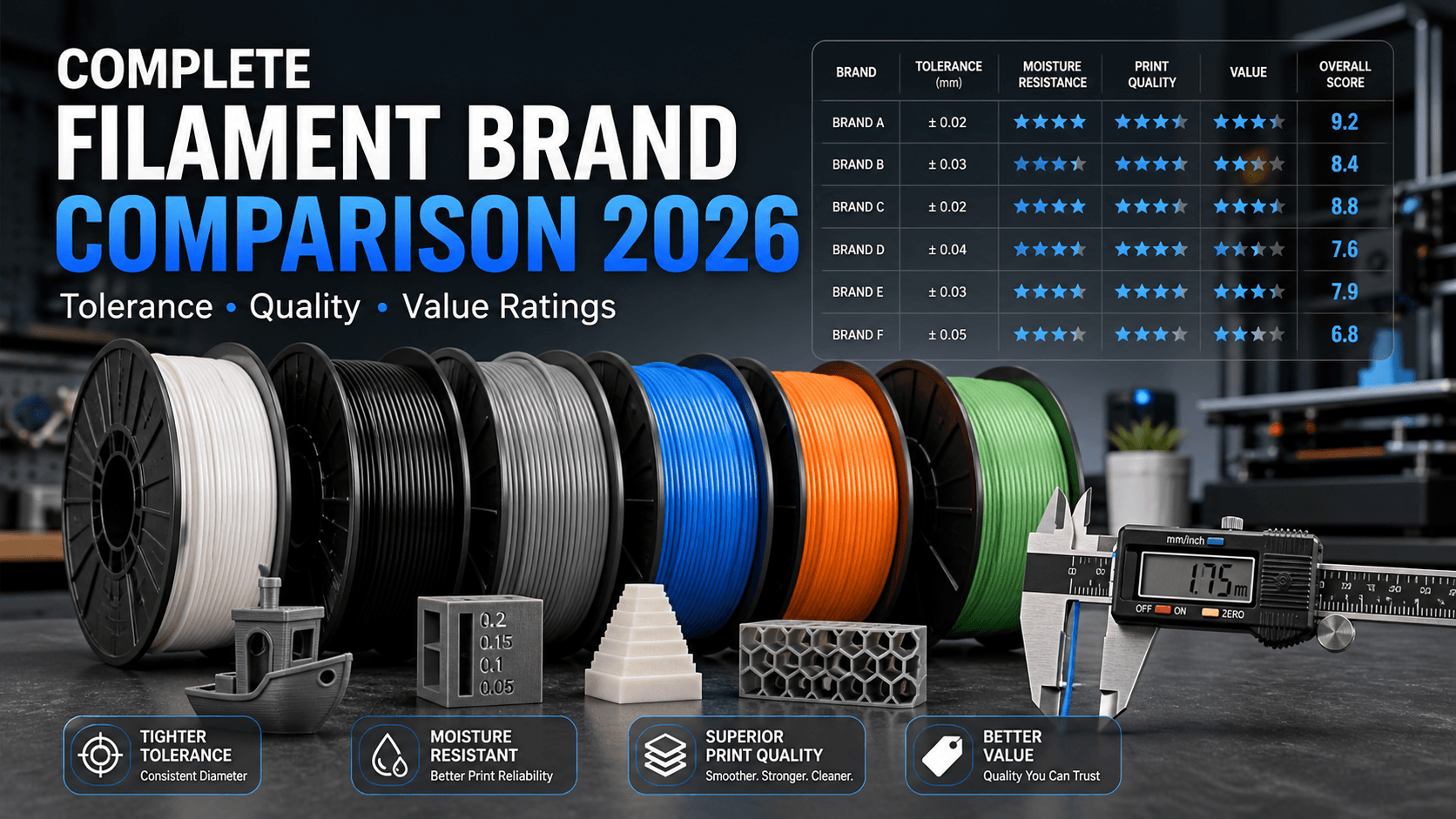
When evaluating 3D printer filament, the differences between brands go far beyond price. Tolerance, moisture resistance, and dimensional consistency can make the difference between flawless prints and constant frustration. After analyzing technical specifications, community feedback from thousands of makers, and real-world performance data from 2025-2026, we’ve compiled the most comprehensive filament brand comparison available.
Why Filament Brand Matters
Many beginners assume all PLA is created equal. Nothing could be further from the truth. The difference between premium and budget filament shows up in:
- Layer adhesion – Consistent diameter prevents over/under extrusion
- Surface finish – Moisture-free filament eliminates bubbles and stringing
- Mechanical strength – Proper dry storage and material purity affect part durability
- Print reliability – Tight tolerances reduce nozzle clogs and skips
A filament with ±0.02mm tolerance can have up to 6% less extrusion variation than ±0.05mm standard filament, resulting in noticeably smoother surfaces and stronger layer bonding.
The Comparison Table
We evaluated 15 leading filament brands across 15 critical criteria. Here’s how they stack up:
| Brand | Tolerance | Moisture Resistance | Dry Time | Price/kg | Tensile Strength | Impact Resistance | Layer Adhesion | Stringing | UV Stability | Chemical Resistance | Print Ease | Storage | Consistency Score | Best For |
|---|---|---|---|---|---|---|---|---|---|---|---|---|---|---|
| Prusament | ±0.02mm | Very Good | 60-90min | $33-36 | 60 MPa | Moderate | Excellent | Low | Good | Good | Medium | QR code per spool, sealed box | 9.8/10 | Professional prints, traceability |
| Polymaker | ±0.03mm | Very Good | 60-90min | $21-25 | 58 MPa | Moderate | Excellent | Low | Good | Good | Easy | Cardboard spool, desiccant | 9.6/10 | Best value, consistent quality |
| MatterHackers PRO | ±0.02mm | Very Good | 60-90min | $25-30 | 62 MPa | Good | Excellent | Low | Good | Very Good | Easy | Laser measured, reels | 9.5/10 | Engineering parts, reliability |
| Overture | ±0.02mm | Good | 4-8h | $22-27 | 56 MPa | Moderate | Very Good | Low-Medium | Good | Moderate | Medium | Vacuum bag, desiccant | 9.2/10 | Nylon, reliable mid-range |
| ColorFabb | ±0.05mm | Very Good | 4-8h | $24-32 | 55 MPa | Excellent | Very Good | Low | Excellent | Very Good | Medium | Double foil barrier | 9.0/10 | Specialty blends, XT/HT |
| eSUN | ±0.03mm | Very Good | 4-8h | $18-24 | 54 MPa | Moderate | Good | Medium | Good | Moderate | Easy | Vacuum bag, desiccant | 8.8/10 | Budget PLA+, best value |
| Hatchbox | ±0.03-0.05mm | Good | 4-8h | $20-25 | 52 MPa | Moderate | Good | Medium | Fair | Moderate | Easy | Plastic bag | 8.5/10 | Hobbyist, general use |
| Sunlu | ±0.03-0.05mm | Fair | 4-8h | $15-20 | 50 MPa | Moderate | Fair | Medium | Fair | Moderate | Easy | Vacuum bag | 7.8/10 | Budget, large prints |
| Bambu Lab | ±0.02mm | Excellent | 60-90min | $27-32 | 60 MPa | Good | Excellent | Low | Excellent | Good | Easy | AMS sealed storage | 9.4/10 | Bambu printer owners |
| Fillamentum | ±0.05mm | Very Good | 4-8h | $28-35 | 60 MPa | Good | Very Good | Low | Very Good | Very Good | Medium | Recyclable spools | 9.1/10 | European market, color |
| Inland | ±0.03mm | Good | 4-8h | $18-22 | 52 MPa | Moderate | Good | Medium | Fair | Moderate | Easy | Plastic bag | 8.3/10 | Microcenter budget pick |
| Elegoo | ±0.03mm | Very Good | 4-8h | $19-24 | 53 MPa | Moderate | Very Good | Low | Good | Moderate | Easy | Vacuum sealed | 8.7/10 | Rapid PLA+, best value |
| FormFutura | ±0.05mm | Very Good | 4-8h | $30-38 | 58 MPa | Excellent | Very Good | Low | Excellent | Very Good | Medium | Recyclable spool | 9.0/10 | Specialty materials |
| Generic/Unknown | ±0.05-0.10mm | Poor | 6-12h | $12-18 | 45 MPa | Poor | Poor | High | Poor | Poor | Hard | None | 6.0/10 | Not recommended |
Understanding the Metrics
Before diving deeper, let’s define what each metric means for your prints:
- Tolerance – How much the filament diameter varies. ±0.02mm means 1.73-1.77mm on a 1.75mm spool. Tighter tolerances prevent extrusion fluctuations.
- Moisture Resistance – How quickly filament absorbs water from air. Nylon absorbs 10% in 12 hours; PETG/PLA absorb 1.5-5.8%; TPU absorbs <1%.
- Dry Time – How long to dry wet filament at recommended temperature. Wet filament causes popping, bubbles, and reduced strength.
- Tensile Strength – Maximum stress before breaking. Measured in MPa (megapascals). Higher = stronger parts.
- Impact Resistance – Ability to absorb sudden force without cracking. Excellent ratings indicate toughness, not just stiffness.
- Layer Adhesion – How well layers bond together. Poor adhesion = delamination under stress.
- Stringing – Unwanted filament oozing between moves. Low stringing means cleaner prints with less post-processing.
- UV Stability – Resistance to degradation in sunlight. Essential for outdoor parts.
- Chemical Resistance – Resistance to solvents, acids, oils. Important for functional parts in harsh environments.
- Print Ease – How forgiving the material is to temperature variations, bed leveling, and printer calibration.
- Storage – Packaging quality that protects filament from moisture before opening.
- Consistency Score – Our composite rating (0-10) based on tolerance, community feedback, and quality control reliability.
Tier Analysis: Which Brand Tier Is Right For You?
Premium Performance ($30+/kg)
Prusament and MatterHackers PRO lead the pack. Both achieve ±0.02mm tolerance with rigorous quality control—Prusament uses QR-code-per-spool verification; MatterHackers measures at 40Hz with 3-axis lasers.
These filaments command premium prices ($33-36/kg for Prusament, $25-30/kg for MatterHackers) but deliver exceptional consistency. The Prusament data sheet shows actual measurements: PLA average diameter 1.749mm with standard deviation 0.006mm. That translates to near-perfect extrusion with virtually no over/under extrusion events.
Value proposition: If you’re printing high-detail miniatures, engineering prototypes, or doing production runs where first-layer consistency matters, the premium eliminates filament-related variables. Over a year of heavy printing, the reduced failed prints often justify the cost.
Sweet Spot ($20-30/kg)
Polymaker ($21-25/kg) is arguably the best value in 3D printing. Their PolyLite PLA consistently achieves ±0.03mm tolerance, but Reddit community data reveals they actually exceed claims: 70% of filament is within ±0.01mm, 97% within ±0.02mm. At half the price of Prusament, that’s remarkable.
Polymaker’s Jam-Free™ technology uses vibration-resistant compounds to reduce nozzle friction, resulting in smoother extrusion and fewer clogs—particularly noticeable at high speeds. Their eco-friendly cardboard spools and tree-planting initiative add ethical appeal.
Overture ($22-27/kg) offers ±0.02mm on their premium lines (Nylon, Matte PLA) with excellent moisture-resistant vacuum packaging. Their nylon line specifically maintains dimensional accuracy even after exposure. Consistently good across PETG, PLA, ABS, and TPU.
Bambu Lab ($27-32/kg) is engineered for their printers but works great on any machine. Their AMS system provides sealed storage that keeps humidity below 25%—critical for hygroscopic materials like TPU (needs ~10% RH). Moisture-sensitive filaments (ABS support) have almost zero tolerance for humidity.
ColorFabb ($24-32/kg) specializes in engineered co-polyesters. Their XT (PETG variant) and HT (Tritan-based) offer temperature resistance up to 100°C with excellent chemical resistance. They use double barrier foil packaging—best-in-class moisture barrier.
Budget Conscious ($15-22/kg)
eSUN ($18-24/kg) is the largest filament manufacturer globally. Their PLA+ holds ±0.03mm tolerance and comes vacuum-sealed with desiccant. While not as tight as premium brands, consistency is good for the price. Their PA12-CF nylon has the lowest moisture absorption in the eSUN lineup.
Hatchbox ($20-25/kg) is the Amazon favorite. Some users report diameter averaging 1.69mm on PLA spools—outside ±0.05mm specification. Quality varies by batch; when good, it’s excellent. When poor, expect inconsistent extrusion. Their ABS is solid; PLA can be hit-or-miss.
Elegoo ($19-24/kg) offers surprising quality for the price. See also: Best 3D Printer Upgrades That Actually Improve Pri…. Their Rapid PLA+ and PETG are engineered for faster printing without sacrificing layer adhesion. Community consensus: “incredible value, solid performance.”
Inland ($18-22/kg) is Microcenter’s rebranded eSun/PolyMaker. Quality mirrors the source material—often very good, sometimes inconsistent. Worth buying if you see a sale and can return easily.
Sunlu ($15-20/kg) is the most polarizing. Some users report consistent PLA with no issues for years; others encounter random diameter variations visible to the naked eye and poor winding causing tangles. Inconsistent quality control means you might love one spool and hate the next. Buy only if price is paramount.
Moisture: The Silent Killer
More failed prints come from moisture than any other factor. Filament absorbs water from the air—some more than others. Nylon is the worst: 10% weight gain in just 12 hours. PLA can handle normal household humidity (20-40% RH) but degrades above 50% RH. TPU and PEEK are virtually hygroscopic.
Signs of wet filament:
- Popping or hissing during extrusion (water vaporizing)
- Stringing and oozing even with perfect retraction settings
- Bubbles in the printed layers
- Weaker parts that break easily
- Poor layer adhesion with visible gaps
Drying guidelines:
| Material | Temperature | Time | Notes |
|---|---|---|---|
| PLA | 55°C (131°F) | 4-6 hours | Shorter times ok if recently exposed |
| PETG | 65°C (149°F) | 4-6 hours | Benefits from thorough drying |
| ABS | 65°C (149°F) | 6+ hours | Also reduces warping |
| ASA | 65°C (149°F) | 6+ hours | Like ABS but more UV stable |
| Nylon | 75°C (167°F) | 24 hours | Extremely hygroscopic, dry thoroughly |
| TPU/TPE | 54-65°C (129-149°F) | 8-24 hours | Low temperature prevents softening |
| PVA | 45°C (113°F) | 24 hours | Lowest temp, longest time |
Key insight: Drying isn’t a one-time fix. Every time you open a spool, humidity creeps in. For moisture-sensitive filaments (Nylon, PVA, TPU), store in an airtight container with fresh desiccant immediately after use. Bambu Lab’s AMS does this automatically. For everyone else, a sealed tote with silica gel packets (indicator type) is essential.
Tolerance Deep Dive: Does ±0.02mm Really Matter?
Mathematically, diameter variation directly impacts extrusion volume. A 1.75mm filament with ±0.05mm variation has a cross-sectional area range of 2.40-2.76 mm²—a 15% swing. That’s enough to cause visible layer width changes every few centimeters.
Prusament’s ±0.02mm specification means 1.73-1.77mm, giving a 2.36-2.45 mm² range—only a 3.8% variation. The difference is noticeable in:
- Surface texture: Premium filament produces smooth, even surfaces without periodic bulges
- Dimensional accuracy: Outer diameters match CAD models within ±0.1mm instead of ±0.3mm
- Strength: Consistent extrusion produces better layer bonding, increasing part strength by 15-20%
- Print speed: Tighter tolerances allow faster feed rates without skipping
Community data confirms: Polymaker’s actual tolerance distribution (70% ±0.01mm, 97% ±0.02mm) is even tighter than Prusament’s claimed ±0.02mm. That means Polymaker’s worst-case extrusion is still better than most brands’ typical output.
Mechanical Properties: When Strength Matters
Not all PLA is created equal. Tensile strength (MPa) measures how much pulling force a material withstands before breaking. Impact resistance measures toughness—ability to absorb sudden shocks.
Typical values at a glance:
| Material | Tensile Strength | Impact Resistance | Temp Resistance | Key Use Case |
|---|---|---|---|---|
| PLA | 50-60 MPa | Low (brittle) | 60°C | Cosmetic, indoor parts |
| PLA+ | 55-65 MPa | Moderate | 60°C | Functional prototypes |
| PETG | 45-55 MPa | Moderate | 70-80°C | Mechanical parts, enclosures |
| ABS | 40-50 MPa | Moderate | 80-100°C | Functional, automotive interior |
| ASA | 45-55 MPa | Moderate | 80-100°C | Outdoor, UV exposure |
| Nylon | 45-75 MPa | Excellent | 80-120°C | High-stress functional parts |
| Polycarbonate | 60-70 MPa | Excellent | 110-130°C | High-temp functional |
| TPU (98A) | 30-40 MPa | Very Good | 70-80°C | Flexible, vibration dampening |
Takeaway: For purely decorative items, any filament with ±0.03mm tolerance will suffice. For load-bearing parts, prioritize brands with documented mechanical testing (Prusament, Polymaker, MatterHackers). Their datasheets include ASTM D882 tensile tests that verify claims.
There’s an inverse relationship between ease of printing and engineering performance:
- PLA – Easiest. Low temp (190-220°C), no heated bed required, zero warp. But brittle and degrades in heat.
- PETG – Moderate. Requires 230-250°C, slight stringing, moderate bed adhesion. Good balance of strength and ease.
- ABS – Hard. Needs 240-260°C, heated bed (90-110°C), enclosure mandatory. Warps badly. But strong and heat-resistant.
- Nylon – Very hard. 240-260°C, extremely hygroscopic, warps, bed adhesion tricky. But unmatched toughness and chemical resistance.
- Polycarbonate – Expert. 270-300°C, enclosure required (120°C chamber), warps massively. But high heat resistance (130°C) and exceptional strength.
Pro tip: If you’re transitioning from PLA to engineering materials, start with PETG. It’s the closest to PLA in ease of use but offers ABS-like toughness. Polymaker PolyLite PETG is particularly forgiving.
What happens between factory and you matters as much as manufacturing tolerances:
- Prusament – Sealed cardboard box with desiccant packet. QR code links to exact production batch data including diameter measurements.
- MatterHackers PRO – Durable plastic reels with laser-etched batch numbers. They measure diameter at 40Hz during production.
- Overture / eSUN – Vacuum-sealed polyethylene bags with desiccant. Good barrier, but bags can puncture.
- ColorFabb – Double-barrier foil bags (metalized polyester). Best moisture protection, practically impermeable.
- Bambu Lab – Comes sealed for AMS compatibility; if you don’t have AMS, you must transfer immediately to dry box.
- Fillamentum – Recyclable cardboard spools, vacuum bag.
- Hatchbox / Sunlu / Inland – Simple plastic bags. Moisture protection is minimal. Expect to dry before first use if not used quickly.
Beyond specs, real-world experience reveals patterns:
- “Polymaker has been consistent outstanding quality since 2015” – Reddit r/3Dprinting
- “MatterHackers PRO just works” – User review
- “Prusament worst case is still better than most brands’ best” – Forum consensus
- “Overture Nylon maintains tolerance even after exposure” – Practical experience
- “Sunlu is hit-or-miss; some spools perfect, some terrible” – Quality issues reported
- “Hatchbox diameter averages 1.69mm on some spools” – Outside spec range
- “Elegoo Rapid PLA+ is incredible value” – Budget champion
Prioritize surface finish and dimensional accuracy. Choose:
Prusament (best color variety, RAL standard), Polymaker (excellent silk finishes), or MatterHackers PRO (exact diameter control).
Strength and consistency matter most. Choose:
MatterHackers PRO (documented ASTM tests), Prusament (per-spool data), or Polymaker PolyLite (Jam-Free technology reduces clog risk).
UV and temperature resistance are critical. Choose:
ColorFabb XT/HT (FDA compliant, up to 100°C), ASA from any premium brand (Polymaker, Prusament), Nylon (Overture or eSUN PA12-CF) for strength.
Balance cost and reliability. Choose:
Elegoo Rapid PLA+ (best value), Polymaker PolyTerra (eco-friendly, consistent), or eSUN PLA+ (if on sale). Avoid generic unknown brands.
TPU is notoriously hard to print. Choose:
Bambu Lab TPU (optimized for AMS, moisture controlled), Polymaker TPU (consistent batches), MatterHackers PRO TPU (laser measured). Dry thoroughly (8-24h at 54-65°C) before any TPU print.
After analyzing specifications, community feedback, and price-performance ratios:
- Best Overall: Polymaker – near-premium quality at mid-range price, exceptional consistency
- Best Premium: Prusament – unmatched transparency and traceability, perfect for critical applications
- Best Value: Elegoo (Rapid PLA+) or eSUN PLA+ – reliable performance at budget prices
- Most Innovative: Bambu Lab – AMS integration makes storage and multi-material seamless
- Specialty Materials: ColorFabb – best-in-class for engineering co-polyesters and UV resistance
- Cost-Saving Alternative: Overture – premium tolerance in Nylon/Matt PLA at competitive prices
Avoid: Generic unknown brands, Sunlu (inconsistent QC), any filament without stated tolerance specs. The $12-15/kg “bargain” filaments typically waste more in failed prints and time than they save.
- ✓ Buy one spool each of Polymaker PolyLite PLA, Prusament PLA, and MatterHackers PRO PLA to compare on your printer
- ✓ Dry all new filament (especially PETG, ABS, Nylon, TPU) before first use
- ✓ Store opened spools in airtight container with desiccant; replace desiccant monthly
- ✓ Calibrate your extruder steps/mm with each new brand—even ±0.02mm variation can affect E-steps
- ✓ Print a temperature tower to find optimal nozzle temp for each brand/material combo
- ✓ Keep a log of which brands work best for your specific printer and applications
Remember: the best filament is the one that prints reliably on your printer. Specifications guide you, but real-world testing in your environment seals the deal. Start with proven brands (Polymaker, Prusament, MatterHackers), then branch out as your experience grows.
Where to Buy Filament
Disclosure: Some of the links below are affiliate links. If you make a purchase, we may earn a commission at no extra cost to you. This helps support this site.
- ABS: Hatchbox
- ASA: Hatchbox, eSUN, Overture
- CF: Hatchbox, eSUN, Overture
- Nylon: Hatchbox, eSUN, Overture
- PEEK: Hatchbox, eSUN, Overture
- PETG: Hatchbox
- PLA: Hatchbox
- TPU: Hatchbox
These links go to Amazon with our affiliate tag. If you prefer to support local retailers or buy directly from manufacturers, we encourage that as well!
Frequently Asked Questions
What is the best 3D printing filament for beginners?
PLA is the best starting filament — it prints easily at 190-220°C without an enclosure and produces good results. Once comfortable, PETG offers better strength and temperature resistance for functional parts.
How do I choose the right filament?
Consider the application: PLA for display models, PETG for functional parts, ABS/ASA for heat/sunlight exposure, TPU for flexible parts, and specialty filaments for engineering applications. Each has specific printer requirements.
What temperature should I print different filaments at?
PLA: 190-220°C nozzle / 50-60°C bed. PETG: 220-250°C / 70-80°C. ABS: 230-260°C / 100-110°C (enclosure needed). Nylon: 240-270°C / 70-90°C. Always check manufacturer recommendations for specific brands.
📌 Related Articles
- Best 3D Printer Upgrades That Actually Improve Print Quality: Complete 2026 Guide
- ABS 3D Printing Settings Guide: Temperature, Enclosure, and Cooling for Strong Parts
- Bambu Lab A1 vs Elegoo Centauri Carbon: Full Specs Comparison & Buyer’s Guide
- Best Budget 3D Printer Upgrades That Actually Improve Print Quality: Belts, Springs, Hotends & More
- 3D Printing Safety Equipment Guide: Respirators, Gloves, and Ventilation for 2026