
When it comes to 3D printed food, I really need to stop thinking, “Well, now I’ve seen everything!” Every time I do, I am proven wrong. The latest innovation comes from a team of researchers at the Singapore University of Technology and Design (SUTD), who have managed to 3D print milk—yes, you read that correctly. I don’t mean that you should go grab some cookies and stick your glass under an extruder, however. The team determined how to turn powdered milk into a sort of ink.
Cheng Pau Lee,

Understanding Filament Properties
This tiny edible sofa was 3D printed from powdered milk.
The abstract states, “3D printing of food products has been demonstrated by different methods such as selective laser sintering (SLS) and hot-melt extrusion. Methods requiring high temperatures are, however, not suitable to creating 3D models consisting of temperature-sensitive nutrients. Milk is an example of such foods rich in nutrients such as calcium and protein that would be temperature sensitive. Cold-extrusion is an alternative method of 3D printing, but it requires the addition of rheology modifiers and the optimization of the multiple components. To address this limitation, we demonstrated DIW 3D printing of milk by cold-extrusion with a simple formulation of the milk ink. Our method relies on only one milk product (powdered milk).”

A setup for direct ink writing (DIW) 3D printing for cold extrusion. (A) A photograph of a DIW printer used in the experiment. (B) A schematic illustration of DIW of mesh structure with milk ink onto a glass substrate.
Material Comparison and Selection
The researchers wanted to avoid having to add the stabilizers necessary for most cold 3D printing processes, as well as print milk in such a way that high temperatures would not be required. AM methods such as hot-melt extrusion and SLS wouldn’t work in this scenario, as they aren’t usually compatible with the kinds of temperature-sensitive nutrients, like protein and calcium, found in many types of food, like milk.
Assistant Professor Hashimoto, the principal investigator of the study, explained, “Cold-extrusion does not compromise heat-sensitive nutrients and yet offers vast potential in 3D printing of aesthetically pleasing, nutritionally controlled foods customized for individual requirements.”
Print Settings and Optimization
Cold-extrusion could work, but additives or rheology modifiers are needed to add stability to the printed structure, which can be difficult to accomplish. Additionally, inks for DIW 3D printing need to exhibit shear-thinning behavior and have the ability to maintain shape after extrusion.
So, the researchers studied how the rheological properties of their milk inks were effected by the concentration of milk powders, and then adjusted the properties accordingly, to figure out the optimal solution. They completed “extensive characterizations” of their milk ink formulation in order to analyze its rheology.
Strength and Durability Testing
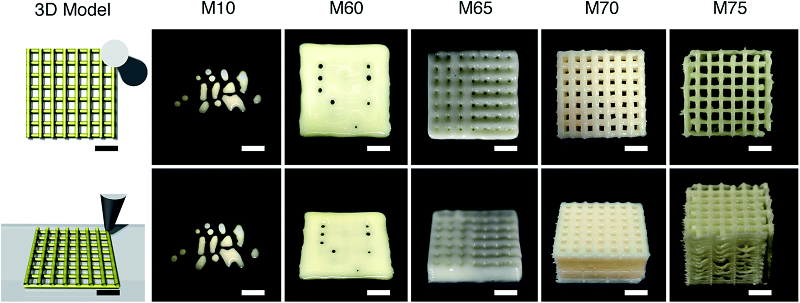
Optical images of the DIW 3D-printed models of milk. The effects of the concentration of milk on the spreading of the printed ink were evident from the printed models. The mesh structures printed with inks of M10, M60, and M65 spread and filled the gaps. The printed mesh structures were maintained after printing with M70 and M75 (Scale bar: 5 mm).
“The formulated milk ink is based on a single milk-based ingredient that controls the rheological properties of its own ink,” they wrote in the paper. “The rheological properties of milk ink were modified by adjusting the concentration of milk powder, which was characterized and evaluated for the printability. With inks containing 70–75 w/w% of milk powders, we successfully printed complex 3D structures.”
Their recipe consisted of powdered milk only, which was mixed with water in order to attain the correct consistency for 3D printing milk models using DIW and cold-extrusion methods. The water is actually what controls the rheology of the ink, which makes the solution simple enough that it could most likely be successfully used in real world scenarios someday soon, like in nursing homes or hospitals, rather than only a laboratory setting.
Lee, the main author of the study, stated, “This novel yet simple method can be used in formulating various nutritious foods including those served to patients in hospitals for their special dietary needs.”
Cost and Availability Considerations
In order to determine the best printability, the researchers tested out their method and material by 3D printing a clover leaf, a cone, a fortress, a wheel, and a tiny, adorable sofa, in addition to some other shapes. See also: Best 3D Printer Upgrades That Actually Improve Pri…. They also printed a two-tone, multimaterial version of the couch by combining their milk ink with a chocolate one made of chocolate syrup and cocoa powder, and tested out how filling the prints with materials like cream, coconut, and maple syrup would change them.

Advanced and Specialty Filaments
The SUTD team 3D printed a variety of shapes from milk. A – D: 3D printed milk structures of couch, fortress, wheel, and cloverleaf. E: 3D printed cone containing liquid chocolate syrup as an internal filling. F: 3D printed cube with four compartments containing liquid blueberry syrup, liquid chocolate syrup, milk cream, and maple syrup as internal fillings.
“This method offered an easy route to formulate other edible inks without additives and fabricate a visually appealing meal without temperature control. Our method has potential applications in formulating foods with various needs for nutrition and materials properties, where food inks could be extruded at room temperature without compromising the nutrients that would be degraded at elevated temperatures,” the researchers concluded.
(Sources: EurekAlert!, CNET / Images: SUTD)
The post 3D Printed Milk Made Possible with Cold Extrusion Tech appeared first on 3DPrint.com | The Voice of 3D Printing / Additive Manufacturing.
Understanding Filament Properties
from 3DPrint.com | The Voice of 3D Printing / Additive Manufacturing https://bit.ly/3hX9aJA
Related Articles: All-Electric Race Car Made Possible with Electron Beam Metal 3D Printing · Modular Heat Exchanger Made via 3D Printed Molds · 3D Printed Implant Device Stimulates Nerves in Bird Brain for Possible Treatment of Human Diseases
Frequently Asked Questions
What is the best 3D printing filament for beginners?
PLA is the best starting filament — it prints easily at 190-220°C without an enclosure and produces good results. Once comfortable, PETG offers better strength and temperature resistance for functional parts.
How do I choose the right filament?
Consider the application: PLA for display models, PETG for functional parts, ABS/ASA for heat/sunlight exposure, TPU for flexible parts, and specialty filaments for engineering applications. Each has specific printer requirements.
What temperature should I print different filaments at?
PLA: 190-220°C nozzle / 50-60°C bed. PETG: 220-250°C / 70-80°C. ABS: 230-260°C / 100-110°C (enclosure needed). Nylon: 240-270°C / 70-90°C. Always check manufacturer recommendations for specific brands.
📌 Related Articles
- The Current State of Metal 3D Printing in 2020
- Best 3D Printer Upgrades That Actually Improve Print Quality: Complete 2026 Guide
- 3D Printing Tungsten Carbide: How Hot-Wire Laser Technology Creates Metal Harder Than Steel
- The Ultimate Guide to 3D Printer Calibration: Complete Step-by-Step Manual
- Best Budget 3D Printer Upgrades That Actually Improve Print Quality: Belts, Springs, Hotends & More