
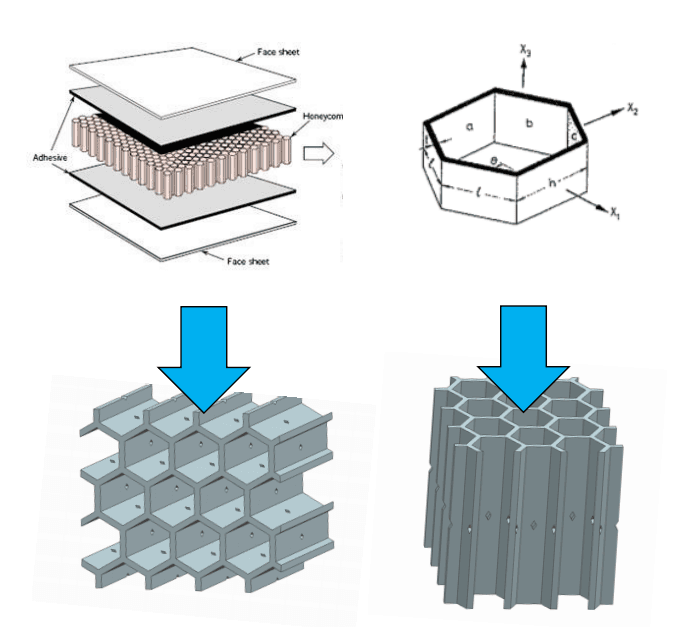
When it comes to 3D print infill, honeycomb structures are generally the most efficient, maximizing storage space and minimizing necessary material. Research also shows that the honeytube, a novel form of the honeycomb structure, can also provide 3D printed objects with excellent energy absorption.
Recently, Rachel Harvey, Norman M. Wereley, PhD, and Min Mao, PhD, researchers in the University of Maryland‘s Composites Research Laboratory (CORE) in the Department of Aerospace Engineering, published a paper, titled “Development of 3D Printed Honeycombs for Crash Mitigation Applications,” that takes a closer look at the structure, and why its mechanical properties make it “ideal for usage in crash mitigation, particularly for helicopters and automobiles.”
Understanding Filament Properties
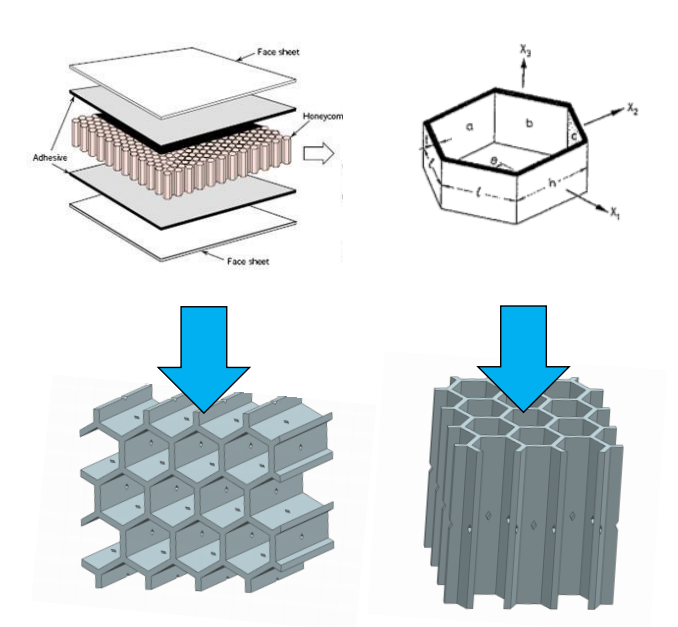
30 mm tall honeycombs shown with diamond-shape vertex buckling initiators (L) crushed in-plane, and diamond-shape face buckling initiators (R) crushed in the out-of-plane direction
“Currently, when crushed by a dynamic load, there is an impulse in force prior to a steady absorption – which could be detrimental in such crash mitigation applications. In this study, 3D printed honeycombs are investigated for subsequent crush efficiency with quasi-static and dynamic crush tests,” the researchers wrote in the abstract. “3D printing, rather than conventional manufacturing, allows for structural modifications within the honeycomb that influence its force-displacement profile. Buckling initiators on the face and/or vertex of honeycombs should reduce the initial peak stress and increase the strain at which densification, the point at which the stress once again increases, begins.”
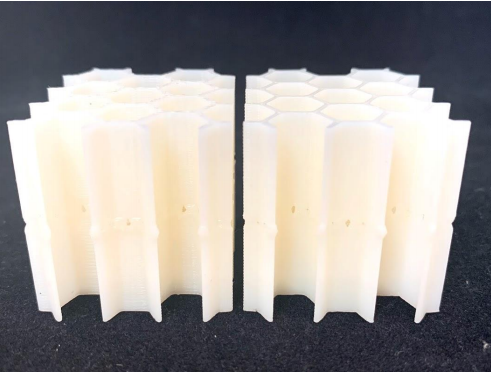
30 mm tall honeycombs with .65 mm diamond-shaped face buckling initiators
Material Comparison and Selection
The goal was to design and fabricate 3D printed honeycombs with both diamond-shaped and circular buckling initiators, which they found will “decrease the initial peak stress of tested honeycombs.” They used a uPrint SE system to 3D print the honeycombs out of ABSplus filament, with 1 mm cell wall thickness, solid infill, and standing 30 mm tall.
Print Settings and Optimization
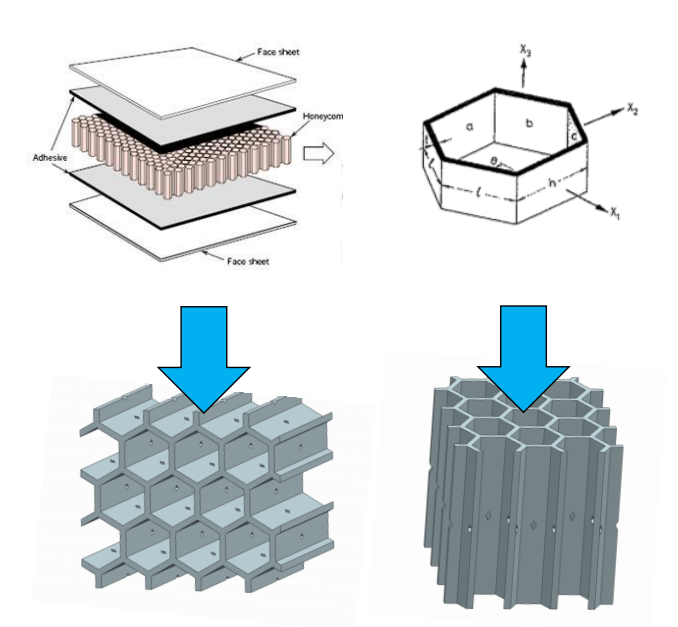
30 mm tall honeycomb with diamond-shape vertex buckling initiators (L) and diamond-shape face buckling initiators (R)
First, in order to find the energy absorption and crush efficiency, they tested the in-plane direction for the honeycomb structures.
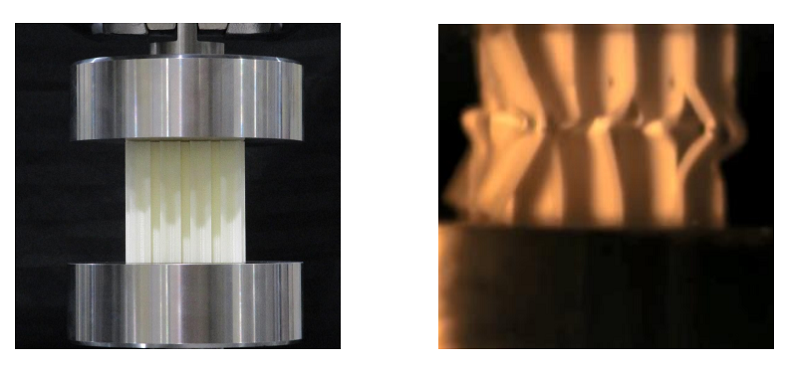
Then, the 3D printed honeycombs were tested on their out-of-plane properties on a 20,000 lb MTS machine, “for comparison with Gibson and Ashby equations and previous data.” They placed the honeycomb between two compression platens on the machine, “with a displacement of .002in/sec, .02in/sec, .2in/sec, and 2in/sec.” They raised the platens 1″ above the samples before the dynamic testing began, which was captured with a high-speed camera so they could properly document the crush testing of the structures.
Strength and Durability Testing
L-R: 20,000 lb MTS machine out-of-plane testing configuration, and diamond-shaped face and vertex buckling initiator crushed at .2in/sec
They found that the two types of buckling initiators definitely influenced the 3D printed honeycomb structures’ stress-strain curves – meaning their energy absorption was ideal. You can see this reflected in the tables below.
“Initial peak stress has shown to decrease with the implementation of buckling initiators, along with later points of densification,” the researchers concluded.
Cost and Availability Considerations
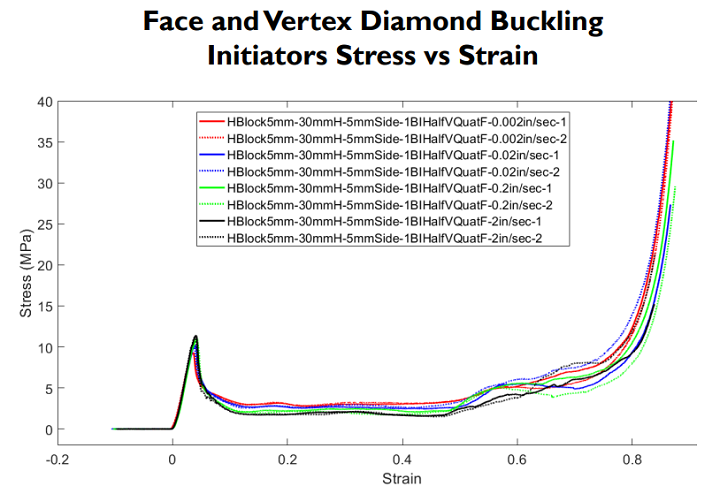
The resultant stress-strain curve from out-of-plane face and vertex diamond buckling initiators displays a minimized initial peak stress at all crush rates, with significant variation in the densification points for crush speeds of .2 in/sec and 2 in/sec.
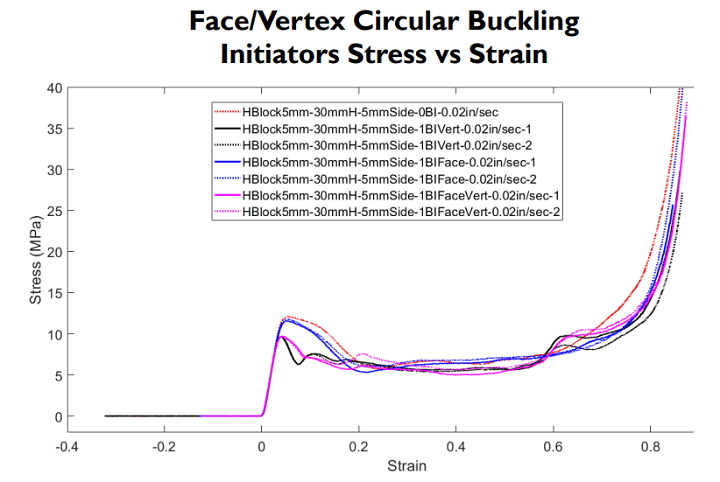
The resultant stress-strain curve from out-of-plane testing on 30 mm tall honeycombs with 5 mm face and/or vertex circular buckling initiators displays that circular face and vertex buckling initiators performed the best at decreasing the initial peak stress. See also: The Current State of Metal 3D Printing in 2020. The tested buckling initiators had comparable densification points.
Advanced and Specialty Filaments
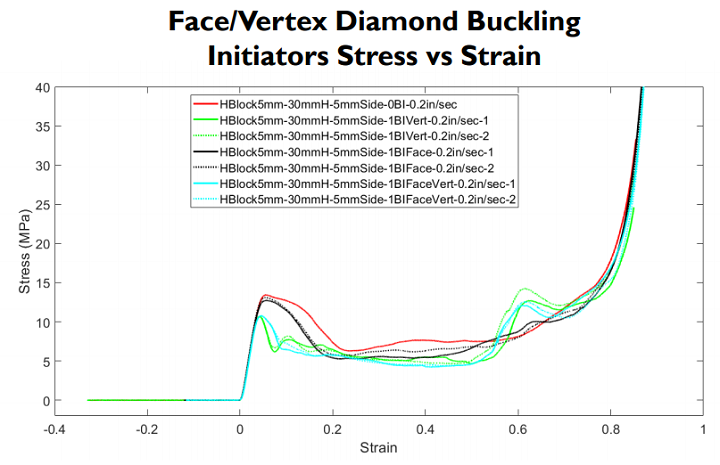
The resultant stress-strain curve from out-of-plane testing on 30 mm tall honeycombs with 5 mm diamond buckling initiators on the face and/or vertex indicates that at a crush of .2in/sec, face and vertex buckling initiators greatly decreased the initial peak stress compared to honeycombs with only face or vertex buckling initiators.
The researchers will continue their work on energy absorption of 3D printed honeycomb structures.
“Future directions for the project include testing honeycombs of other materials with buckling initiators, and the implementation of variations of current buckling initiator designs,” they concluded.
Understanding Filament Properties
They plan on testing honeycombs made with different materials, like foam and aluminum, with buckling initiators; testing different cell-designs, such as a flower petal; and conducting drop tests on 3D printed honeycombs using a high-speed camera. In addition, they will also keep testing the honeycombs they previously designed in order to compare the efficiency of these designs with the new ones.
Discuss this story and other 3D printing topics at 3DPrintBoard.com or share your thoughts in the Facebook comments below.
The post University of Maryland: 3D Printing Honeycomb Structures with Buckling Initiators for Crash Mitigation appeared first on 3DPrint.com | The Voice of 3D Printing / Additive Manufacturing.
Frequently Asked Questions
What is the best 3D printing filament for beginners?
PLA is the best starting filament — it prints easily at 190-220°C without an enclosure and produces good results. Once comfortable, PETG offers better strength and temperature resistance for functional parts.
How do I choose the right filament?
Consider the application: PLA for display models, PETG for functional parts, ABS/ASA for heat/sunlight exposure, TPU for flexible parts, and specialty filaments for engineering applications. Each has specific printer requirements.
What temperature should I print different filaments at?
PLA: 190-220°C nozzle / 50-60°C bed. PETG: 220-250°C / 70-80°C. ABS: 230-260°C / 100-110°C (enclosure needed). Nylon: 240-270°C / 70-90°C. Always check manufacturer recommendations for specific brands.
📌 Related Articles
- The Complete 3D Printing Filament Guide: Types, Properties & When to Use Each
- The Current State of Metal 3D Printing in 2020
- 3D Printing News: Multi-Material Breakthrough and Aerospace Market Boom
- Best 3D Printers Under $500: 2026 Comparison Guide
- Best 3D Printer Upgrades That Actually Improve Print Quality: Complete 2026 Guide