
Researchers from India seek to further improve 3D printing with concrete. In the recently published ‘Additive manufacturing of self-compacting concrete through controlled heating,’ Shashank Shekhar, Manish Kumar, and Rishabh Mathur (all from the Indian Institute of Technology), investigate whether self-compacting concrete may offer better bonding and strength due to heating.
While this study is unique in its focus, many researchers and industrial users have tackled the topic of 3D printing with concrete, from fabrication of concrete panels to the use of geopolymers, to creating on the large scale. The authors point out that many different mixes have been used previously, to include ultra- and high-strength, fiber-reinforced, and more.
Understanding Filament Properties
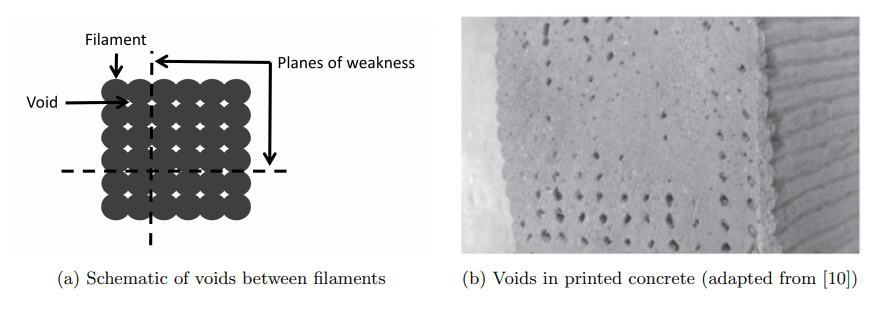
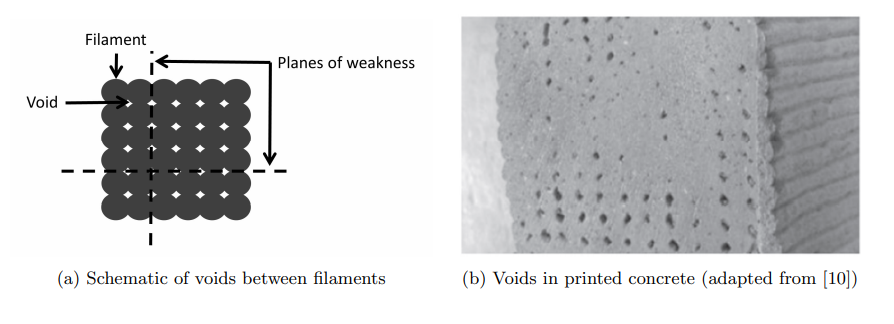
Voids between filaments of printed concrete
While improved bonding can be possible with SCC, the initial yield strength is weak, resulting in the need for better strength gain. This can be accelerated with chemical admixtures, but they have the potential to cause ‘choking in the printing set-up.’ The researchers set up a concrete printer in house at the Indian Institute of Technology (IIT) in Gandhinagar.
“Three self-compacting concrete mixes are considered, which have identical workability but different water-to-cement ratios,” stated the researchers.
Material Comparison and Selection
Fresh state properties were studied, including:
- Shape stability
- Buildability
- Layer moisture
- Surface moisture
- Infrared surface reflectance
- Early-age shrinkage
Print Settings and Optimization
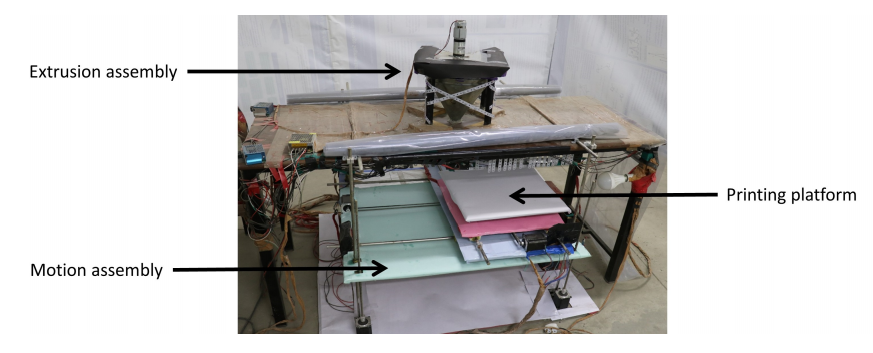
Concrete printing set-up at IIT Gandhinagar (adapted from [46])
The heating system is made up of two 1,000-watt quartz radiation heaters, along with six 116 12 V DC fans, and is mounted between the extrusion area and printing platform.
Strength and Durability Testing
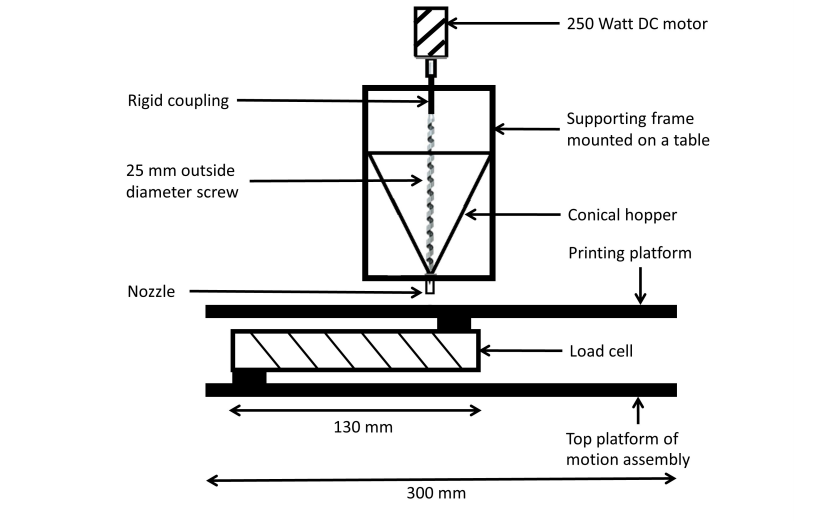
Schematic of the static extruder and the printing platform (drawing not to scale)
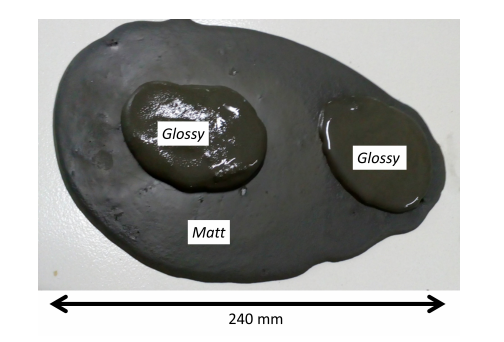
Freshly-printed concrete surface before and after heating
Overall, the researchers discovered that a stable layer thickness could be achieved, as buildability was characterized via direct compression and a Vicat penetration test.
“The buildability was greater for a smaller water-to-cement ratio and/or a longer duration of heating. A longer duration of heating would be associated with a greater loss of moisture from the printed layer, and it may adversely affect the bonding between adjacent layers. A sufficient level of buildability was considered achieved when the texture of the printed surface had turned into matt,” stated the researchers. “The same could be characterized through the measurement of surface reflectance of the printed surface. Early-age shrinkage in a printed layer was greater if the layer was subjected to heating for 60 seconds compared to when it was not.”
Cost and Availability Considerations
“The strength for the corresponding printed specimen was 61.5 MPa when the direction of loading was parallel to the layers and each layer was heated for 60 seconds. The strength was 49.1 MPa corresponding to 180 seconds of heating. For loading perpendicular to printed layers, the average compressive strength for the two durations of heating was 65.7 MPa and 56.4 MPa, respectively. The average shear strength of the printed cubes was 3.8 MPa (4 MPa) and 3 MPa (3.9 MPa) for the two durations of heating, respectively, and when the direction of loading was parallel (perpendicular) to the layers. The average shear strength of the mold-cast cubes was 4.2 MPa.”
What do you think of this news? Let us know your thoughts! Join the discussion of this and other 3D printing topics at 3DPrintBoard.com.
[Source / Images: ‘Additive manufacturing of self-compacting concrete through controlled heating’]
The post Additive Manufacturing: Self-Compacting Concrete Through Controlled Heating appeared first on 3DPrint.com | The Voice of 3D Printing / Additive Manufacturing.
Frequently Asked Questions
What is the best 3D printing filament for beginners?
PLA is the best starting filament — it prints easily at 190-220°C without an enclosure and produces good results. Once comfortable, PETG offers better strength and temperature resistance for functional parts.
How do I choose the right filament?
Consider the application: PLA for display models, PETG for functional parts, ABS/ASA for heat/sunlight exposure, TPU for flexible parts, and specialty filaments for engineering applications. Each has specific printer requirements.
What temperature should I print different filaments at?
PLA: 190-220°C nozzle / 50-60°C bed. PETG: 220-250°C / 70-80°C. ABS: 230-260°C / 100-110°C (enclosure needed). Nylon: 240-270°C / 70-90°C. Always check manufacturer recommendations for specific brands.
📌 Related Articles
- The Complete 3D Printing Filament Guide: Types, Properties & When to Use Each
- The Current State of Metal 3D Printing in 2020
- Best 3D Printer Upgrades That Actually Improve Print Quality: Complete 2026 Guide
- Best Budget 3D Printer Upgrades That Actually Improve Print Quality: Belts, Springs, Hotends & More
- Best 3D Printer Air Filtration and Enclosure Ventilation for 2026: Breathe Safe While Printing