
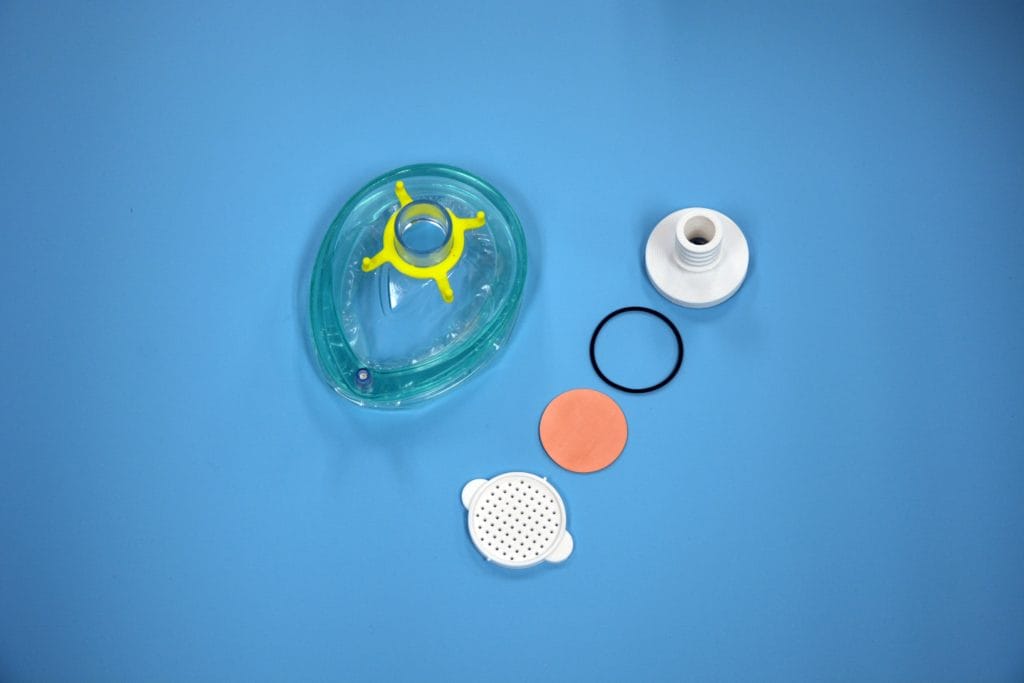
There is a flurry of industrial additive manufacturing (AM) activity in response to the medical supply shortages caused by the COVID-19 outbreak, with some work being directed toward what may be dead-end avenues and other generating some novel and interesting results. Among the more unique applications of AM to the production of medical supplies is an effort by ExOne to produce reusable metal filters for filtration masks and other equipment.
Most of the large 3D printing companies, including ExOne, have noted that their global supply chain clued them into the wide-ranging impact of the coronavirus outbreak early on, pushing them to consider the effects the disease would have both on manufacturing operations and medical supplies. ExOne CEO John Hartner told 3DPrint.com that this got the company thinking about its potential role in the supply chain.
The State of Metal 3D Printing
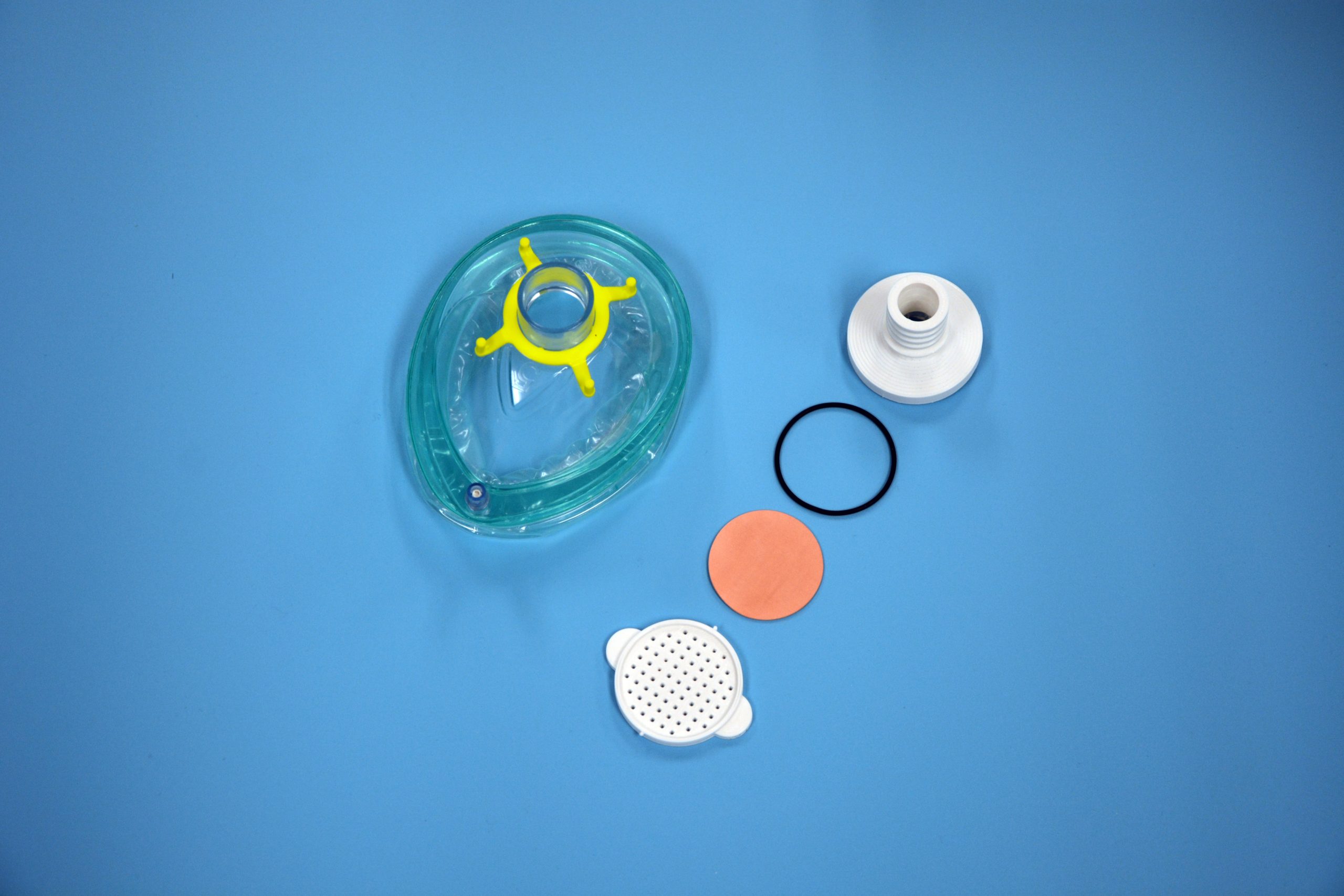
A 3D-printed copper filter with a mask. Image courtesy of ExOne.
It was when the company recognized the medical waste accumulating as a result of disposable personal protective equipment (PPE) that the company understood one area that it could provide its expertise. Multiple news stories have reported how discarded PPE could cause ecological damage. Hospitals in Wuhan have purportedly generated six times as much medical waste at the peak of the pandemic than normally used, with daily waste output reaching 240 metric tons.
Because ExOne already has customers who use the company’s metal binder jetting technology to create industrial filters, the company realized that it might be able to both ensure the availability of filtering face masks, like N95 respirators (for differences in medical mask types, read our article here), and limit medical waste. The company has partnered with the University of Pittsburgh to develop and test 3D-printed, reusable filters made from a variety of metal materials. These filters are autoclavable, meaning that they can be completely sterilized before reuse.
Technical Challenges and Solutions
ExOne began with one particular mask and after performing sufficient testing internally, the company began conducting filtration testing with an agency that performs official testing for National Institute for Occupational Safety and Health standards. Initial results have been promising, pushing the partners to work with two local hospitals to set up clinical trials and begin the emergency approval process with the U.S. Food and Drug Administration. Beyond the first mask model that the company is working with, ExOne is exploring other models from other manufacturers, as well as ventilator filters.

The use of metal binder jetting technology provides the benefit of being able to control the density of a part by way of powder particle size and level of sintering, which is what has drawn some of its customers to producing industrial filters, such as strainer plates. With Ansys, the company is able to run particle filtration simulation for the mask filters, which can then be controlled through the printing and sintering process. Hartner explained:
“It is amazing the detail [ANSYS has] in the calculation capability to look at different applications, different form factors, what flow rate is necessary, what filtration is necessary. Then, we just print and perform the appropriate level of sintering to get that porosity and that filter output.”
Material Properties and Performance
Due to fewer constraints related to particle size and energy source requirements (no lasers or electron beams), the process can also use a wider range of materials. In turn, ExOne is testing a variety of metals, including stainless steel and copper, both of which are widely used in the medical industry. Copper, in particular, has demonstrated value in the COVID crisis for its ability to kill roughly 96 to 99 percent of the SARS-CoV-2 virus on contact.
“We’re doing both stainless steel and copper at this point and we actually have other materials we’re testing, as well,” Hartner told 3DPrint.com. “Honestly, this project is evolving relevant to how this virus responds to different material sets. Copper is one that’s been identified as one of the better materials, which is why we moved from stainless steel to copper as another way to test the possibilities.”
Industrial Applications and Use Cases
Of course, it is too early to tell how many times a metal filter could be reused. See also: 3D Printing Tungsten Carbide: How Hot-Wire Laser T…. One would assume that, at some point, they would need to be discarded. From its industrial customers, ExOne knows that filters for industrial applications can survive over a year in abrasive environments, suggesting that metal filters could substantially longer than traditional cloth filters. With ExOne estimating that filters would cost less than $20 per unit, they would quickly pay for themselves over the course of reuse while reducing hazardous medical waste.
Comparing Metal AM to Traditional Manufacturing
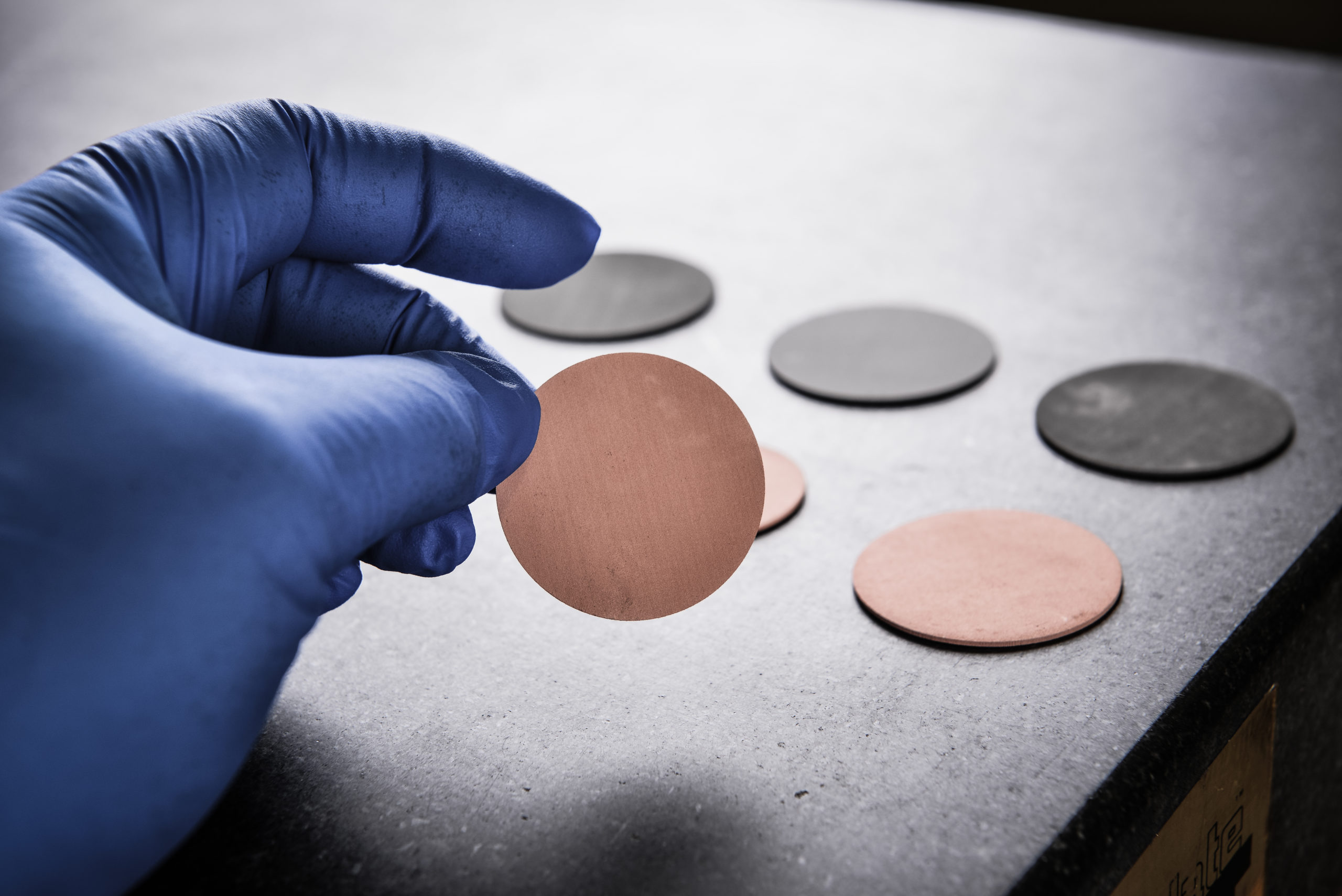
3D-printed copper and stainless steel filters made by ExOne and the University of Pittsburgh.
Not only does the example presented here by ExOne demonstrate a more innovative response to medical supply shortages, but also new futures for medical supplies in general. While the current crisis will hopefully be drawn to something of a close at some point in the future, the problem of medical waste and waste in general will continue, necessitating more long-lasting items.
The post 3D Printing and COVID-19: Reusable Metal Filters Being Tested by ExOne appeared first on 3DPrint.com | The Voice of 3D Printing / Additive Manufacturing.
Frequently Asked Questions
What is metal 3D printing?
Metal 3D printing (additive manufacturing) builds metal parts layer by layer using techniques like laser powder bed fusion, directed energy deposition, and binder jetting. It enables complex geometries impossible with traditional manufacturing while reducing material waste significantly.
How strong are 3D printed metal parts?
3D printed metal parts can achieve mechanical properties comparable to traditionally manufactured metals. Tensile strength and fatigue resistance depend on the process and post-processing, but many meet or exceed ASTM standards for wrought materials.
What are the main metal 3D printing technologies?
The primary technologies include Laser Powder Bed Fusion (LPBF), Electron Beam Melting (EBM), Directed Energy Deposition (DED), Binder Jetting, and Metal FDM (with bound filaments). Each has different strengths in terms of resolution, speed, and material options.
📌 Related Articles
- The Current State of Metal 3D Printing in 2020
- 3D Printing Tungsten Carbide: How Hot-Wire Laser Technology Creates Metal Harder Than Steel
- 3D Printing Safety Equipment Guide: Respirators, Gloves, and Ventilation for 2026
- Best 3D Printer Upgrades That Actually Improve Print Quality: Complete 2026 Guide
- Best Budget 3D Printer Upgrades That Actually Improve Print Quality: Belts, Springs, Hotends & More