
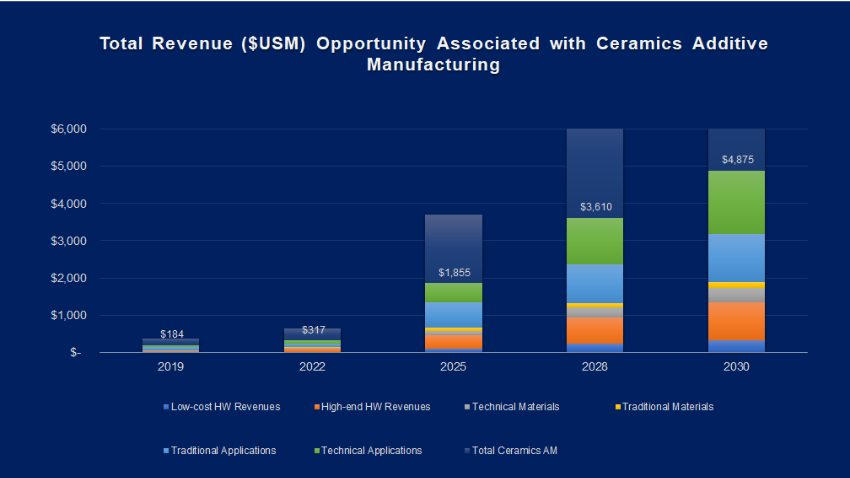
SmarTech Analysis has put out its most recent report on the ceramics additive manufacturing (AM) market, Ceramics Additive Manufacturing Part Production: 2019-2030. The report suggests that, even with the current dynamics occurring related to the COVID-19 outbreak, the ceramics AM market will reach an estimated $4.8 billion in revenue by 2030. Moreover, the report suggests that final parts, both technical and traditional, will drive these opportunities in the medium- and long-term.
Ceramics 3D printing still fits into the emerging technology field, though there are certainly a number of companies that have developed full-fledged ceramics printing technology. What SmarTech projects is that this dynamic will change mid-decade, with the ceramics 3D printing market will hitting an inflection point after 2025 as all major ceramics AM technologies become fully developed and are established enough to perform serial production. After this inflection point, the company projects the ceramics AM applications market to triple in size, once the market has fully recuperated from the COVID-19 slowdown.
This definitely fits with the trends suggested by the development of serial 3D printing technology. Multi Jet Fusion from HP, traditional binder jetting from ExOne, high speed sintering from Xaar and MOVINGLight from Prodways/3DCeram all suggest that mass production of ceramic 3D-printed parts is around the corner.
How 3D Printing Responded to COVID-19
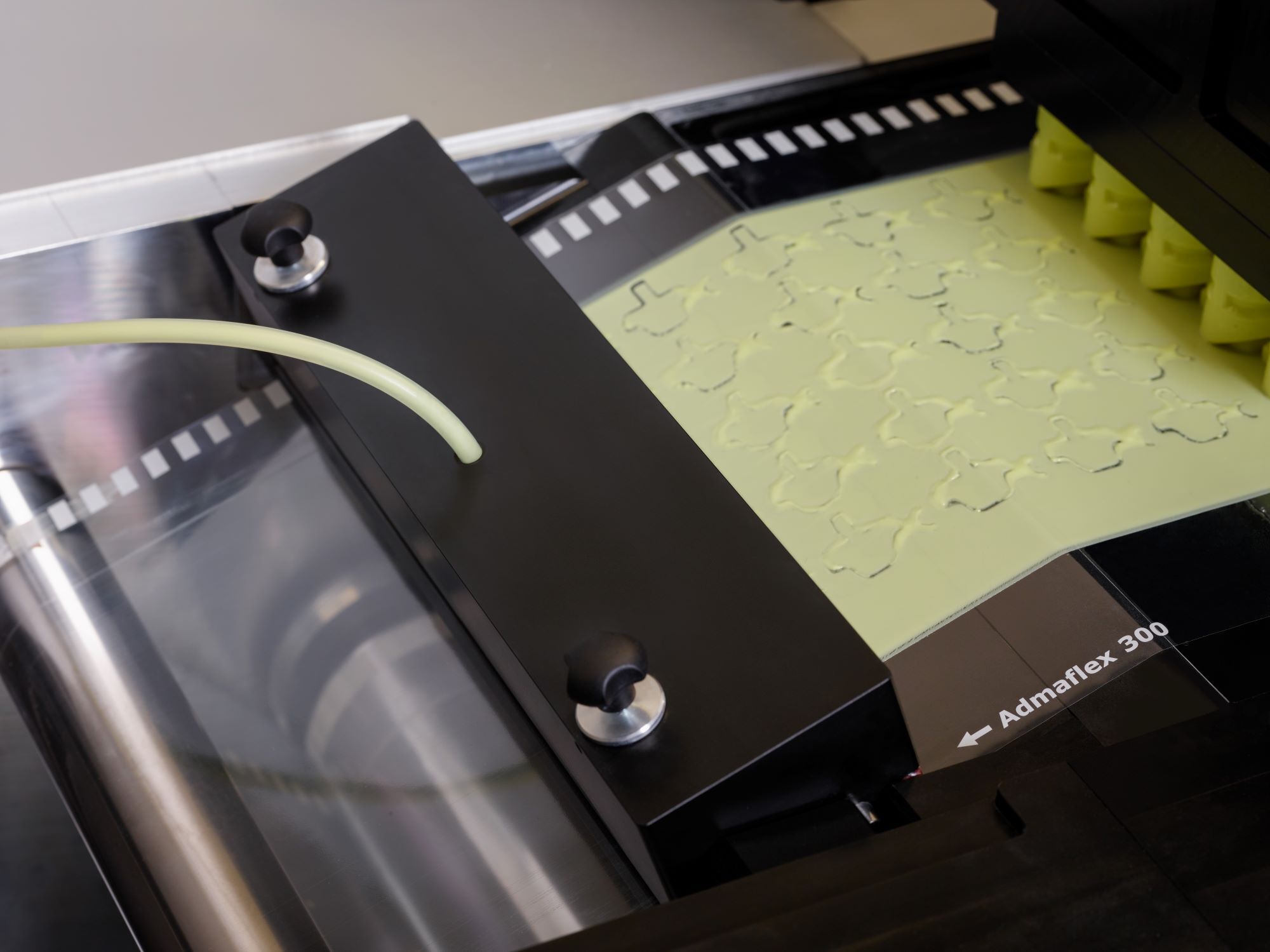
The Admaflex 300 ceramics 3D printer. Image courtesy of Admatec.
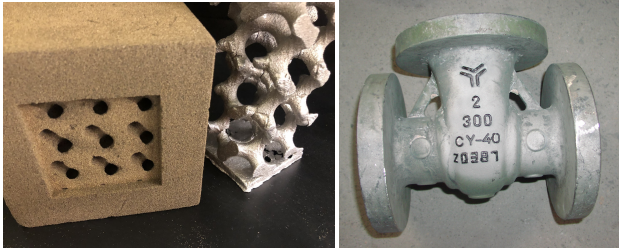
The report segments technical and traditional ceramic materials, such as alumina 3D printing from a company like Lithoz or Admatec versus sand printing from a company like ExOne. See also: The Current State of Metal 3D Printing in 2020. This also informs the specific applications covered in the report, ranging from medical or electrical components using technical materials to sand cores and molds. Naturally, the AM service bureaus offering ceramics printing are explored, as well as the types of parts. Other companies discussed include: 3DCeram-Sinto, voxeljet, SGL Carbon, Schunck Carbon Technologies, XJet, Nanoe and more.
HP and the Pandemic Manufacturing Shift
Image courtesy of SmarTech Analysis.
Compared to previous issues of SmarTech’s ceramics report, this edition will for the first time include the new bound ceramic 3D printing segment and materials, in which green ceramic parts are made via thermal extrusion of ceramic powders bound in a thermoplastic filament matrix.
Interestingly, the report takes into consideration the impact from COVID-19 on the ceramics AM market, with modeling associated with the resulting economic slowdown and how that will extend through 2025. Apparently, the company has established two levels of impact, with some segments more significantly impacted in the short term and others less so, realigning to previously forecasted levels by 2024.
Supply Chain Disruptions and Digital Solutions
This, according to the market research firm, will also be reflected in regional effects, with the APAC region benefitting from more efficient methods of managing business and manufacturing amid the pandemic. SmarTech suggests that APAC countries, China and Japan in particular, are already adopting ceramic AM at a faster rate than European and American countries.
The full table of contents and the report itself can be found at the SmarTech website here.
The post Ceramics 3D Printing to Hit $4.8B by 2030, Says SmarTech appeared first on 3DPrint.com | The Voice of 3D Printing / Additive Manufacturing.
Frequently Asked Questions
How did 3D printing help during COVID-19?
During the COVID-19 pandemic, 3D printing enabled rapid production of critical medical supplies including face shields, ventilator components, nasal swabs, and PPE. Distributed manufacturing allowed makers worldwide to produce items locally without waiting for traditional supply chains.
What was the pandemic digital manufacturing shift?
The pandemic accelerated adoption of digital manufacturing including 3D printing, as companies sought more resilient supply chains. Organizations shifted from centralized to distributed production, using digital files to produce parts locally on demand.
Can 3D printing supply chains be resilient in emergencies?
Yes, 3D printing provides supply chain resilience through distributed manufacturing — designs can be shared digitally and produced anywhere with compatible equipment, eliminating the need for physical inventory and shipping of parts.
📌 Related Articles
- The Current State of Metal 3D Printing in 2020
- Best Budget 3D Printer Upgrades That Actually Improve Print Quality: Belts, Springs, Hotends & More
- 3D Printing News: Multi-Material Breakthrough and Aerospace Market Boom
- Best 3D Printer Upgrades That Actually Improve Print Quality: Complete 2026 Guide
- 3D Printing Tungsten Carbide: How Hot-Wire Laser Technology Creates Metal Harder Than Steel