

Texas startup Essentium Inc., a materials and 3D printer OEM, is always looking to disrupt traditional manufacturing processes with industrial AM solutions by combining production speed and product strength. With its production-ready High Speed Extrusion (HSE) 3D printing platform, FlashFuse processing technology, and engineering-grade 3D printing materials, it’s a mission at which the company excels.
 Now, Essentium is partnering up with the LEHVOSS Group, which operates under parent company Lehmann&Voss&Co., to develop engineering-grade, high-performance materials for applications in industrial-scale additive manufacturing.
“While there are many compounding companies that optimize materials for 3D printing, few can rival LEHVOSS’ manufacturing knowledge and their approach for designing compounds specifically for extrusion-based 3D printing processes,” said Brandon Sweeney, PhD, Essentium co-founder and its Head of R&D for Materials. “With LEHVOSS we have a true partner who shares our passion in applying material science innovation to accelerate industrial-scale additive manufacturing. We have already seen strong demand for our PEEK and HTN materials and look forward to developing new materials that give manufacturers the trust and confidence to shift from prototyping to full-scale production using 3D printing.”
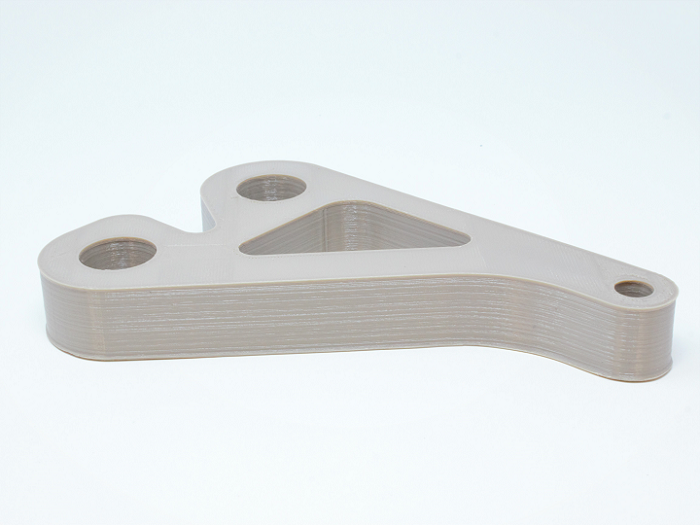
3D printed PEEK pin bracket (Image: Essentium)
LEHVOSS is made up of several chemical companies that develop, make, and market special chemical and mineral materials for a variety of industrial clients. Together, these two companies are creating and delivering AM materials that are tuned, and certified, specifically for extrusion-based 3D printing and multiple industrial applications.
No matter the application, manufacturers want to use trusted polymers that have certified standards. However, quality 3D printing materials are not cheap, which is one of a number of issues keeping AM adoption down. Additionally, materials that have been optimized for 3D printing, but not specifically created for the technology, only offer low performance, which is another major obstacle.
 But, by combining Essentium’s polymer and composite expertise with the experience in thermoplastic high-performance compounds that LEHVOSS offers, the two are creating engineering-grade materials for extrusion-based 3D printing, that have been certified for industry applications in oil and gas, electronic manufacturing, biomedical, automotive, and aerospace fields.
“Partnering with Essentium is a win-win for our industrial customers. Essentium is at the forefront of material science and together we will create a wider range of 3D printing materials certified to meet the performance standards they expect in their end-use parts. Not only will this speed time-to-market and lower the cost to produce the highest quality parts, it will also spur innovation for new additive manufacturing applications,” stated Thomas Collet, Director 3D Printing Materials & Marketing, LEHVOSS Group.
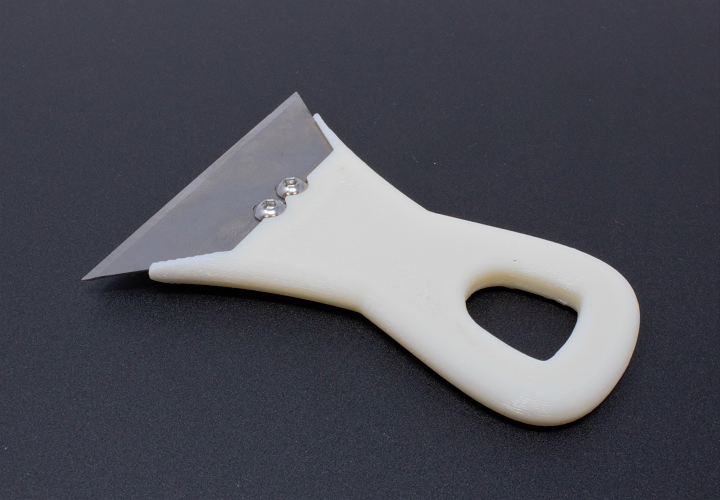
3D printed HTN scraper (Image: Essentium)
Essentium has been working on a line of PEEK and High-Temperature Nylon (HTN) materials, made with compounds from the LEHVOSS Group’s LUVOCOM 3F product family. Now, after two years of research and development, the new line, which was certified on the company’s HSE platform, has launched. The materials feature heat and chemical resistance, high mechanical strength, easy printability, and non-warping properties, which make them a good choice for fabricating end-parts that can hold up under the high stresses of the factory floor; applications include components in the medical technology and mechanical engineering fields.
Discuss this and other 3D printing topics at 3DPrintBoard.com or share your thoughts below.
The post Essentium and LEHVOSS Group Developing High-Performance Materials for Industrial-Scale 3D Printing appeared first on 3DPrint.com | The Voice of 3D Printing / Additive Manufacturing.
Where to Buy Filament
Disclosure: Some of the links below are affiliate links. If you make a purchase, we may earn a commission at no extra cost to you. This helps support this site.
These links go to Amazon with our affiliate tag. If you prefer to support local retailers or buy directly from manufacturers, we encourage that as well!
Related Articles
Frequently Asked Questions
What is the best 3D printing filament for beginners?
PLA is the best starting filament — it prints easily at 190-220°C without an enclosure and produces good results. Once comfortable, PETG offers better strength and temperature resistance for functional parts.
How do I choose the right filament?
Consider the application: PLA for display models, PETG for functional parts, ABS/ASA for heat/sunlight exposure, TPU for flexible parts, and specialty filaments for engineering applications. Each has specific printer requirements.
What temperature should I print different filaments at?
PLA: 190-220°C nozzle / 50-60°C bed. PETG: 220-250°C / 70-80°C. ABS: 230-260°C / 100-110°C (enclosure needed). Nylon: 240-270°C / 70-90°C. Always check manufacturer recommendations for specific brands.
📌 Related Articles
- 3D Printing News: Multi-Material Breakthrough and Aerospace Market Boom
- The Current State of Metal 3D Printing in 2020
- ABS 3D Printing Settings Guide: Temperature, Enclosure, and Cooling for Strong Parts
- The Complete 3D Printing Filament Guide: Types, Properties & When to Use Each
- Best 3D Printer Upgrades That Actually Improve Print Quality: Complete 2026 Guide