
Researchers from Australia and Germany are coming together to delve further into one of the most popular topics surrounding 3D printing today: material science. And polymers are often at the top of the list as one of the most used materials in digital fabrication. Here, the researchers outline their findings in the recently published ‘Fracture Resistance Analysis of 3D-Printed Polymers.’
While the benefits of 3D printing are extensive today, and widely expounded upon, so are the continually emerging challenges as researchers, manufacturers, and a world full of users on every level press the limits, according to their project needs or innovative ambitions. Pointing out that FDM 3D printing, SLA, and multi-jet fusion (MJF) are extremely popular, the authors reiterate that these mainstream methods of 3D printing ‘bring quite a number of uncertainties’ with them, and especially in mechanical engineering concepts.
Issues and defects are usually related to material properties, strength, stability in microstructures, and more—requiring experimental tests as well as finite element analysis. Fracture toughness is a concern in applications where mechanical reliability is a must.
“Catastrophic failures often occur due to unstable crack propagations and therefore, study of fracture of components is a vital component of engineering design,” stated the researchers. “In this respect, to address the fracture behavior of 3D-printed plastic components we used FDM and MJF techniques to manufacture notched samples and supported the experimental observations with a failure model.”
Understanding Filament Properties
Pre-existing cracks may be caused by manufacturing defects in filament, or they may have grown slowly, emanating from surface imperfections or notches, where fracture toughness experiments have proven to be an effective method of evaluation.
For this study, the researchers focus on analyzing the U-notch fracture in 3D printed thermoplastic components. With the goal of offering a new model for failure prediction, they tested rectangular nylon samples fabricated via FDM and MJF modes, using both nylon 12 filament and PA12 nylon powder. A series of tensile tests were performed on the samples and compared with the EMC model.
For FDM 3D printing, 12 nylon samples were created on a Fortus 450mc. An HP 3D printer was used for fabrication of the MFJ PA12 samples.
Material Comparison and Selection
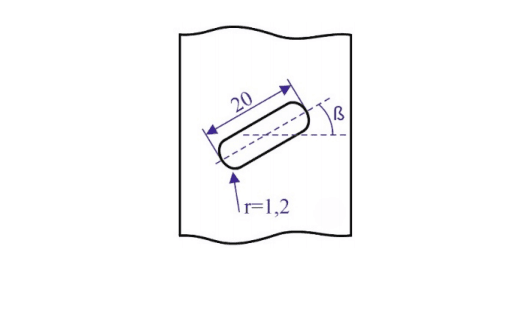
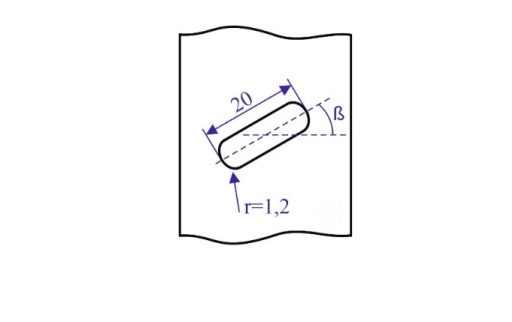
A schematic of centrally located bean-shaped notch with two U-shaped ends (dimensions in mm)
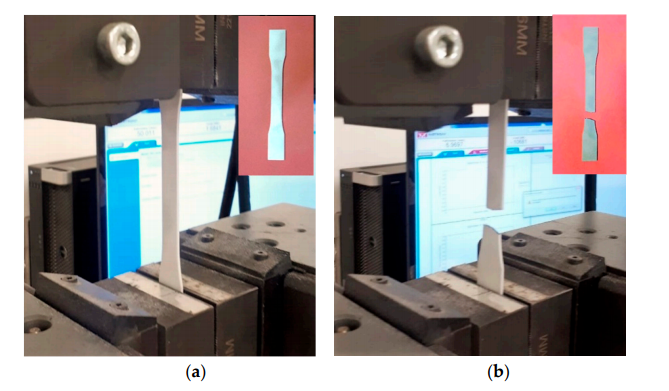
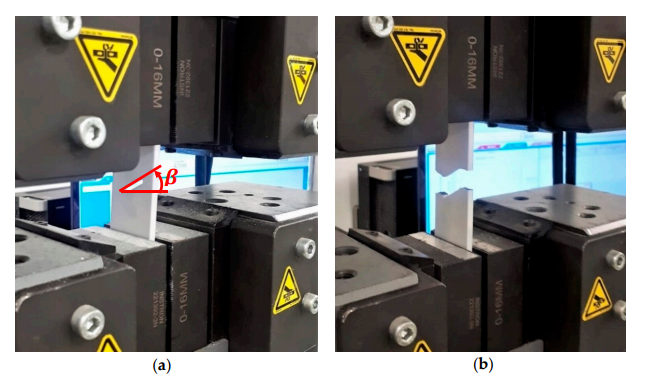
A dog-bone shaped MJF nylon 3D-printed nylon specimen; before (a), and after (b) tensile
For tensile tests, dog-bone specimens were created, with strength and modulus determined regarding stress versus grain.
Print Settings and Optimization
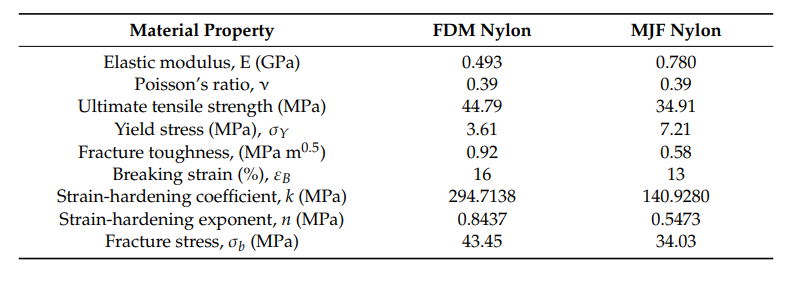
Mechanical properties of the 3D printed nylon specimens
Three modes were available during fracture tests:
- Mode 1 – crack opening – axial normal stress was applied perpendicular to the notch plane.
- Mode 2 – shear mode – shear stress is applied normal to the crack front and parallel to the crack plane.
- Mode 3 – tearing mode – shear stress is applied parallel to the crack front.
Strength and Durability Testing
An MJF nylon 3D-printed specimen under tensile test conditions; (a) before (b) after fracture
Uniform heat was used to create an isotropic solid layer upon fusing the powder.
“The continuous nature of the filament aligned in the direction of the applied stress have resulted in better structural integrity in the FDM samples than that achieved by MJF, thus resulting in significantly higher elongation at break and toughness. However, the mechanical properties of an FDM 3D-printed part is far more complex than it may appear at first glance. It is well established that the FDM specimens are anisotropic with the greater tensile strength in the axial direction than in the transverse direction normal to the bonds,” concluded the researchers.
Cost and Availability Considerations
No matter the notch orientations, every sample created via MJF was brittle, accompanied by flat fracture surfaces. The failure load of the MJF nylon samples was also found to be higher than that of the FDM samples—except for when the inclination angle was set to 60◦.
“Finally, the equivalent material concept (EMC) was combined with the J-integral failure principle to predict the fracture failure of U-notched 3D-printed specimens subjected to tensile loading under mode I and mixed mode I/II loading regimes,” concluded the researchers. “The agreement between the experimental and simulation results proved the EMC-J approach to be capable of successfully predicting fracture in the 3D-printed notched ductile material components.”
Advanced and Specialty Filaments
Researchers around the world continue to performance analysis of 3D printing, from stress analysis to tensile testing of 4D prints, chemical modifications in bioprinting, and more. What do you think of this news? Let us know your thoughts; join the discussion of this and other 3D printing topics at 3DPrintBoard.com.
[Source / Images: ‘Fracture Resistance Analysis of 3D-Printed Polymers’]
The post 3D Printing Polymers: Fracture Resistance Analysis in FDM and MJF 3D Printing appeared first on 3DPrint.com | The Voice of 3D Printing / Additive Manufacturing.
from Your daily news from 3DPrint.com http://bit.ly/2uw79Bz
Related Articles
Frequently Asked Questions
What is the best 3D printing filament for beginners?
PLA is the best starting filament — it prints easily at 190-220°C without an enclosure and produces good results. Once comfortable, PETG offers better strength and temperature resistance for functional parts.
How do I choose the right filament?
Consider the application: PLA for display models, PETG for functional parts, ABS/ASA for heat/sunlight exposure, TPU for flexible parts, and specialty filaments for engineering applications. Each has specific printer requirements.
What temperature should I print different filaments at?
PLA: 190-220°C nozzle / 50-60°C bed. PETG: 220-250°C / 70-80°C. ABS: 230-260°C / 100-110°C (enclosure needed). Nylon: 240-270°C / 70-90°C. Always check manufacturer recommendations for specific brands.
📌 Related Articles
- The Complete 3D Printing Filament Guide: Types, Properties & When to Use Each
- The Current State of Metal 3D Printing in 2020
- Best 3D Printer Air Filtration and Enclosure Ventilation for 2026: Breathe Safe While Printing
- Best Budget 3D Printer Upgrades That Actually Improve Print Quality: Belts, Springs, Hotends & More
- Best 3D Printer Upgrades That Actually Improve Print Quality: Complete 2026 Guide